



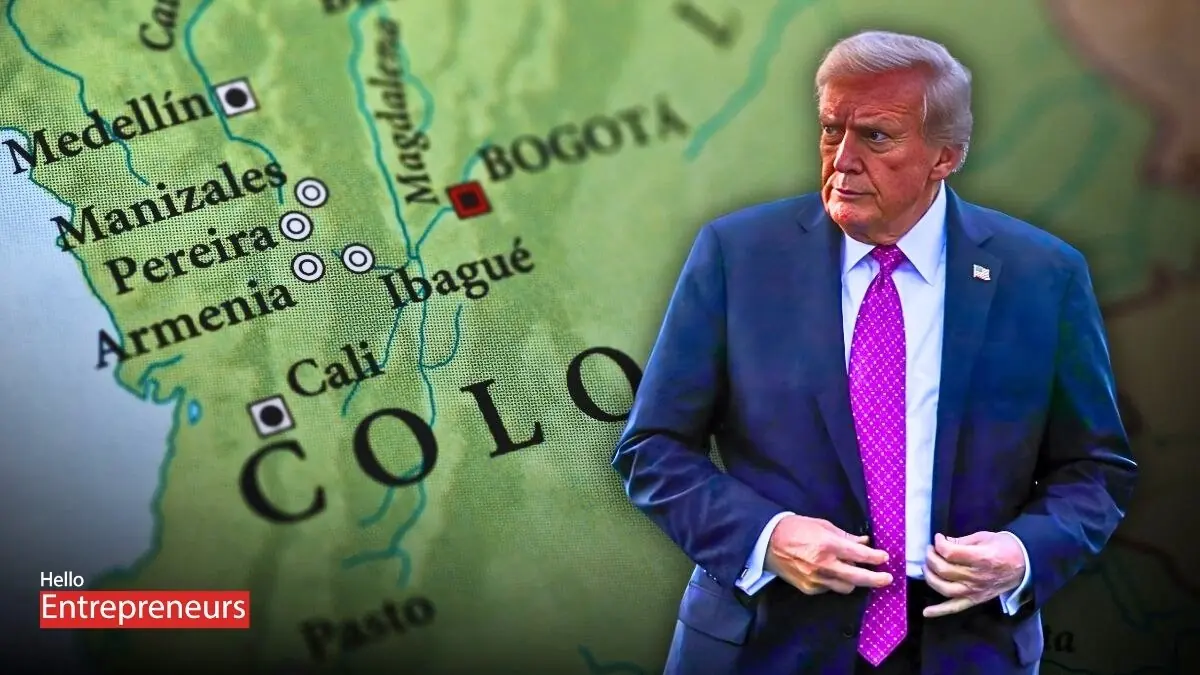
Washington, D.C.: The “US-Colombia Drug War” just went nuclear, figuratively, not literally (for now). With missiles in the Pacific and insults in the air, Donald Trump’s new campaign against alleged narco networks has blown open a diplomatic firefight with Colombia, testing one of America’s oldest regional alliances.
When a ‘Drug War’ Looks a Lot Like a Shooting War
President Trump’s latest move wasn’t subtle. Two boats in the Pacific Ocean, allegedly carrying narcotics, were hit by US strikes this week, leaving five people dead. The Pentagon claims the operations were “precision counter-narcotics missions.” Critics call them what they look like: targeted killings on open water.
Defense Secretary Pete Hegseth, clearly proud of the pyrotechnics, posted videos on social media showing the vessels engulfed in flames. His caption read like a Marvel tagline: “There will be no refuge or forgiveness, only justice.”
In Washington, “justice” now means remote-controlled explosions and public chest-thumping. According to Hegseth, the strikes were conducted in international waters. That makes at least nine such US attacks since the campaign began, 37 people dead by America’s own count.
So far, zero evidence has been released showing that these boats were smuggling drugs. But details seem optional in this new doctrine.
Petro Punches Back, Trump Doubles Down
Colombian President Gustavo Petro wasn’t impressed. He called the strikes “extrajudicial executions” that “violate international law.” Trump responded by branding Petro a “thug” and implying, without evidence, that Colombia’s leader was himself mixed up in the drug trade.
That’s when diplomacy officially left the room. Petro shot back, vowing to “defend myself legally with American lawyers.” In diplomatic circles, that’s the equivalent of flipping the table.
Secretary of State Marco Rubio decided to add fuel to the fire, calling Petro a “lunatic.” The Trump administration then confirmed what Bogota had feared: Washington has suspended parts of its military aid package to Colombia.
Inside Foggy Bottom, officials framed this as “re-evaluation.” Outside, it looked like payback.
‘Armed Conflict’, or Legal Gymnastics?
The Pentagon has told Congress that the United States is now in an “armed conflict” with Latin American drug cartels, labeling them terrorist groups. That’s a legal move that opens the door to military force and closes it to judicial oversight.
Experts say this is shaky ground. Killing suspected traffickers on the high seas without evidence is still illegal under international law. Even if the victims were guilty, that doesn’t make drone strikes lawful.
Colombia’s ambassador to the US, Daniel García-Peña, called Trump’s remarks “unacceptable.” Bogotá recalled him for consultations, a polite diplomatic term meaning, “We’re furious, and we want to talk about it before this blows up further.”
“We are facing a US government that is trying to change the paradigm of its international relations,” he warned. Translation: Washington has gone rogue.
South America on Edge
The fallout is spreading fast. Venezuela’s President Nicolás Maduro accused the US of “inventing a new eternal war” after Trump ordered the USS Gerald R. Ford, America’s largest aircraft carrier, to the Caribbean and Pacific. With 6,000 sailors and marines already in the region, the symbolism is hard to miss.
Brazil isn’t sitting quietly either. Senator Flávio Bolsonaro, son of former president Jair Bolsonaro, publicly urged the US to start bombing suspected narco-boats in Rio’s Guanabara Bay. He even posted that he was “envious” of Trump’s hardline tactics.
In short, Washington’s “war on drugs” is starting to look like a regional military campaign.
The Bigger Game: Narcotics or Influence?
Here’s the thing. Aircraft carriers aren’t built to stop drug boats. They’re built for war. Trump insists this is all about saving American lives; he claimed that “every boat we knock out saves 25,000 American lives.” But the math, like the logic, is debatable.
This isn’t just about cocaine routes or cartel violence. The shadow looming over it all is Venezuela. The country holds the world’s largest oil reserves, and Trump has made no secret of his desire to control what he calls “America’s backyard.”
Experts warn that calling drug traffickers “terrorists” effectively gives Washington a blank check for intervention, land, sea, or air.
US-Colombia Tensions: Collateral Diplomacy
Colombia has been a US ally for decades in the global fight against narcotics. Billions in aid have flowed through Plan Colombia and its successors. That partnership now hangs by a thread.
Trump’s rhetoric, blunt, brash, and personal, has alienated one of Washington’s most reliable partners in the hemisphere. The irony? Petro’s government was still cooperating with US intelligence on cartel monitoring until the strikes began. Now, Colombian officials fear that civilian fishermen could be mistaken for “narco-terrorists” next. And with Trump’s administration refusing to share targeting data, that’s not paranoia, it’s math.
A Familiar Playbook
The United States has been down this road before. Afghanistan. Iraq. Syria. Label an enemy “terrorist,” remove legal constraints, strike first, justify later. Only this time, it’s not the Middle East. It’s America’s own neighborhood.
Trump’s team argues the world’s cocaine supply funds global terrorism and must be destroyed at the source. But critics counter that this approach treats every fishing boat like a cartel submarine, and every Latin American government like a potential enemy.
The Pentagon’s new mantra, “If you’re smuggling drugs, you’re an enemy combatant”, isn’t just aggressive. It’s rewriting international norms on the fly.
The Verdict: Shock and Awe, Rebooted
So, what’s next? More boats. More videos. More hashtags of explosions in the name of saving America. But here’s the twist: the longer Washington plays cowboy, the more Latin American nations will look east, to Russia and China, for partnership.
And no amount of carrier strike groups will win that back. For now, Trump’s war on drugs has become a war of words, images, and power. And it’s clear who’s enjoying the show.
Also Read: María Corina Machado’s Nobel Peace Prize Shakes Global Politics

