



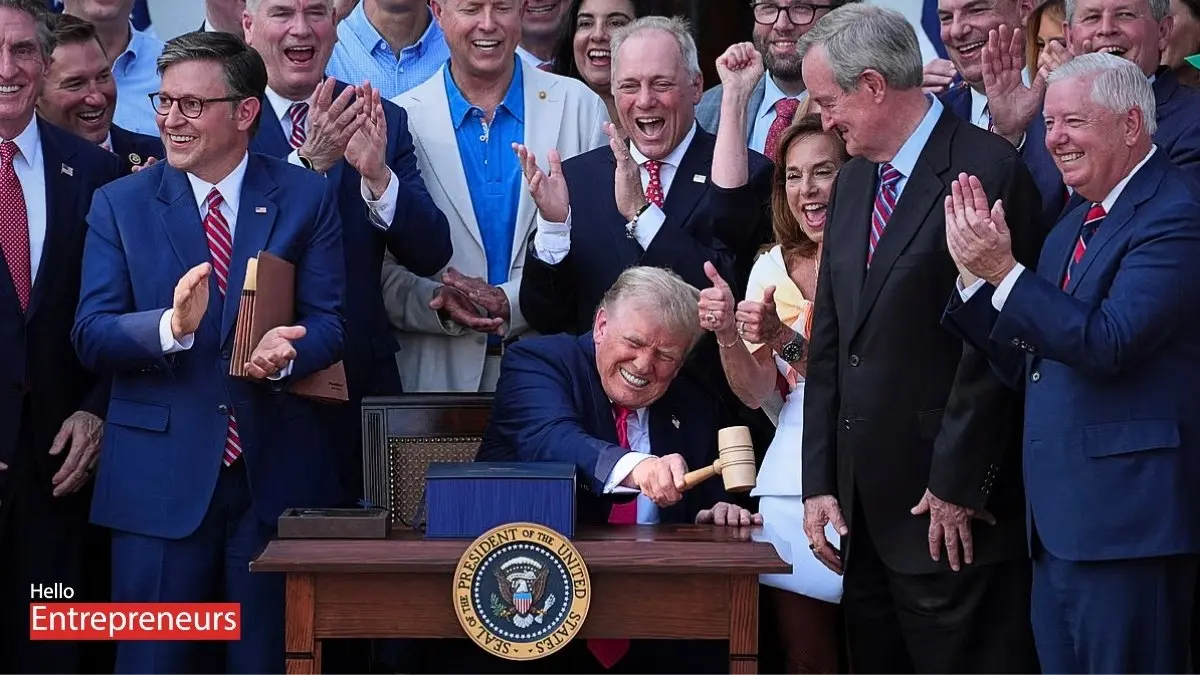
USA: As fireworks lit up Washington on the Fourth of July, Donald Trump used the White House South Lawn as his political stage, signing a sweeping tax and spending package that locks in his 2017 tax cuts and slashes safety net programs by more than a trillion dollars.
The move marks not just a reshaping of domestic policy, but a signal of Trump’s readiness to double down on populist economics and aggressive trade brinkmanship – with Europe now in his crosshairs.
The sprawling legislation – dubbed by Trump as his “one big beautiful package” – enshrines permanent tax breaks for high earners and businesses while setting the stage for punishing Medicaid and SNAP cuts projected to push millions into greater hardship. Meanwhile, his administration’s stalled trade talks with the European Union risk igniting a tariff war within days, threatening a transatlantic economic relationship worth nearly $2 trillion.
Locking in the 2017 Tax Cuts – and Giveaways at the Top
Central to the new law is the permanent extension of Trump’s 2017 tax cuts, which were originally set to expire after 2025. Those cuts lowered tax brackets, boosted the child tax credit, raised the estate tax exemption, and carved a generous deduction for pass-through businesses. Now, they’re locked in indefinitely. The standard deduction will rise modestly next year, and the estate tax exemption will jump to $15 million per person by 2026.
Yet the changes are more than a rehash. The legislation sweetens the pot for wealthier Americans by lifting the state and local tax deduction cap to $40,000 starting in 2025 – a benefit skewed heavily toward high earners in blue states like New York and California. For older voters, there’s a temporary “senior bonus” deduction of up to $6,000, a thinly veiled nod to a core Republican voting bloc.
Cuts to Medicaid and SNAP: Millions at Risk
Even as Trump’s plan showers new breaks on upper-income households, it guts core social programs. Medicaid, which covers more than 70 million Americans, faces roughly $1 trillion in cuts. The bill imposes new work requirements on adults aged 19 to 64, mandates more frequent eligibility checks, and narrows exemptions for parents – changes the Congressional Budget Office warns could leave nearly 8 million people uninsured within a decade.
The Supplemental Nutrition Assistance Program (SNAP) isn’t spared either. Expanded work requirements will now apply to older adults up to age 64 and parents of teens, while eligibility for benefits is sharply restricted. Analysts at the Urban Institute estimate more than 5 million households could see monthly cuts of at least $25, with average losses exceeding $140.
Sweeteners for Select Voters
To cushion the political blow, the package sprinkles in highly targeted, short-term tax breaks: waiters and bartenders will get a deduction of up to $25,000 on tip income; hourly workers can deduct overtime pay; and car buyers may write off up to $10,000 of interest on U.S.-made vehicles. But experts caution these benefits are small in scale and temporary – expiring by 2028 – unlike the permanent tax cuts for the wealthy.
Meanwhile, a new program of $1,000 “Trump accounts” for newborns between 2025 and 2028 aims to showcase a nod to child savings. However, analysts warn these accounts pale in comparison to existing tools like 529 plans, offering limited advantages to most families.
Shredding Biden’s Climate Incentives
Trump’s bill also dismantles key pillars of Joe Biden’s climate agenda. Credits for new and used electric vehicles, home energy upgrades, and efficient appliances – expanded under the Inflation Reduction Act – will vanish entirely after September 2025. That rollback marks a sharp pivot away from clean energy incentives at a moment when the auto industry and renewable sector are already grappling with supply chain upheavals.
A Looming Trade War with Europe?
Beyond the domestic fireworks, Trump’s escalating standoff with the European Union over tariffs is set to reach a boiling point. With a 90-day truce expiring on July 9, failure to clinch a deal could slap EU imports to the U.S. with duties as high as 50% – or even 70%, as Trump hinted last week. Retaliatory tariffs from Brussels are poised to follow, potentially ensnaring everything from pharmaceuticals to vehicles.
While European leaders like Ursula von der Leyen cling to the hope of an “agreement in principle,” both sides admit there is no time for a comprehensive deal. And even if a last-minute face-saving accord emerges, trade experts warn it will only delay a more explosive clash. The stakes are enormous: U.S.-EU trade accounts for about 30% of global goods trade, and Europe’s surplus in goods stands at nearly 200 billion euros.
Trump’s Risky Gamble
Taken together, Trump’s moves are a high-risk wager on a formula of tax breaks for the well-off, deep cuts for the vulnerable, and hardball tactics abroad. While his allies tout the legislation as pro-growth and pro-American, critics say it further cements income inequality and jeopardizes fragile transatlantic relations.
All in the name of political theatre?
With a potential trade war looming and millions facing reduced safety net support, America’s economic future looks more divided than ever – and the rest of the world is bracing for the fallout.
Also Read: On the Brink: Israel, Iran, and a World Wary of the Next Spark – World War 3?

