



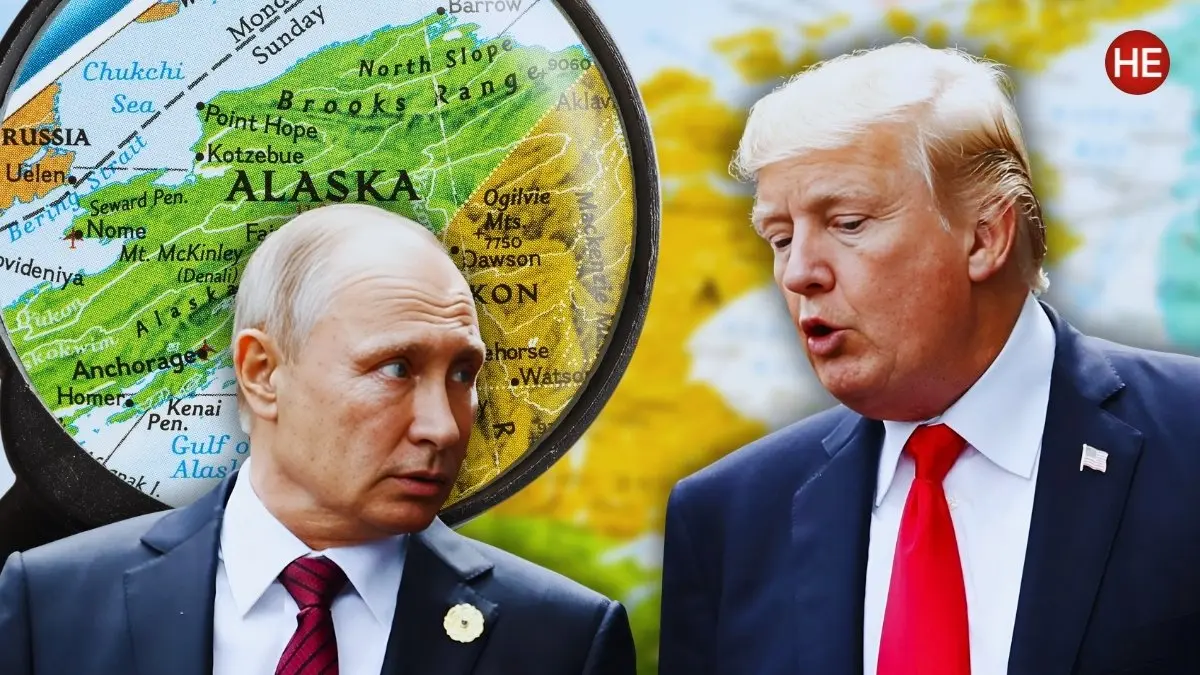
New Delhi: Anchorage, Alaska, isn’t usually where world leaders go to swap handshakes and strategic glares. But tomorrow, the snow-dusted runways of Joint Base Elmendorf-Richardson will see President Donald Trump welcome Russian President Vladimir Putin. The Air Force-Army hub has long been a watchtower against Moscow’s aircraft. Now it’s playing host to Moscow’s president. If walls could talk, the Cold War-era hangars might raise an eyebrow and mutter, “Well, this is different.”
How to Host a Summit at the Edge of the Map
The base’s past life reads like a military action novel, Soviet intercepts, Chinese flyovers, and plenty of midnight scrambles. So it’s got the muscle memory for high-stakes operations. Still, a presidential tête-à-tête with Putin is less about airspace dominance and more about making sure no one sneaks in with a boom mic. Base officials won’t say a word about preparations. White House spokespeople aren’t spilling either, “operational security,” they insist. Translation: You’re not getting the menu, let alone the seating chart.
Ravi Chaudhary, a former assistant Air Force secretary, says the location can handle it, though he hinted that the current administration’s security habits aren’t exactly textbook. It’s a curious choice of venue. But maybe that’s the point. In Alaska, you’re far from the diplomatic circus of Washington, yet close enough to Russia that a summit feels almost like meeting halfway across a frozen backyard.
Europe Quietly Overtakes America in Ukraine Aid
While cameras prep for the summit, another quiet shift has happened. For the first time since Russia’s full-scale invasion of Ukraine, European nations have outpaced the U.S. in total aid. According to Germany’s Kiel Institute, Europe has chipped in roughly $5 billion more than Washington. This isn’t about outshining America; it’s about a long war that needs a long supply line.
The U.S. still leads in sending the heavy-hitters: infantry fighting vehicles, howitzers, rocket systems, and air defenses. Poland, however, wears the crown for tanks, 354 of them. Many of the weapons are fresh from factory floors, not dusty stockpiles. That’s telling. Europe isn’t just emptying its closets for Ukraine; it’s keeping its defense industry humming for the long haul.
A Defense Strategy That Stays Close to Home
The Trump administration’s interim National Defense Strategy, finished in March but kept classified, takes a sharp turn from recent decades. It’s focused squarely on “defending the homeland.” China? Lower priority. The Middle East? Not top of the list. Defense Secretary Pete Hegseth told Congress as much in June.
This “America first, quite literally” approach has already shown up in odd ways, like sending National Guard units to U.S. cities that never asked for them. Some analysts say it’s a trial run for a more domestically focused military posture. Mark Cancian, from the Centre for Strategic and International Studies, summed it up: “We’re learning in real time what that means.” Spoiler: It could mean a lot of helicopters hovering over places like Des Moines instead of the South China Sea.
Aid Withheld, Lives in the Balance
If that wasn’t enough to set the foreign policy world buzzing, a federal appeals court ruled this week that the White House can keep holding back billions in foreign aid, at least for now. That includes $10 billion tagged for global health programs. The court didn’t decide if such holdbacks are constitutional, just that they can continue while the case drags on.
Aid groups warn this could mean more hunger, untreated disease, and, bluntly, more deaths in the world’s most fragile regions. Critics say it’s part of a bigger realignment: redefining who gets U.S. help, and why. Supporters frame it as tough love. The people in the middle? They’re just waiting to see if the money ever leaves the Treasury.
Grit on the Ground, The Best Ranger Competition
Amid the policy chess, one story this week reminded everyone that defense isn’t all about strategy papers and summit backdrops. At Fort Benning, Georgia, 104 soldiers paired up for the Best Ranger Competition, three days of running, crawling, rope climbing, swamp trekking, and sleeping just enough to remember their names. By day three, only 16 teams were still standing.
Among them was First Lieutenant Gabrielle White, the first woman to compete for the title. Out there, it didn’t matter; her fellow Rangers saw a competitor, not a headline. In an era where so much defense talk is about hardware and budgets, it’s worth remembering: the real power comes from the people willing to carry 50-pound packs through a swamp at 3 a.m.
Did you know?
President Donald J. Trump is the President of PEACE. pic.twitter.com/7ZH5hKHLVI
— The White House (@WhiteHouse) August 12, 2025
Conclusion:
From the frostbitten gates of an Alaskan base to the muddy trails of Fort Benning, the week’s defense stories share a common thread: change. Europe is carrying more of Ukraine’s load. Washington is looking inward. Aid decisions are being measured not in dollars spent, but in lives on hold. And tomorrow, two presidents will sit down in a place where radar once scanned for each other’s bombers. You could call it history repeating, or history improvising.
Either way, Anchorage will remember.

