



Mumbai: Donald Trump is done whispering. On Greenland, he’s speaking in blunt verbs and hard edges, and the world is listening.
Trump is back to saying the quiet part out loud. The United States, he declared from the White House, is “going to do something on Greenland, whether they like it or not.” No qualifiers. No diplomatic padding. Just a warning wrapped in certainty.
Standing beside Vice President JD Vance, Secretary of State Marco Rubio, and oil industry leaders, Trump framed Greenland not as a negotiation but as a necessity. His logic was familiar and deliberately stark. Act now, or watch Russia or China move in next.
“We’re not going to have Russia or China as a neighbour,” Trump said. He added that he would prefer a deal, “the easy way.” But if that failed, the hard way remained firmly on the table.
This was not a campaign rally riff. It was a press conference. And it landed like policy.
A cautionary past is murmuring, then clearing his throat.
This is where people get to pass over the unpleasant part.
The United States did not wake up as a powerful country. It accumulated power. At a dawdling pace, then suddenly, then everywhere. It has developed over the years to be a nation of about 330 million individuals with an area amounting to over 3.5 million square miles since 1776. Big numbers, sure. Figures do not give an account of behaviour. Patterns do.
And the pattern is reached.
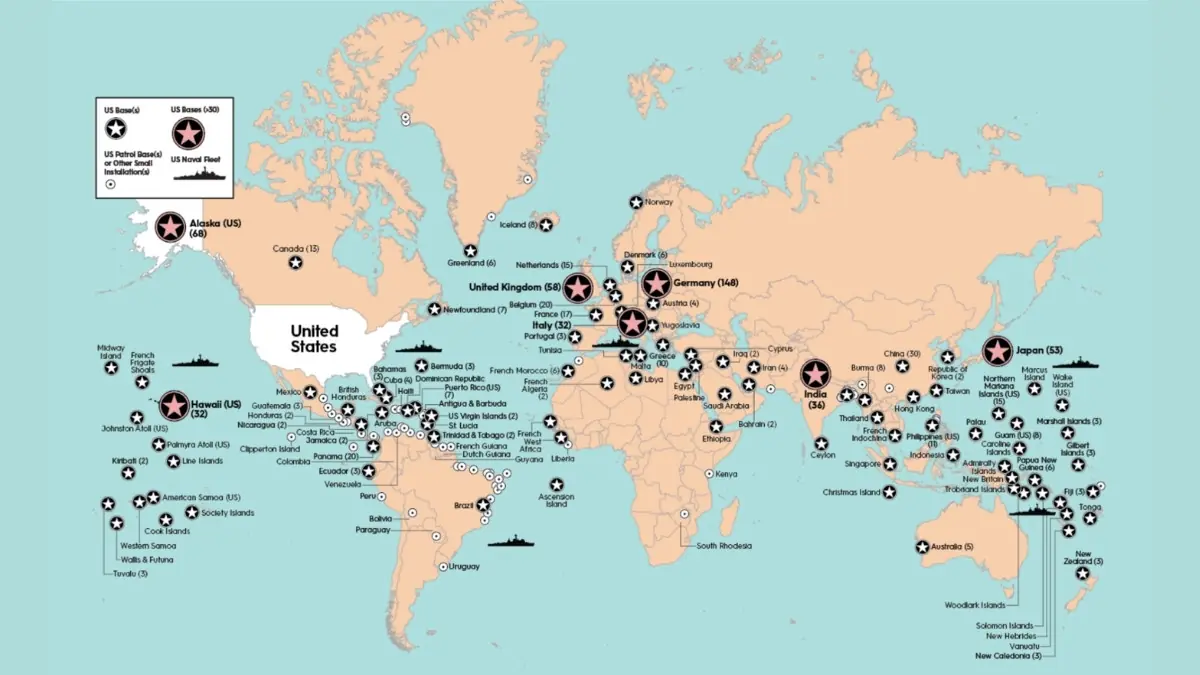
The US has at least 750 military bases distributed all over approximately 80 countries today. Approximately 173,000 American soldiers are present in 159 countries. That’s not presence. That’s permanence. Others cover large areas of land and cost more than millions of dollars.
There are others that are tiny, silent padlets, such as those that are not noticed until they are.
Japan knows this story well. The US has over 53,000 soldiers stationed in more than 120 bases in the country, most of which were built at the conclusion of World War II. The burden of that is proportional to Okinawa alone, bearing about 70%. The next country is Germany, which has almost 34,000 troops across 119 bases. There are more than 26,000 troops in South Korea with 73 bases, one of them, Camp Humphreys, is the biggest US military base on the entire planet.
Then there’s Guam. Italy. Puerto Rico. The UK. Iraq. Bahrain. And Cuba, with its Guantanamo Bay, captured in 1898, leased in 1903 and still there somewhere. Boots may remain in place, long remembered by history.
Since 1950, the US military’s impact has been observed in around 200 countries and territories. Some welcomed it. Some tolerated it. Some are still debating it.
This structure of authority is operational on money. A lot of it. The Stockholm International Peace Research Institute estimates the US military expenditure at approximately 778 billion annually. The war on terror alone has consumed an estimated 8 trillion dollars since the beginning of the 2000s. That’s not ideology. That’s infrastructure.
And it hasn’t been bloodless. Korea. Vietnam. The Gulf War. Afghanistan. Iraq. They left each of them, civilian death, political scar, and unresolved questions. The host countries tend to lose their own defence muscles over time, in the complacency that these forms of defence are here to stay unless otherwise.
This is why the protests continue to reappear in such locations as Okinawa and the Philippines.
Not that people dislike security, but because they have experience of what it is like to have a long-term occupation that is no longer temporary.
Therefore, when Washington calls something a security priority, history does not hear any assurance. It hears a door opening. Slowly. Then wider.
Greenland stands now in that door.
Why Greenland, and why now?
Greenland is massive, icy, sparsely populated, and strategically priceless. It sits astride Arctic shipping lanes, hosts critical US military infrastructure, and is increasingly relevant as melting ice unlocks new routes and resources.
Trump has called acquiring Greenland a “national security priority of the United States.” That line matters. It moves the conversation from curiosity to doctrine.
The island is a self-governing territory under Danish administration, with its own parliament and government. It is not unclaimed. It is not unguarded. And it sits squarely within NATO’s framework.
Which is why Trump’s words triggered instant pushback across Europe.
European allies draw red lines
British Prime Minister Sir Keir Starmer, French President Emmanuel Macron, and other European leaders were quick to say they would defend Greenland’s territorial integrity. Denmark’s Prime Minister Mette Frederiksen went further, warning that any US military action to seize Greenland would spell the end of NATO.
That’s not diplomatic hyperbole. NATO functions on trust. A member forcibly taking territory from another member would crack the alliance at its core.
Trump, however, appears unmoved by alliance sensitivities. He did not deny the possibility of discussing money with Denmark, saying only that he was not talking about it “yet.” The pause was telling.
This wasn’t about price tags. It was about leverage.
The shadow of Venezuela looms large
Trump’s Greenland rhetoric doesn’t exist in isolation. It follows America’s military operation to capture Venezuelan president Nicolas Maduro, an unprecedented move that stunned allies and adversaries alike.
Trump justified that operation by invoking what he now calls the “Donroe Doctrine.” Yes, spelled exactly how it sounds.
The Donroe Doctrine explained
To understand Trump’s mindset, you need a short history detour.
In the 1830s, President James Monroe declared the Americas a US sphere of influence. European powers were warned to stay out. The Monroe Doctrine became foundational US foreign policy, then gradually faded into textbooks.
Until now.
Late last year, the White House revived it in a new national security strategy. But it didn’t stop there. It added a “Trump Corollary,” stating the US would not sit idly by while hostile or criminal neighbours engaged in “chronic wrongdoing.”
Trump now says the Monroe Doctrine has been “superseded.” His version is louder, more personal, and unapologetically muscular.
“They now call it the ‘Donroe Doctrine’,” he said. “American dominance in the Western Hemisphere will never be questioned again.”
Greenland may not be in the Western Hemisphere in the traditional sense, but in Trump’s worldview, geography bends to security.
Hard power, openly stated
This is the key shift. Trump is not hiding behind euphemisms. He is not outsourcing threats to unnamed officials. He is stating intent in plain English.
When asked how much he would offer Denmark, Trump didn’t deny the premise. He delayed it.
That alone marks a departure from conventional diplomacy.
Speculation has swirled that Trump could attempt to take Greenland, especially after Venezuela showed he is willing to cross lines previous administrations treated as taboo. The idea no longer sounds theoretical.
What makes Greenland different?
Unlike Venezuela, Greenland is tied to NATO. Any move there would ripple instantly through global alliances.
It would also accelerate Arctic militarisation. Russia already has a strong Arctic presence. China has labelled itself a “near-Arctic state” and is investing heavily in polar infrastructure.
Trump’s argument is simple. If the US doesn’t lock Greenland down, someone else will.
From an Indian perspective, this matters more than it seems
India has no direct stake in Greenland. But it has a massive stake in how global power behaves.
If territorial integrity becomes negotiable through force or coercion, smaller nations everywhere feel the tremors. Arctic instability affects global shipping, energy markets, and strategic balance. India watches all of that closely.
New Delhi has worked carefully to maintain strategic autonomy while navigating US-China rivalry. A world where major powers openly threaten territorial acquisition raises the cost of neutrality.
What comes next?
Trump started with Venezuela. He has now turned the spotlight north.
There are, as analysts note, plenty of “hostile or criminal neighbours” Trump could decide to confront next. Mexican cartels. Cuba’s regime. Colombia’s cocaine networks.
Greenland fits a different category, but the logic is the same. Pre-emption over patience. Dominance over diplomacy.
Geopolitics just got louder
The early 19th century may indeed be calling, asking for its foreign policy back. But this time, it’s armed with satellites, icebreakers, and social media megaphones.
Trump’s Greenland comments are not a slip. They are a signal.
Whether the world treats them as bluff or blueprint will shape what comes next.