



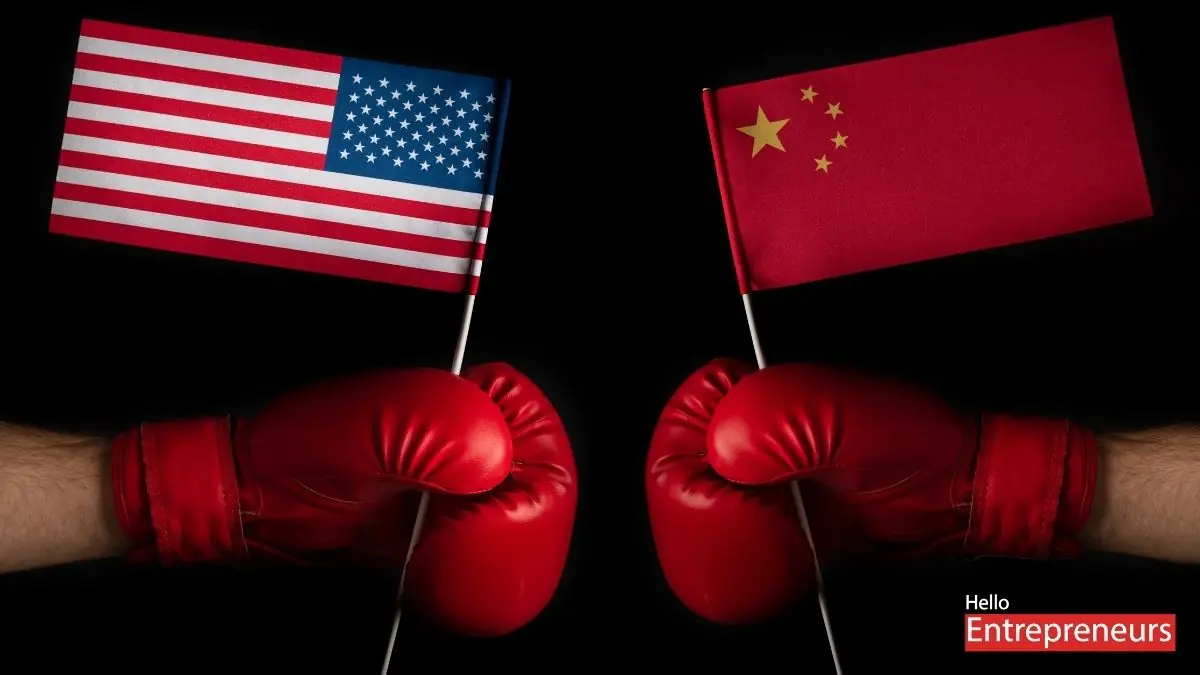
Bengaluru: The global race for AI supremacy didn’t start with ChatGPT. It started with chips, and the geopolitical street fight over who controls them. Here’s how the US-China chip war escalated, twisted, and pivoted its way to 2025.
The US-China chip war. The phrase alone explains the stakes: economic dominance, national security, technological supremacy. Everyone from Washington to Beijing to Bengaluru is watching this silicon-fuelled saga unfold because the winner sets the future of AI. And honestly, nobody likes playing catch-up in a world that runs on nanoseconds.
What follows is a sharp, fact-driven walk through the major flashpoints, all the moves, countermoves, and political drama that dragged us into today’s high-stakes semiconductor showdown.
01] Biden’s 2022 Chips Act Lights the Fuse
The modern phase of the US-China chip war really kicked off in August 2022 when Joe Biden signed the Chips and Science Act. Washington had been fretting over China’s aggressive state-backed push into chipmaking, and this was America’s way of saying: not on our watch.
Fifty-two billion dollars hit the table to boost US microchip production. Not a token gesture. More like a strategic muscle flex. Microchips sit inside everything from cars to missiles to smartphones. If you control chips, you control the future.
India watched with interest. After all, the global supply chain was crying out for diversification, and New Delhi was hungry for a bigger manufacturing footprint. While the US and China traded punches, India positioned itself as the third player willing to take the long game seriously.
02] October 2022, Washington Drops Hard Export Controls
Two months later, Washington escalated. In October 2022, it restricted China’s access to advanced chips and the equipment needed to make them. These chips weren’t toys. They were the backbone of modern AI development and high-performance computing.
China cried foul, accusing the US of trying to “maliciously block and suppress Chinese businesses.” The US wasn’t buying it. National security became the rallying cry, and the blacklist began to grow, 36 Chinese firms added in December, many with deep ties to the country’s defence sector.
This wasn’t just policy. It was a full-force geopolitical blockade.
03] October 2023, The Screws Tighten
By 2023, with the generative AI boom exploding worldwide, Washington tightened the screws again. Nvidia’s monster H100 chip was the star of the AI world, but the US government widened export curbs to cover lower-performing models too. Anything powerful enough to meaningfully train AI models became sensitive tech.
The message was simple: control AI chips, control AI advancement.
India, as usual, played the tactical observer, grabbing any opportunity that emerged from rising US-China supply chain friction.
04] Late 2024–Early 2025, Biden’s Final Gambits
Before leaving office, Biden pushed through another round of restrictions from December 2024 to January 2025. Commerce Secretary Gina Raimondo summed up the mood perfectly: “The US leads the world in AI now…and it’s critical that we keep it that way.”
The new rules were designed to stop China from working around existing restrictions, re-exports, in-country transfers, you name it. Washington patched every loophole it could find.
Meanwhile, India’s tech sector kept building partnerships with US firms eager to offshore manufacturing without going anywhere near China.
05] January 2025, DeepSeek’s Shockwave
Then came the curveball. In January 2025, Chinese startup DeepSeek launched a low-cost, high-quality chatbot that stunned the global AI community. Silicon Valley scrambled. Washington flinched. China celebrated.
DeepSeek’s rise poked a hole in America’s confidence. You can restrict hardware, sure. But innovation? That’s a moving target. This was one moment Beijing won decisively on narrative, and narrative matters.
06] April 2025, Nvidia’s H20 Gets Blocked
Trying to work around export rules, Nvidia developed the H20, a weaker cousin of the mighty H100, tailored for China. But Washington wasn’t convinced. Even these downgraded chips needed export licences, especially because they could still power supercomputers.
Nvidia CEO Jensen Huang, never one to mince words, pushed back. He insisted he was “willing to continue to plough deeply into the Chinese market.”
The man wasn’t bluffing. China remains one of Nvidia’s biggest markets, even with all the political fireworks.
07] May 2025, Trump Rolls Back the Rules
When Donald Trump returned to the White House in 2025, he moved fast. In May, his administration rescinded some of the Biden-era export controls, citing pressure from partner countries who argued that they were being locked out of AI tech entirely.
Trump painted himself as the dealmaker, restoring access without compromising security. Whether that’s true depends on who you ask. But he certainly changed the tone.
For India, this shifting landscape offered more room to negotiate for technology partnerships without being swallowed by superpower politics.
08] July–September 2025, Bans and “Nanoseconds Behind”
In July, Nvidia announced it would resume H20 sales to China because Washington had finally agreed to issue licences. Problem solved? Not quite.
Beijing blocked Chinese firms from buying them. The government pushed domestic chips instead, part protectionism and part strategic necessity. China was clearly tired of being held hostage by US controls.
By September, Jensen Huang issued a warning that should’ve made Washington nervous: China’s chip industry was now “nanoseconds behind.” His point was blunt. With every restriction, the US was accidentally fueling China’s determination to catch up.
India has heard this story before. Squeeze a giant hard enough, and it doesn’t break. It evolves.
09] December 2025, The Trump-Xi Agreement
Finally, in December 2025, Donald Trump announced an agreement with Xi Jinping to allow Nvidia to ship H200 chips, a more advanced model than the H20, to approved Chinese customers.
Trump framed it as a win for security and diplomacy, while criticizing Biden’s earlier approach. The US wouldn’t release Nvidia’s newest tech, the Blackwell series and upcoming Rubin processors, but the H200 was still a significant concession.
Keep in mind: the H200 is about 18 months behind Nvidia’s cutting-edge chips. In AI time, that’s basically a generation. Washington was giving ground, but not too much.
India, strategically located between both tech spheres, gained breathing room as the global supply chain recalibrated once again. With every shift in the US-China balance, India becomes a more appealing neutral hub.
—
The whole story proves a simple point: you can slow a rival down, but you can’t stop a nation determined to catch up. And China is definitely determined. The US knows it. Nvidia knows it. India knows it too; which is why we’re smart to build our own semiconductor capabilities while the giants keep throwing punches.
Also Read: The 2025 Rise of Nano GCCs and the Power of 100-Person Talent Hubs

