



New Delhi: Prime Minister Narendra Modi opened Semicon India 2025 in Delhi on Tuesday with a blunt message: India’s chip story is no longer theory, it’s execution.
With more than 20,000 attendees, hundreds of industry leaders, and representation from nearly 50 countries, India’s biggest semiconductor show yet is not just optics. It’s a pitch to investors, a pep talk to Indian talent, and a warning shot to rivals: India wants its share of the trillion-dollar chip pie.
Semicon India 2025: India Stakes Its Claim in the Chip Race
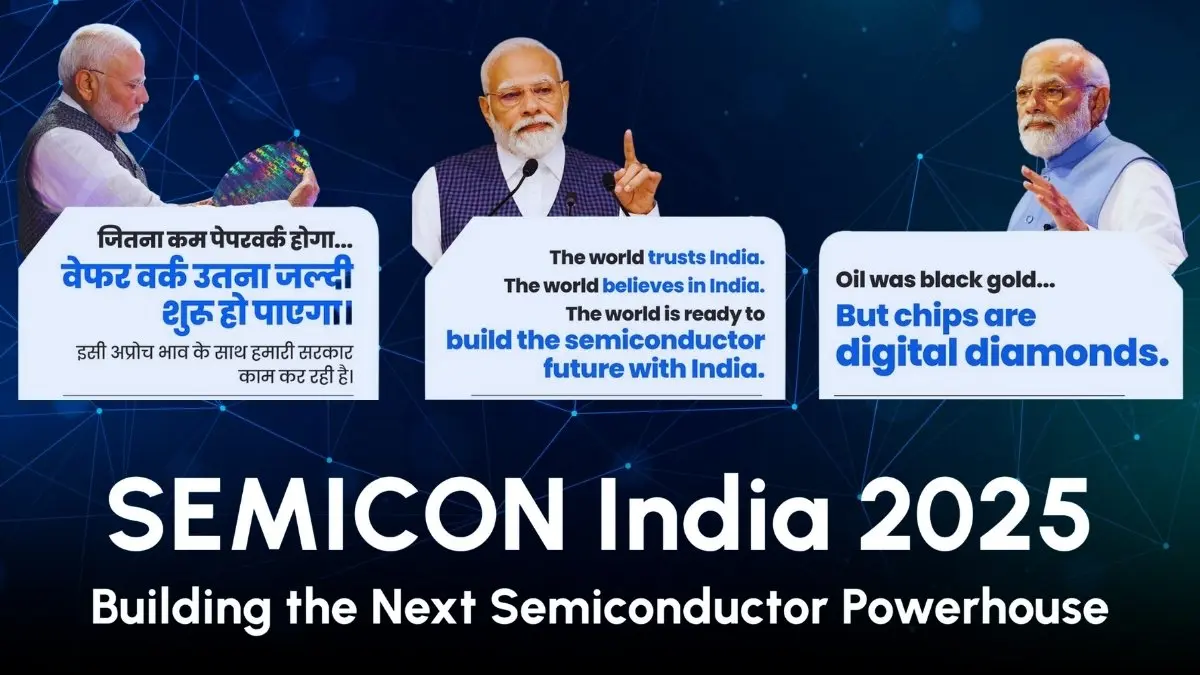
At Yashobhoomi, PM Modi compared chips to “digital diamonds.” Oil dictated the last century, he said. Chips will dictate this one.
The global semiconductor market is already worth $600 billion. By the end of this decade, it will cross $1 trillion. Taiwan, Korea, the US, Japan, and China are pouring billions into fabs and research. India is late to the party, but the Prime Minister made clear: late doesn’t mean locked out.
“The world trusts India, the world believes in India, and the world is ready to build the semiconductor future with India,” he declared.
That trust is backed by hard numbers: India clocked 7.8% GDP growth in the last quarter, while major economies struggle with stagnation. PM Modi used those figures to remind global investors that India is not just growing; it’s powering global growth.
From Mission Launch to Real Plants
India launched its semiconductor mission in 2021. Three years later, the approvals came. Today, ten projects worth over $18 billion (₹1.5 lakh crore) are in the pipeline.
2023: First fab approved.
2024: Multiple new plants cleared.
2025: Five more projects sanctioned.
This isn’t just policy talk. Pilot production is underway. CG Power fired up its first line last week. Kaynes follows shortly. Test chips from Micron and Tata are already in production. Full commercial output is promised this year.
For a country that has long been dismissed as “just a back-office,” this is a critical turning point.
Bureaucracy vs. Speed
PM Modi’s jab at paperwork drew laughs but carried bite: “The lesser the paperwork, the sooner the wafer work can begin.”
For decades, India’s bureaucracy has been the biggest bottleneck for manufacturing. The government now promises a National Single Window System, approvals from both the Centre and states in one place.
Add to that semiconductor parks with plug-and-play facilities: land, power, airports, ports, and skilled workers on tap. Combine with PLI incentives and design-linked grants, and India suddenly looks less like a red-tape maze and more like a factory-ready pitch.
From Backend to Full-Stack Nation
India has long provided the brains; 20% of the world’s semiconductor design talent works out of Indian offices. But design without fabs means dependency.
PM Modi said the goal is a “full-stack semiconductor nation”, from design to manufacturing to packaging. That’s a big shift.
Design centres in Noida and Bengaluru are already working on next-gen chips with billions of transistors.
The revamped Design Linked Incentive Scheme and Chips-to-Startup programme are meant to push Indian IP, not just services.
The National Research Fund will support deeper R&D and global tie-ups.
If it all clicks, India won’t just be coding for others; it will own patents, fabs, and products.
Minerals: The Invisible Backbone
You can’t make chips without rare earths and critical minerals. PM Modi reminded the audience that steel is invisible in a skyscraper, but essential. Same with minerals for chips.
India is working through its National Critical Mineral Mission to secure a domestic supply. Over the past four years, projects have been launched to reduce reliance on imports from China and other suppliers.
It’s blunt realism. Without minerals, the dream of “Designed in India” stays just that, a dream.
States Enter the Arena
Gujarat has already bagged Micron’s plant. Karnataka and Tamil Nadu are pushing incentives. Odisha and Uttar Pradesh are positioning themselves.
PM Modi called this “healthy competition” and urged states to race harder. For once, states fighting for factories is a welcome change from fighting over freebies.
Global Context: Why This Matters
The US is subsidising fabs under the CHIPS Act. Europe has its own chip push. China is investing at a scale India can’t yet match. Taiwan and Korea guard their lead fiercely.
Against this backdrop, India isn’t aiming to beat TSMC tomorrow. But even a 10% slice of the trillion-dollar market would be transformative. It would cut import dependence, build tech sovereignty, and give Indian talent a homegrown platform.
PM Modi: Reform, Perform, Transform
PM Modi’s political mantra made its way into the semiconductor pitch: Reform, Perform, Transform.
India has reformed its policy, he said. It is now performing with plants and pilots. The next step is transformation, scaling fast, avoiding delays, and actually delivering chips to the global supply chain.
He ended with a soundbite investors love:
“Design is ready. Mask is aligned. Now is the time for precision execution and delivery at scale.”
And then the punchline:
“The day is not far when the world will say, Designed in India, Made in India, Trusted by the World.”
Not Just Optics
Semicon India 2025 isn’t just speeches. Over 20,750 participants are here: 2,500 delegates, 150+ speakers, 350 exhibitors, plus country roundtables and startup pavilions.
Japan, the US, and Europe are present. Startups are pitching. States are competing. And India’s youth, the real “semiconductor capital”, is watching closely.

