
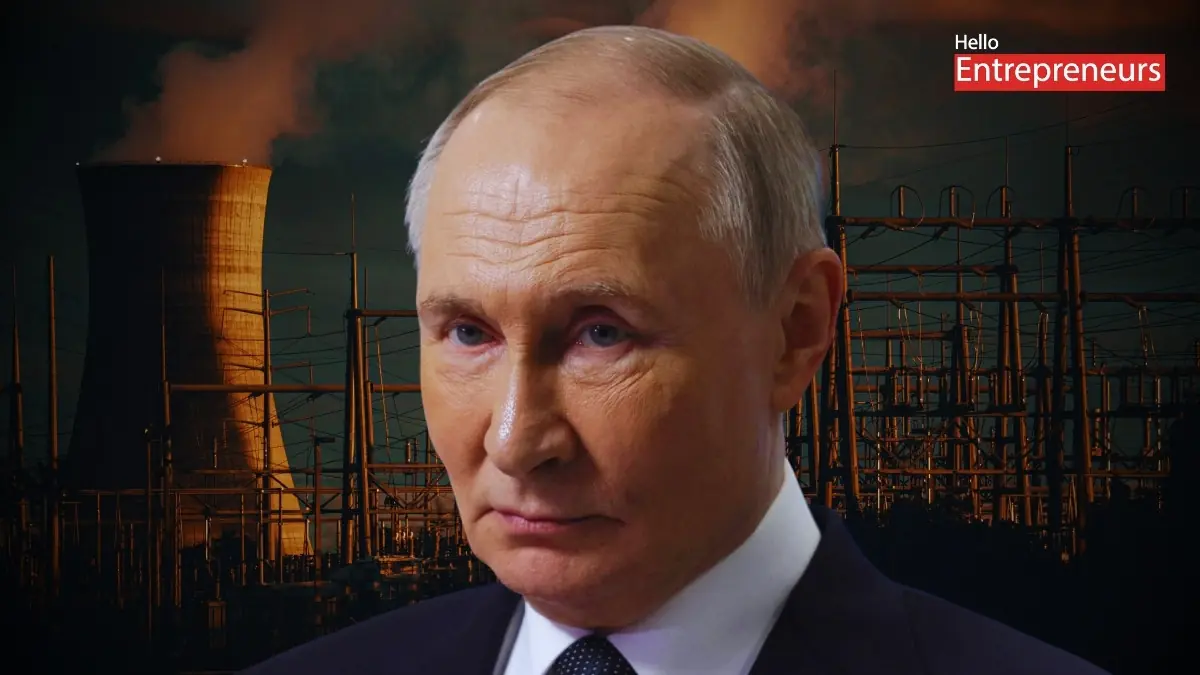








New Delhi: The world is calling it what it is – nuclear terrorism. Vladimir Putin’s forces have launched new strikes on Ukraine’s power grid, hammering substations that keep nuclear plants running. It’s not just war anymore; it’s radioactive brinkmanship with a winter deadline.
Russia’s War Takes a Darker Turn
The Kremlin’s latest offensive has hit below the belt – again. Ukraine’s Foreign Ministry accused Moscow of executing “targeted strikes” on power substations supplying energy to nuclear power plants. The goal? Cripple the country’s grid before winter freezes morale and pipelines alike.
The International Atomic Energy Agency (IAEA) didn’t mince words either. After inspecting one of the damaged substations, the UN watchdog confirmed that Russia’s attacks have “negatively impacted the reliability of off-site power supply” to Ukrainian nuclear power plants. In plain English: that’s one bad fuse away from disaster.
Ukraine’s Prime Minister Yulia Svyrydenko summed it up: “Russia continues its systematic energy terror – striking at the lives, dignity, and warmth of Ukrainians on the eve of winter.” She’s not wrong. The Kremlin’s obsession with turning off the lights before the snow hits is less about military victory and more about psychological warfare.
G7 Calls It “Nuclear Terrorism”
The G7 energy ministers finally said the quiet part out loud – branding the strikes “nuclear terrorism.” In a joint statement, they slammed Moscow for targeting the infrastructure that powers nuclear facilities, calling the attacks a threat not just to Ukraine but to “human lives, communities, and global energy stability.”
This is a rare diplomatic consensus from a group that can barely agree on dinner menus. But even they recognise that Putin’s power plays have crossed into nuclear-risk territory. Every strike on Ukraine’s grid amplifies the possibility of a meltdown.
Zelensky’s Dilemma: Hold Pokrovsk or Lose the East
Meanwhile, on the ground, the war grinds on with a grim rhythm. In Donetsk, Russian forces have surrounded the strategic town of Pokrovsk. Ukrainian President Volodymyr Zelensky called the situation “difficult,” acknowledging that Russian units had “infiltrated” parts of the city.
According to Kyiv’s intelligence, 170,000 Russian troops have massed in the region – Putin’s biggest push in months. The aim: a symbolic and logistical win that would give Moscow control over key supply routes to the east.
Yet Zelensky insists his forces are “weeding them out.” That may sound defiant, but even the Institute for the Study of War admits progress has been marginal.
The Human Cost: 339 Stolen Children
As if bombed grids and frozen cities weren’t enough, Ukraine has uncovered another horror. The country’s foreign intelligence service has identified 339 Ukrainian children abducted by Russia. Zelensky said Kyiv will soon release “a document listing all 339 children – with names, addresses, and the institutions that took them.”
It’s a chilling echo of darker chapters in history – forced deportations disguised as “evacuations.” Ukraine plans to push for international sanctions on the individuals and entities responsible. “It’s crucial they face consequences,” Zelensky said.
This isn’t the first time Russia has been accused of weaponising childhood, and it likely won’t be the last. In the information age, though, the receipts are digital – and permanent.
Russian Recruitment Mirrors ISIS Tactics
If Putin’s foot soldiers are brutal, his digital ones are insidious. Disinformation experts warn that Russian intelligence is using ISIS-style recruitment methods to build a network of disposable operatives inside the EU.
The Centre for Countering Disinformation says Moscow is targeting marginalised Russian-speaking groups through social media – mixing nationalism, religion, and manipulation into a toxic cocktail. Once radicalised, recruits are tasked with minor missions like spying on infrastructure or spreading fake news. The pattern mirrors ISIS recruitment between 2013 and 2019, but with a Kremlin accent.
It’s psychological warfare 2.0 – and Europe’s security agencies are scrambling to catch up.
A U.S. Retrenchment That Raises Eyebrows
Adding another twist, Washington is reportedly withdrawing troops from Eastern Europe. The Trump administration plans a “recalibration” of its presence in Romania, Bulgaria, Hungary, and Slovakia.
The Pentagon insists it’s “appropriate.” Critics, however, call it reckless. Senator Jeanne Shaheen warned that scaling back sends “exactly the wrong signal to Vladimir Putin.” Even Republicans like Mike Turner are uneasy, urging a “robust and resolute” U.S. stance as Russia tests NATO’s resolve with provocative airspace incursions.
This move might look like a strategic realignment. But on the Kremlin’s chessboard, every empty NATO base is an open square.
Nuclear Escalation: The Oreshnik Revelation
In a rare offensive admission, Zelensky revealed that Ukrainian agents destroyed a Russian Oreshnik missile – a nuclear-capable system – inside Russia’s own territory. The strike took place at the Kapustin Yar range in Astrakhan Oblast.
Putin, predictably, boasted that Western air defences couldn’t intercept the Oreshnik, which reportedly has a 5,000 km range. But Kyiv’s sabotage shows otherwise: Russia’s superweapons aren’t invincible. And if Moscow is indeed planning to deploy these in Belarus, Europe’s front line just got shorter and scarier.
Nuclear Blackmail Isn’t a Strategy
This is the story of a dictator running out of levers. Putin’s nuclear sabre-rattling and energy terror aren’t signs of strength – they’re proof of exhaustion. When you can’t win on the battlefield, you turn off the power, kidnap children, and call it strategy.
But the international community is finally naming it for what it is: nuclear terrorism. And in the long run, that label may carry heavier consequences than any sanctions list.