



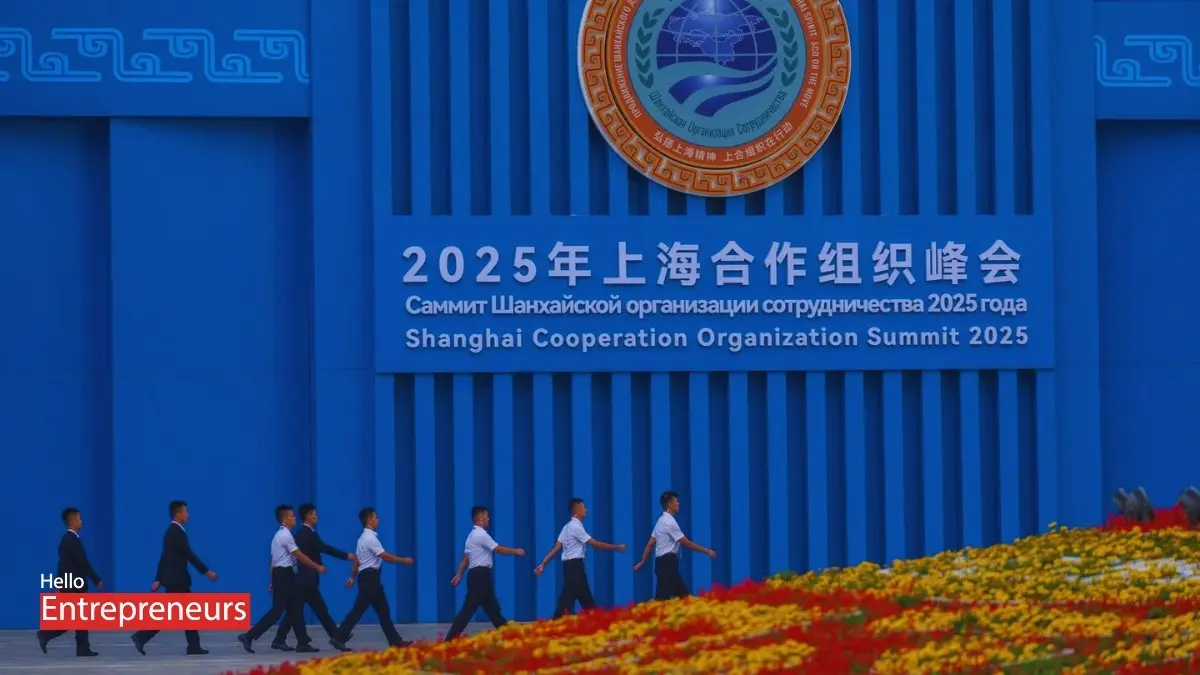
New Delhi: PM Narendra Modi has landed in China after seven years, sitting at the same table as Xi Jinping and Vladimir Putin. The SCO summit is less about handshakes and more about who sets the rules in a world no longer run from Washington.
China’s Big Bonanza
Chinese President Xi Jinping is hosting leaders from Russia, India, Iran, Pakistan and nearly 20 others at the Shanghai Cooperation Organization (SCO) summit. It’s the SCO’s biggest gathering yet, and Beijing is milking the optics.
Xi wants the world to see that there is life outside Washington’s orbit. “China is bringing them together and making a statement about global governance,” said Yun Sun of the Stimson Center in Washington. Translation: Beijing wants to set the table, and the West isn’t invited.
PM Modi Returns to Beijing
For India, this summit is loaded. Prime Minister Modi hasn’t visited China in seven years. His timing? Days after the US slapped India with 50% tariffs for buying Russian oil. Washington’s trade tantrum has given New Delhi fresh motivation to recalibrate.
“India was putting too many eggs in the American basket,” said Sanjay K. Bhardwaj of Jawaharlal Nehru University. “Now it is trying to balance by placing some eggs in the Chinese basket too.” That’s professor-speak for hedging bets.
But PM Modi isn’t walking into this summit with an open field. China has been arming Pakistan with fighter jets, among other toys, even as Beijing and New Delhi keep their soldiers glaring at each other along the Himalayan border.
SCO: Not NATO, But No Picnic Either
The SCO started after the Cold War as a security club for China, Russia and Central Asia. It’s no NATO, there’s no collective defence pact. But members do cooperate on counter-terrorism and sometimes hold joint drills.
This year, as the rotating chair, China gets to drive the agenda. According to Yu Jie of Chatham House, Beijing’s line is clear: if there’s going to be a China-led world, it won’t include Europe or the US. Subtlety is not on the menu.
Who’s at the Table
Apart from PM Modi, Xi and Putin, the guest list includes Pakistan’s Shehbaz Sharif, Iran’s Masoud Pezeshkian, Turkey’s Recep Tayyip Erdoğan and UN chief António Guterres.
Xi is rolling out the red carpet, banquets, bilateral chats, and a joint declaration at the end. Putin, fresh from dodging Western sanctions, plans a “cup of tea” with Xi before his own side meetings with PM Modi and others.
India’s Tightrope
The optics for PM Modi aren’t simple. He is seen as arriving in Beijing with a “weakened hand,” argues Brahma Chellaney of New Delhi’s Centre for Policy Research, given Trump’s tariffs and China’s open flirtation with Pakistan.
And yet, New Delhi has been busy re-opening channels: reviving trade ties, importing rare earths and fertilisers, and restarting travel. PM Modi even hosted China’s foreign minister Wang Yi last week.
The bigger question: can PM Modi, Xi and Putin revive their trilateral dialogue, frozen since the 2020 border clashes between India and China? Don’t bet on it, but the world will watch closely.
Distrust Runs Deep
The SCO loves to preach “unity against terrorism.” But India and Pakistan’s presence under the same roof is more about gritted teeth than solidarity. They fought a brief armed conflict just months ago.
Analysts like Amit Ranjan of the National University of Singapore warn that relations with Beijing can’t be patched up overnight. “It’s not very easy to just settle all these issues in a few days’ time,” he said. Understatement of the year?
The US Angle
The backdrop to all this: Washington’s tariff war. Trump’s policies have rattled export-driven economies across Southeast Asia. The SCO summit, with its record attendance, doubles as a stage for leaders bruised by American trade weapons to show they have alternatives.
Xi, of course, would love nothing more than to position himself as the “clear winner” in global politics, as Yu of Chatham House put it. But even his banquet can’t erase the fact that many SCO members, especially India and Pakistan, distrust each other more than they distrust Washington.
What Next
The summit will end with a joint declaration, photo ops and plenty of diplomatic jargon about “multipolarity.” But the real takeaway is simpler: China is making a pitch to run a new world club, and India is trying to avoid becoming a pawn in anyone’s game.
Also read: 50% Trump Tariff Slams India Exports, Risks Jobs?