



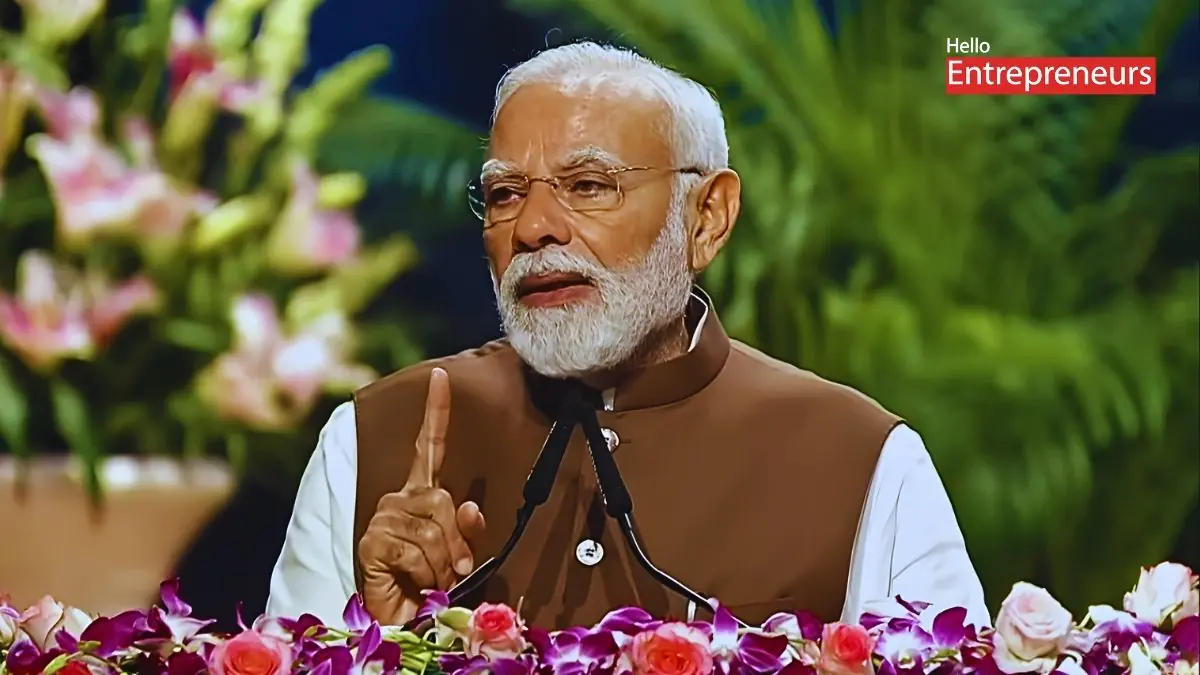
New Delhi: Prime Minister Narendra Modi just dropped a ₹35,440-crore truth bomb on the agriculture sector, two mega schemes aimed at making Indian farmers not just self-reliant, but unstoppable.
A New Era of Farm Power
The air at the Indian Agricultural Research Institute crackled with the energy of transformation. Prime Minister Narendra Modi unveiled two headline-grabbing schemes, the PM Dhan Dhaanya Krishi Yojana and the Dalhan Atmanirbharata Mission, carrying a combined outlay of ₹35,440 crore.
The mission? Simple, audacious, and long overdue: make Indian agriculture future-proof, tech-powered, and globally competitive.
The PM made it clear, this wasn’t another “policy for the files.” It’s a structural reset. “From seed to market, we’ve reformed everything,” he said. And he wasn’t exaggerating.
Breaking the Cycle of Neglect
For decades, Indian agriculture was treated like the middle child of the economy, needed but ignored. PM Modi’s address cut through that history like a laser: “Earlier governments neglected farmers. We broke that apathy in 2014.”
Since then, the numbers have told a different story:
- Foodgrain production: Up by 90 million metric tonnes.
- Fruit and vegetable output: Up 64 million metric tonnes.
- Milk: India now leads the world.
- Fish: We’re No. 2 globally.
- Honey and egg production have both doubled since 2014.
That’s not luck. That’s investment. Six new fertilizer plants, 25 crore soil health cards, and 100 lakh hectares under micro-irrigation, all point to a clear strategy: modernize, mechanize, and monetize Indian farming.
अपने किसान, पशुपालक और मछुआरा भाई-बहनों के कल्याण के लिए हम दिन-रात मेहनत कर रहे हैं। इसी दिशा में आज दिल्ली से हजारों करोड़ रुपये की परियोजनाओं का उद्घाटन-शिलान्यास मेरे लिए गर्व का क्षण है।
https://t.co/NZUWauzwYa— Narendra Modi (@narendramodi) October 11, 2025
The Heart of It: PM Dhan Dhaanya Krishi Yojana
Let’s talk about the ₹24,000-crore centerpiece, the PM Dhan Dhaanya Krishi Yojana.
This isn’t your usual subsidy parade. It’s a high-performance framework modeled after the government’s own “Aspirational Districts Programme.”
Here’s the blueprint:
- 100 districts selected on three data-backed parameters: agri output per land unit, crop intensity, and institutional credit access.
- 36 government schemes will converge here, from natural farming missions to irrigation drives.
- Each district gets flexibility to design its own plan, led by local collectors.
Think of it as decentralization with purpose. Instead of “one-size-fits-all” agriculture, India gets 100 custom-built growth engines.
As the PM put it, “We’re bringing 36 schemes under one roof, from ‘Per Drop More Crop’ to livestock health campaigns. This is convergence in action.”
It’s like assembling the Avengers of agri policy; everyone plays their part, but now they’re finally on the same team.
Dalhan Atmanirbharata Mission: Protein for Progress
The second big play, the Dalhan Atmanirbharata Mission, comes with an outlay of ₹11,440 crore. The target? Increase pulse cultivation by 35 lakh hectares and empower two crore pulse farmers.
This isn’t just about growing more tur, urad, and masoor. It’s about powering India’s nutritional security.
“Rice and wheat can fill stomachs,” PM Modi said. “But pulses build strength.” For a country where protein deficiency often hides behind full plates, this mission hits the mark.
The strategy is end-to-end: expand cultivation, streamline procurement, and build a strong processing network. That’s how you turn a nutrition gap into an export opportunity.
From Fields to Markets: Farmers as CEOs
PM Modi’s version of the Indian farmer isn’t the old-school ploughman. It’s the entrepreneur in the field, backed by FPOs, drones, and digital data.
Over 10,000 Farmer Producer Organizations have been set up, creating a collaborative model where farmers scale up, market smartly, and earn better. Add to that the Namo Drone Didis, rural women using drones to spray fertilizers and pesticides, and you’ve got the perfect blend of empowerment and innovation.
When you put tech in the hands of women who already run India’s villages, you don’t just change agriculture. You change society.
The Economic Backbone of Rural India
The PM wasn’t just rolling out schemes; he was making a statement. Agriculture isn’t charity. It’s a strategy. Over 11 years, the agriculture budget has grown sixfold, and it’s paying off where it matters most, small and marginal farmers.
Fertilizer subsidies are keeping input costs low. Micro-irrigation, natural farming, and renewable energy tools are making sustainability profitable. And under the new GST reforms, even tractors and sprinklers are cheaper, a win-win for both farmers and the economy.
Women Leading the Charge
This revolution wears a saree and carries a drone remote.
From Lakhpati Didis building local enterprises to Krishi Sakhis training farmers in natural methods, women are quietly leading India’s agri renaissance.
- 17,000+ clusters are working on natural farming.
- 70,000 Krishi Sakhis are mentoring farmers.
- And three crore women are on track to become “Lakhpati Didis.”
That’s not empowerment talk. That’s impact metrics.
From Self-Reliance to Global Ambition
PM Modi’s closing message hit a global note hard: “We must not just produce for ourselves. We must produce for the world.” The PM Dhan Dhaanya Krishi Yojana and Dalhan Atmanirbharata Mission are not the endgame; they’re the launchpad.
If India can become the world’s IT powerhouse, why not the global agri engine? The playbook is clear: data-driven planning, decentralized execution, and women-led innovation.
Also Read: India Employment Growth Surges – 17 Crore Jobs In 6 Years

