



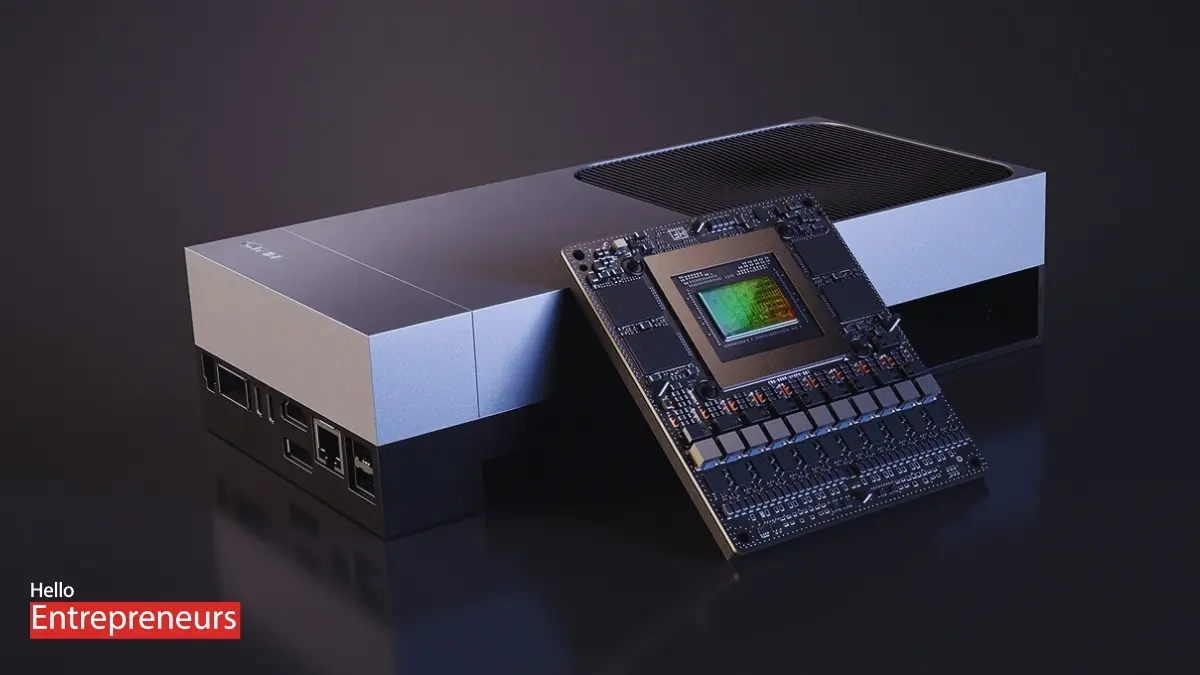
Mumbai: Humanoid robots just got a new brain. And yes, it comes from Nvidia, the chipmaker that’s been eating the AI world alive.
The company unveiled Jetson Thor, a high-powered AI module built to run humanoid robots and self-driving cars in real time. Nvidia claims it’s faster, leaner, and much smarter than its predecessor.
What’s Inside This “Robot Brain”
Jetson Thor runs on Nvidia’s latest Blackwell GPUs, with seven times the AI compute power of Jetson Orin. Memory has doubled. Efficiency has tripled.
Translation: Robots can now process more sensor data, see better, and, if Nvidia’s hype holds, make decisions almost as fast as humans.
According to the company, this is the missing piece for machines that need to walk, talk, and react without choking on slow calculations.
“Jetson Thor solves one of the most significant challenges in robotics: enabling robots to have real-time, intelligent interactions with people and the physical world,” Nvidia said in its release.
Early Adopters Are No Small Names
Amazon, Meta, Caterpillar, and Agility Robotics are already testing Jetson Thor. John Deere and OpenAI are eyeing it too. That’s Big Tech, heavy machinery, and AI labs all on the same chip train.
Universities aren’t far behind. Stanford, Carnegie Mellon, and the University of Zurich are experimenting with Jetson Thor for autonomous robots in labs and medical research.
For developers, the Jetson AGX Thor kit is up on Nvidia’s site at $3,499. The kit includes the T5000 module, carrier board, power supply, and a fan-cooled heatsink.
Self-Driving Gets Its Version
Not just humanoids, cars get the Thor brain too. Nvidia’s Drive AGX Thor kit, designed for autonomous vehicles, is up for pre-order now with deliveries slated for September.
That puts Nvidia squarely into the driver’s seat of the AV (autonomous vehicle) race, a space every automaker is desperate to crack, from Tesla to Toyota.
Nvidia’s Bigger Bet: Robots Everywhere
CEO Jensen Huang isn’t shy about it. In his own words:
“This is going to be the decade of AV, robotics, autonomous machines,” he stated.
At a shareholder meeting, Huang doubled down, robotics and AI combined could be a “multitrillion-dollar growth opportunity” for the company.
It’s not just chips. Earlier this year, Nvidia rolled out Cosmos, a set of AI models that can help train humanoid robots. It’s a one-two punch: hardware + software.
Meanwhile, The World Stage Is Heating Up
China just hosted its first World Humanoid Robot Games, a kind of Olympics for robots. Machines sprinted 1,500 meters in seconds, sorted medicine, and even took food orders. Sounds futuristic, until you realize some robots still tripped, froze mid-race, or even ploughed into bystanders.
In short, the tech is flashy but still far from mass adoption.
Big Week, Big Timing
Nvidia dropped the Jetson Thor news just before its Q2 earnings report. Investors are jittery. Why?
- Nvidia crossed a jaw-dropping $4 trillion market value last month, the first public company to do so.
- Its China business is on a policy rollercoaster thanks to U.S.-China chip wars.
- A new MIT study says less than 1 in 10 AI pilot projects turn into real money.
That leaves Nvidia with a point to prove: is Thor a true leap forward, or another shiny chip feeding AI hype?
India Angle: Don’t Ignore It
India isn’t in the humanoid robot Olympics yet. But don’t be surprised if our IT giants, Infosys, TCS, even startups in Bengaluru, start sniffing around Jetson Thor for automation in factories, logistics, or healthcare. Robots sorting meds in Zurich? That’s a market screaming for Indian hospitals too. And let’s be real: if Nvidia wants scale, it can’t ignore the “factory of the world.” That includes India, not just China.