
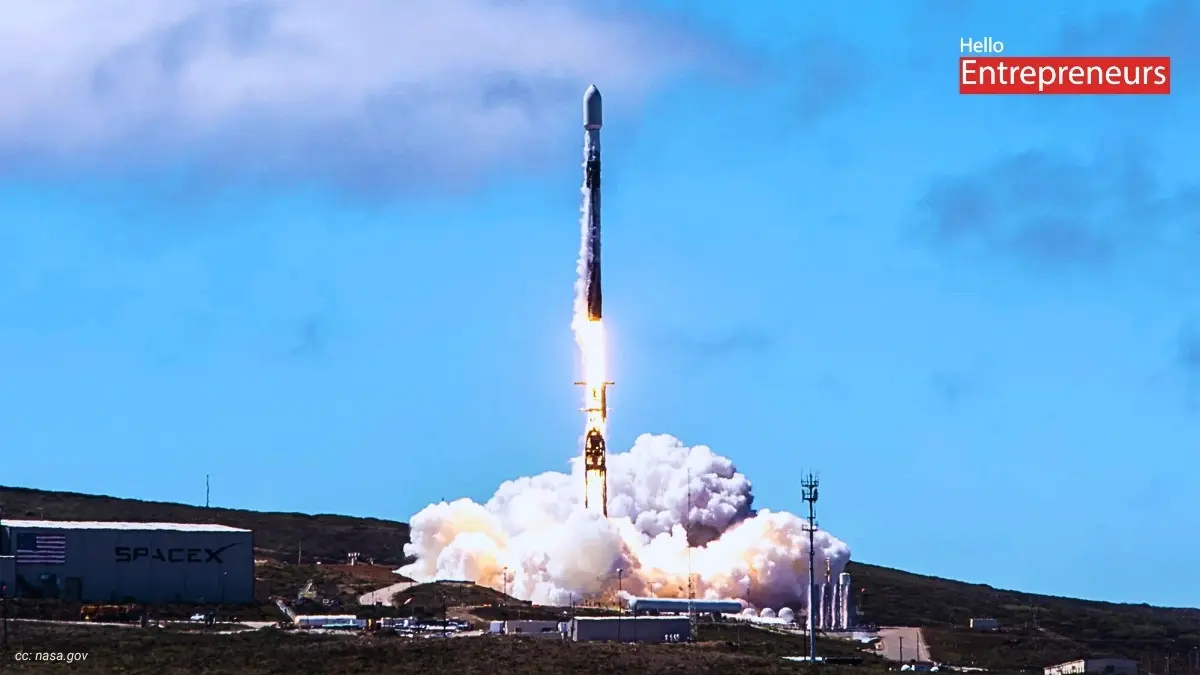








California: If space had a crime scene, Earth’s magnetic field would be the chalk outline. And NASA? It just launched two forensic investigators skyward to uncover how the chaos of the cosmos reshapes our planet’s invisible armor.
Enter TRACERS, not the sci-fi kind, but real-deal twin satellites named for their mission: Tandem Reconnection and Cusp Electrodynamics Reconnaissance Satellites.
At precisely 2:13 p.m. EDT on Wednesday, the two climbed aboard a SpaceX Falcon 9 and departed California for the polar cusp, an area close to the North Pole where turbulence occurs and the Earth’s magnetic field is disrupted by the Sun.
“The TRACERS satellites will move us forward in decoding space weather and further our understanding of the connection between Earth and the Sun,” said acting NASA Administrator Sean Duffy. “This mission will yield breakthroughs that will advance our pursuit of the Moon, and subsequently, Mars.”
Twin Trouble in Space (In a Good Way)
These satellites aren’t just up there to look pretty. They’ll trail each other, at a blink-and-you-miss-it 10-second gap, as they orbit Earth. The goal? To watch, record, and decode thousands of magnetic reconnection events: explosive, energetic moments when the Sun’s magnetic field, via the ever-blowing solar wind, slams into Earth’s own.
The result of this cosmic clash? Magnetic lines snap, realign, and hurl charged particles Earthward at jaw-dropping speeds. It’s like watching nature’s version of breaking and entering, and TRACERS is here to get it all on record, 3,000 times in the first year alone.
“TRACERS is set to transform our understanding of Earth’s magnetosphere,” said David Miles, principal investigator at the University of Iowa. “We’re excited to explore the dynamic processes driving space weather.”
A Celestial Shield Worth Understanding
Earth’s magnetic field is undetectable to the untrained eye, but it is vital to electrical networks, satellites, and astronauts. High-energy particles that might normally destroy electronics and interfere with GPS are repelled by this protective bubble.
But this shield isn’t bulletproof. It buckles at the poles, especially in the polar cusp, where TRACERS is headed, letting in just enough of the Sun’s wrath to create auroras and occasionally cause technical headaches back on Earth.
NASA’s top heliophysics official, Joe Westlake, put it plainly:
“By adding TRACERS to our fleet, we’re not just expanding science, we’re improving the security of life and technology on Earth.”
A Rideshare with a Purpose: Athena EPIC, PExT, and REAL
NASA knows how to carpool in style. Alongside TRACERS, the Falcon 9 rocket also deployed three smaller missions that may be mini in size but major in impact:
- Athena EPIC: Think of it as the Ikea of satellites, modular, affordable, and efficient. This SmallSat will show off NASA’s new plug-and-play design ethos and spend a year measuring Earth’s outgoing radiation, a key metric in understanding climate change.
- PExT: The polyglot of the payload. This tech demo will test whether a single satellite can fluently switch between government and commercial communication networks. It’s the first space mission to test this kind of interoperability, paving the way for smarter, more resilient spacecraft.
- REAL: A CubeSat with a serious mission, to track how dangerous electrons escape the Van Allen belts and dive toward Earth. The data could help design future missions that dodge the deadliest radiation zones in space.
A Powerhouse Collaboration of Brains and Orbits
TRACERS is spearheaded by the University of Iowa (home of some of NASA’s finest space weather minds), with instruments built by UCLA, UC Berkeley, and Southwest Research Institute. Mission ops? The decisions are being made by NASA’s Goddard Space Flight Center, which is part of the Heliophysics Explorers Program.
Regarding the other satellites, NOAA, the U.S. Space Force, and commercial partner NovaWurks collaborated to construct Athena EPIC. PExT rides on the innovation of NASA’s SCaN program and Johns Hopkins Applied Physics Lab, while REAL is helmed by Dartmouth College with a dream team of academic collaborators.
All four missions launched under NASA’s Venture-class Acquisition of Dedicated and Rideshare (VADR) program, think Uber Pool, but for satellites.
From the Sun to Silicon Valley: Why TRACERS Matters
In reality, magnetic reconnection is a basic component of solar-terrestrial physics, despite the fact that it can appear to be the invention of a comic book villain. Understanding how solar radiation penetrates Earth’s defenses is important and goes beyond academics. It safeguards satellites, prevents electricity systems from going awry during geomagnetic storms, and ensures astronaut safety.
As famed physicist Richard Feynman once noted, “It is important to realize that in physics today, we have no knowledge of what energy is.” But thanks to missions like TRACERS, we’re getting a whole lot closer.
So, the next time your GPS is spot-on or your satellite TV doesn’t blink during a solar flare, thank the invisible forcefield around Earth, and the twin TRACERS now out there, decoding how it holds strong.
Also Read: Elon Musk in July 2025: Tesla, xAI, America Party, and Chaos