



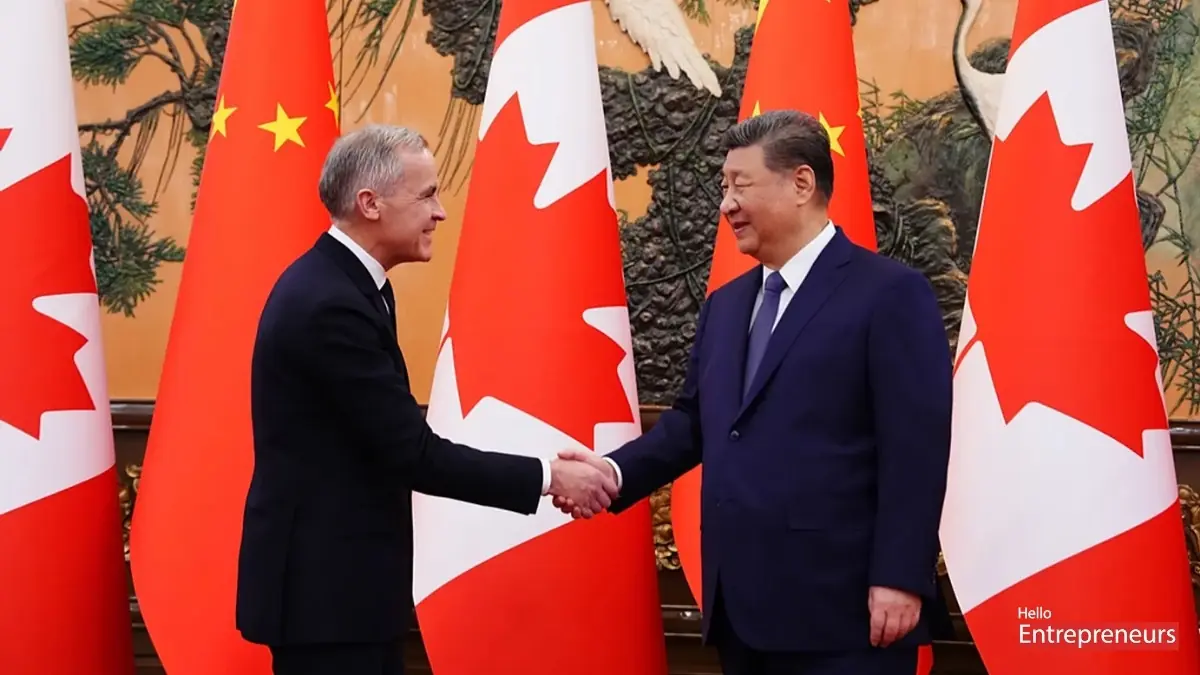
New Delhi: The Mark Carney Xi Jinping meeting landed softly but carried weight. This was the first visit by a Canadian prime minister to Beijing in almost a decade. That absence wasn’t accidental. It reflected years of frozen trust, quiet retaliation, and unfinished arguments.
Inside the Great Hall of the People, Carney chose his words with care. Canada and China, he said, should shape a relationship “adapted to new global realities.” No romance. No nostalgia. Just a blunt acknowledgement that the world has shifted and Canada intends to move with it.
Xi Jinping responded in kind. He spoke of building “a new type of China-Canada strategic partnership,” one that benefits both peoples and supports global peace. Diplomatic phrasing, yes, but the subtext was unmistakable. Beijing is open. Right now.
Timing explains everything.
Donald Trump’s return to hard-edged, unpredictable policymaking has rattled allies. Canada, perhaps more than most, feels exposed. The US remains its dominant trade partner, but dominance cuts both ways. Dependence limits room to manoeuvre.
Carney’s answer is diversification. Ottawa wants to double exports to non-US markets over the next ten years. That goal turns heads. It also narrows choices. China, for all the risk and friction, is simply too large to ignore.
For Beijing, the calculus is colder. Trump’s erratic posture has created openings. Canada is a Nato member, a close US partner, and a G7 economy. Even marginally warming ties with Ottawa nudges the global balance.
So yes, both leaders arrived with motives. That’s diplomacy. Not a flaw.
The past never stayed outside the room.
Relations collapsed in 2018 when China detained two Canadians after Canada arrested Huawei executive Meng Wanzhou on a US extradition request. The message from Beijing back then was sharp. Actions have consequences.
The chill that followed was deep. Trade stalled. Political dialogue dried up. Trust, already thin, tore completely.
This visit doesn’t erase that history. It acknowledges it, then steps around it.
This wasn’t a sudden pivot.
In June, Carney and Chinese premier Li Qiang agreed to regularise communication. In October, Carney met Xi on the sidelines of an ASEAN summit. Each move was cautious. Almost rehearsed.
This week made it official.
Chinese officials didn’t hide their enthusiasm. State media called the visit “pivotal and symbolic.” Foreign minister Wang Yi spoke of trust, cooperation, and eliminating interference. The language was polished. The intent was clear.
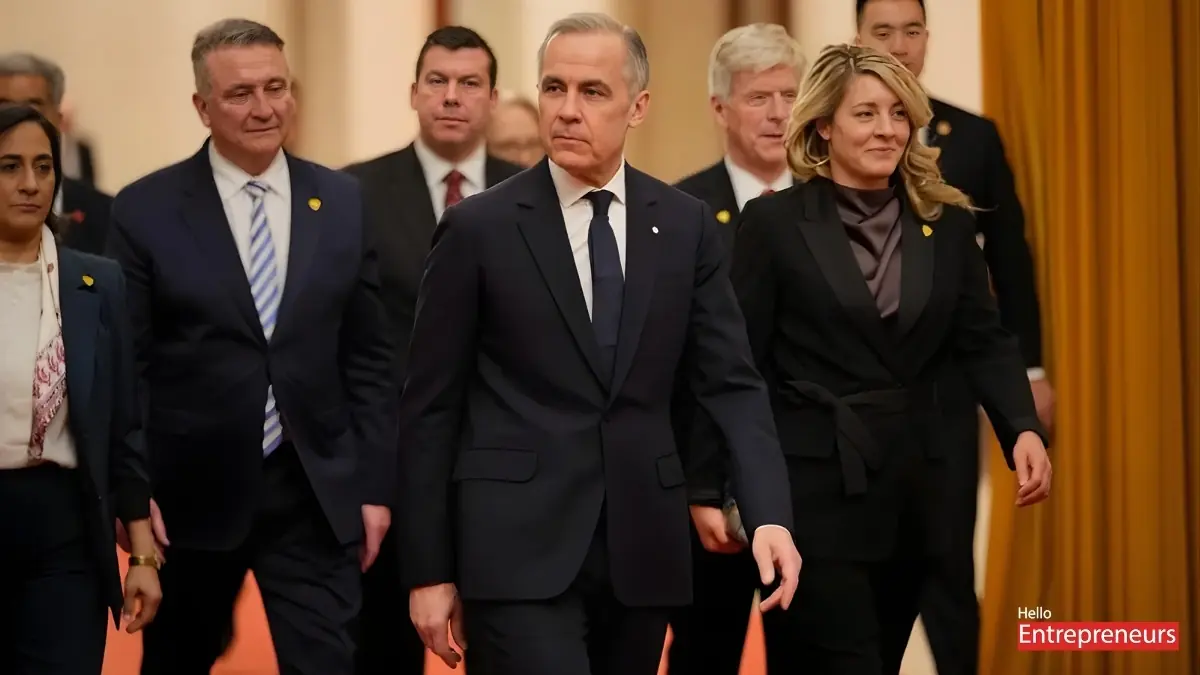
Carney also met Li again and Zhao Leji, head of China’s National People’s Congress. Afterwards, he pointed to alignment in clean energy, agriculture, and finance. Areas where friction is manageable and upside obvious.
That message wasn’t just for Beijing. It was aimed squarely at Canadian voters and exporters watching closely.
Carney arrived carrying domestic baggage.
Canola farmers. Lobster exporters. Fishermen. All have felt the bite of Chinese tariffs imposed last year. They want relief, not theory. Every handshake in Beijing carried that expectation.
At the same time, Canada hasn’t exactly been accommodating. Since October 2024, Ottawa has imposed tariffs on Chinese electric vehicles and steel, shut TikTok’s Canadian offices, and banned Hikvision surveillance cameras.
This is not capitulation. It’s calibration.
For all the diplomatic smiles, distrust remains.
Canada’s security agencies accuse China of election interference, intimidation of members of the Chinese diaspora, particularly Hong Kong activists, and rank it as the country’s top cyber threat. Those assessments haven’t softened.
Neither side pretended otherwise. The reset is narrow by design.
One area of comfort was global governance.
Xi spoke about cooperation through the United Nations, the G20, and APEC. Canada is comfortable there. Multilateral frameworks dilute pressure and slow escalation. They also fit Ottawa’s self-image as a rules-first middle power.
Canada’s Indo-Pacific strategy captures the contradiction neatly. China is called disruptive. Its economy, however, remains full of opportunity. Both statements are true. Carney is betting they can coexist.
Chinese academics are realistic.
Zhao Minghao of Fudan University described the moment plainly. Many US allies, he said, are de-risking from the US. That creates space for China to improve ties.
Improve, not dominate. Even Beijing knows Canada won’t flip sides. But warming matters. It chips away at isolation.
Mark Carney Meets Xi Jinping – From India, this story feels familiar.
India has spent years balancing engagement with competition, cooperation with caution. It trades with China, argues with China, and prepares for China, all at once.
Canada is learning the same lesson, later but quickly. Dependence is fragile. Optionality is strength. The Mark Carney Xi Jinping meeting wasn’t a breakthrough. It was something subtler and more durable. Canada is signalling it won’t outsource its future to a single capital. Not Washington. Not Beijing. Anyone.
This is diplomacy without illusions. Engagement without surrender. And yes, friction without paralysis. In today’s fractured order, that might be the most realistic strategy available.

