



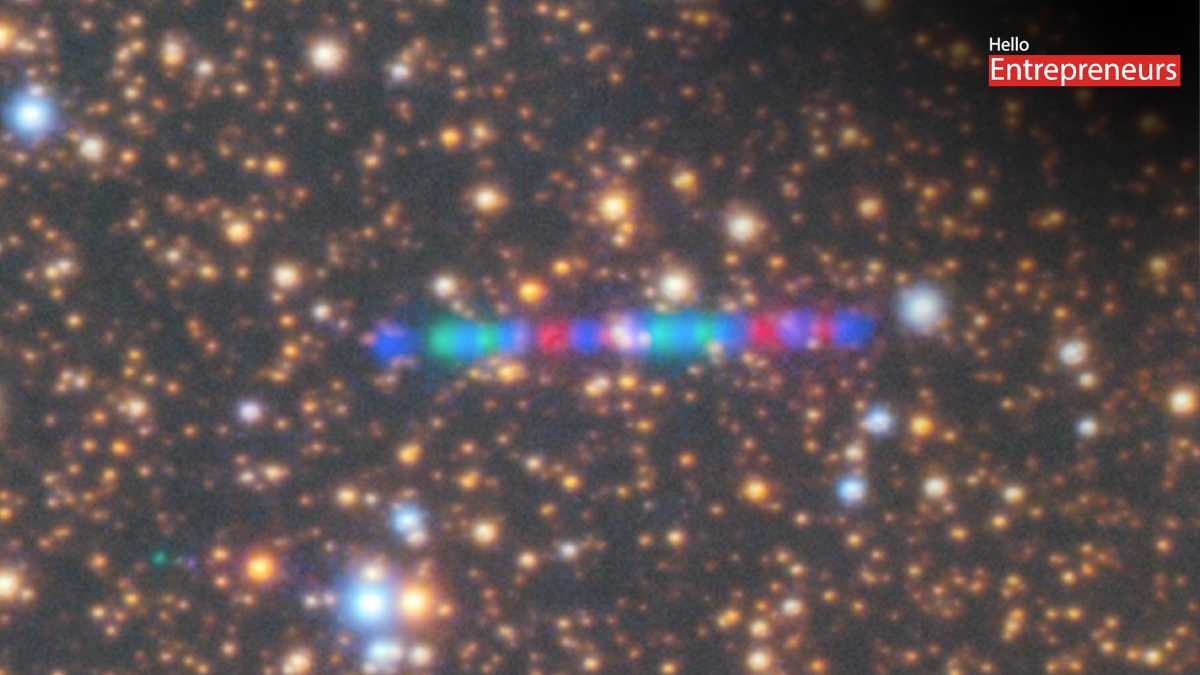
An interstellar comet passing through our solar system has been found to contain far more carbon dioxide than typical comets from our own cosmic neighborhood, giving astronomers a rare glimpse into the chemistry of a distant star system.
The object, designated 3I/ATLAS, is only the third interstellar visitor ever detected. Observations from NASA’s James Webb Space Telescope (JWST) and other major observatories confirm that it releases significantly more carbon dioxide relative to water than comets born around the Sun, marking it as a chemical outsider.
A Chemical Outsider
Webb’s spectroscopic data revealed that 3I/ATLAS’s gas emissions are dominated by carbon dioxide, a composition unlike anything seen in solar system comets. The telescope also made the first direct detection of methane on an interstellar visitor, a molecule scientists believe was trapped beneath the surface and released only after solar heating penetrated deeper icy layers.
Cyrielle Opitom, an astronomer at the University of Edinburgh who co-led observations using the Very Large Telescope (VLT) in Chile, described unexpected findings during her team’s analysis. “Rather than seeing a lot of cyanogen, what I was seeing was a line of nickel,” she said, noting unusually high levels of metals in the comet’s gas atmosphere.
Earlier Webb measurements also detected exceptionally high levels of deuterium — a heavy isotope of hydrogen — at concentrations roughly 30 times greater than those found in solar system comets. This isotopic signature further underscores the comet’s alien origins and suggests it formed under very different conditions than objects in our own planetary system.
Clues From the Cold
A separate study published September 8 in the Monthly Notices of the Royal Astronomical Society adds fresh details about where this ancient traveler may have formed. Led by Dr. Lea Ferellec of Northumbria University, the research used the WEAVE instrument on the William Herschel Telescope to analyze ionized gas streaming from the comet’s tail.
The team identified five different types of ions and determined that 3I/ATLAS likely formed at temperatures below −240°C. Such extreme cold suggests the comet originated at the frigid outer edge of a distant star system, in a region analogous to our solar system’s Oort Cloud.
“This object gives us a rare chance to study material that formed somewhere completely different from our own solar system,” Ferellec said.
Opitom’s own work, combining data from the VLT, Webb, and the Atacama Large Millimeter/submillimeter Array (ALMA), pointed to a complementary conclusion: the comet likely formed around a star older than our Sun, one with lower metallicity, in a distant region of the Galaxy where older stellar populations reside.
More Visitors Ahead
Discovered in July 2025 by the ATLAS survey telescope in Chile, 3I/ATLAS was observed from July 2025 through March 2026 before fading from view as it moved back into interstellar space. While this particular visitor has now departed, astronomers expect many more to follow.
Opitom noted that the Vera C. Rubin Observatory’s Legacy Survey of Space and Time (LSST), now officially underway, could detect roughly one interstellar object per year. This would mark a shift from studying these visitors one at a time to examining them as a population, enabling statistical comparisons of their compositions and origins.
“I can’t wait to see what the next interstellar object will teach us,” Opitom said.
Why It Matters
The unusual chemistry of 3I/ATLAS provides direct evidence that planetary systems beyond our own can produce comets with compositions radically different from those in our solar system. The high carbon dioxide and deuterium levels, combined with traces of nickel and methane, suggest formation in a cold, metal-poor environment around an ancient star.
Such findings help astronomers refine models of how planetary systems form and evolve, and how common Earth-like conditions might be across the Galaxy. As more interstellar objects are discovered and characterized, scientists will be able to build a clearer picture of the diversity of planetary chemistry in our cosmic neighborhood.
For now, 3I/ATLAS stands as a messenger from another world — a frozen relic carrying the chemical fingerprints of a distant star, now within reach of human instruments for the first time.

