



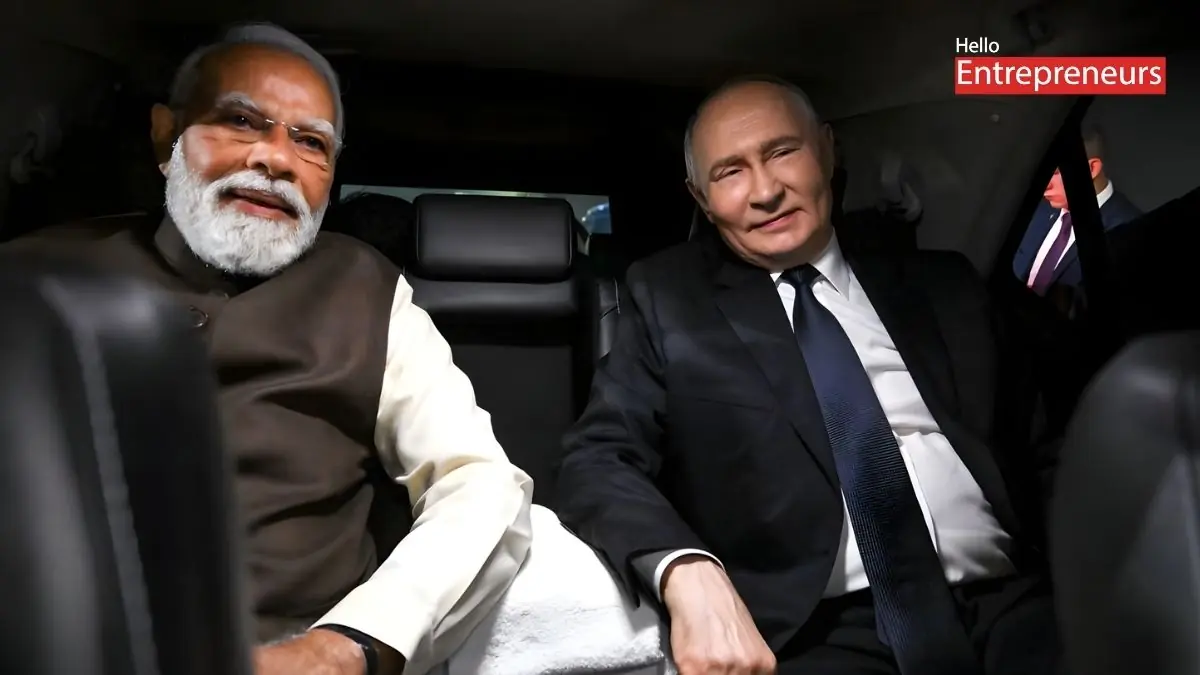
Mumbai: Some relationships age poorly. India Russia somehow age like fine wine. The 23rd Annual Summit in New Delhi didn’t just underline that fact. It supercharged it. What landed on the table this year is a sprawling, high-stakes, unapologetically strategic roadmap stretching from trade to tech and from the Arctic to outer space.
A Partnership That Doesn’t Flinch
Say what you want about global realignments, but the India Russia strategic partnership isn’t wobly. Twenty-five years since the original Declaration on Strategic Partnership, both sides continue to treat it like prime geopolitical real estate. With Vladimir Putin flying into New Delhi in December 2025 for the 23rd Annual Summit, the signal was clear: the relationship is mature, still relevant, and built on that rare commodity in international politics, trust.
Both leaders didn’t mince words. They called the partnership “special,” “privileged,” “time-tested,” and yes, still an anchor of global peace and stability. In diplomat-speak, that’s basically saying: we know the world is messy, but we’re not letting this equation drift.
They also acknowledged a reality that most capitals privately admit but rarely state publicly: India Russia ties have stayed resilient despite an “uncertain geopolitical situation.”
Translation: The world is busy picking sides. India and Russia continue picking strategy.
Across 2024–25, the sheer frequency of high-level engagement proves the point. From meetings on the sidelines of the 16th BRICS Summit in Kazan and 25th SCO Summit in Tianjin, to the 26th IRIGC-TEC and 22nd IRIGC-M&MTC sessions, ministers, speakers, deputies and national security teams have all been on the move. If diplomacy had an attendance sheet, this partnership would be topping the class.
And with India opening new consulates in Yekaterinburg and Kazan, the inter-regional track, often overlooked, now has fresh legs.
Trade & Tech: The Push Toward USD 100 Billion
Let’s get to the money. Both sides want bilateral trade to hit USD 100 billion by 2030. Tall order? Sure. Impossible? Not really. Especially since Russia has become one of India’s largest energy partners, and India wants to crank up its exports to balance the equation.
Programme 2030, the new roadmap for economic cooperation, is now the formal engine driving this ambition. It’s built on trade facilitation, industrial partnerships, tech collaborations, and fresh investment mechanisms.
Negotiations on the India–Eurasian Economic Union Free Trade Agreement have picked up speed. If it lands, Indian exporters (especially manufacturers) will get a larger, more predictable market. Both sides also want an upgraded investment protection agreement. Again, long overdue.
There’s a laundry list of trade friction points they want to fix: logistics bottlenecks, insurance and reinsurance hurdles, payment settlements, currency volatility, and customs unpredictability. For once, both sides agreed the fixes should be fast. The emphasis on national currency settlement and interoperability of payment systems is particularly telling; the world is moving toward fragmentation, and India and Russia want buffers.
From fertilizers to diamonds to critical minerals, resource trade continues to be a backbone of the relationship. Russia’s mineral and energy heft combines neatly with India’s market needs and manufacturing push. And both countries know it.
Energy: The Steel Beam of the Relationship
If there’s one sector where cooperation is not just deep but indispensable, it is energy. Oil, gas, petrochemicals, LNG, LPG, underground coal gasification, the works.
The summit reinforced a simple truth: Indian companies and Russian companies work well together when energy is on the table. The problem, usually, is red tape or unresolved investment wrinkles. Both leaders publicly committed to ironing those out. In energy speak, that’s a big deal.
Indian refiners have benefited enormously from sourcing energy from Russia, and there’s a recognition that long-term supply security is mutually beneficial. On top of that, both sides have fresh interest in upstream technologies, petrochemical integration, and infrastructure upgrades.
And then there is nuclear energy, more on that in a moment, which continues to be the most strategic layer of all.
Connectivity: Corridors That Redraw Maps
India Russia connectivity is no longer a “future idea.” It’s becoming a real, hard-edged logistical alternative. The International North-South Transport Corridor (INSTC), the Chennai–Vladivostok maritime route, and cooperation on the Northern Sea Route form a triad that can shift regional trade flows.
Put simply, these corridors are India’s way of hedging against chokepoints and overdependence on Western supply lanes. For Russia, they provide access to warm-water markets and reduce its reliance on European corridors.
With new MoUs on training polar navigation specialists and ongoing work between railway authorities, this connectivity push is no longer theoretical engineering. It’s operational.
Russian Far East & Arctic: India Steps Up
India’s interest in the Russian Far East isn’t new, but this summit sharpened it. There’s already a 2024–2029 cooperation programme covering agriculture, energy, manpower, diamonds, mining, and pharma. The message now is: accelerate.
India is doubling down on its Arctic presence too. As an Observer on the Arctic Council, it wants more research, more scientific access, and more commercial footholds. Russia, for its part, wants reliable partners in developing the Northern Sea Route. It’s a natural fit.
New Delhi’s participation in the 6th International Arctic Forum in Murmansk earlier this year wasn’t symbolic. It’s part of a long game.
Nuclear & Space: The Big-Ticket Domains
Here’s where the partnership enters the elite tech tier.
Nuclear
Kudankulam Nuclear Power Plant (KKNPP) remains the flagship, and both sides reaffirmed timelines for equipment and fuel supplies. But the bigger headline is this: India wants nuclear capacity at 100 GW by 2047. For that, it needs partnerships that deliver. Russia remains one of the few countries that can.
There’s progress on additional units at Kudankulam, discussions on a second site, and deeper collaboration on VVER reactors. Even more interesting is the push for localization of equipment and fuel assemblies, potentially transforming India into a nuclear manufacturing hub for Russian-design reactors.
Space
ISRO and Roscosmos have quietly been some of the most efficient partners over decades. Now they’re expanding into human spaceflight, navigation, rocket engine development, and planetary exploration.
Look, cooperation in space is never “just cooperation.” It’s strategic signalling. And this partnership is clearly levelling up.
Defence: A Reset Toward Co-Development
India Russia defence ties have usually revolved around procurement. That era is fading, by design. India’s goal is self-reliance. Russia’s goal is to retain relevance in India’s defence ecosystem. The new model is co-development, co-production, joint R&D, and manufacturing in India.
The IRIGC-M&MTC session in December 2025 confirmed this direction. Both sides want Indian factories to produce spare parts, components, sub-systems, and eventually export them to “mutually friendly” countries. That phrase is doing a lot of diplomatic heavy lifting.
Military exercises INDRA will continue, and delegation-level exchanges will intensify. Defence ministers met in Qingdao earlier this year and reaffirmed the same tone: partnership must evolve, not stagnate.
Science, Tech, and the Race for Critical Minerals
The summit almost reads like a technology manifesto. Critical minerals. Rare earth processing. Recycling. Emerging tech. Digital security. Critical infrastructure resilience.
Both sides want joint R&D pipelines, SME and startup collaboration, academic mobility, and tech co-development. There’s even a push to create soft support programs for innovators, a fancy way of saying: let’s make it easier for smart people to build cool things together.
India and Russia also want deeper cooperation on information protection and law enforcement digital frameworks. In a world where cyber threats are the new frontline, this isn’t optional.
Culture, Tourism & People: Soft Power That Still Works
Despite the heavy geopolitical layers, India Russia cultural ties remain easy, warm, and genuinely popular among people who grew up in the decades of Dangal-era Hindi-dubbed Russian cartoons or Moscow’s love for Indian cinema.
The summit pushes fresh cultural festivals, more film collaboration, joint productions, and participation in international book fairs, art festivals, and craft exhibitions. There’s even a dedicated exhibition agreement titled “India. Fabric of Time.”
Tourism is up, and with both sides introducing e-Visas, including 30-day gratis e-tourist visas for Russians, this will only grow. Student exchanges and academic partnerships also continue to strengthen. The people-to-people layer is still one of the most underrated strengths of this relationship.
Multilateral Alignment: BRICS, SCO, G20
This is the geopolitical core. India and Russia view global governance through similar lenses: reform the UN Security Council, boost voices of the Global South, keep multilateralism alive, and prevent the world from tilting into bloc politics.
Russia reiterated support for India’s UNSC permanent seat, consistent, unambiguous. Both sides praised India’s G20 presidency and the entry of the African Union as a permanent member. BRICS, now expanded, remains a strategic platform, with India set to chair it in 2026.
Within the SCO, both countries want modernization, especially on counterterrorism, information security, and anti-drug cooperation. The upcoming SCO Civilizational Dialogue Forum in 2026 (an Indian initiative) got a special mention. Again, quiet leadership.
Counterterrorism: A Hard, Clear Line
Both sides condemned the Pahalgam terror attack (April 2025) and the Crocus City Hall attack (March 2024). No ambiguity, no qualifiers.
The joint statement calls for a zero-tolerance policy toward terrorism, faster adoption of the Comprehensive Convention on International Terrorism, and action against all UN-listed groups including ISIS, Al Qaeda and affiliates. Importantly, it stresses the need for eliminating financing networks and rooting out safe havens.
There’s also serious work on countering technology-enabled terrorism, drones, payment platforms, ICT manipulation. The Delhi Declaration from the UNSC CTC meeting (2022) still anchors much of this.
Regional Issues: Afghanistan, the Middle East, and Climate
On Afghanistan, both sides noted coordination through National Security Councils and the Moscow Format. Counterterrorism remains the priority. Humanitarian assistance is a major focus.
In the Middle East, they called for restraint, protection of civilians, and compliance with international law. The humanitarian situation in Gaza was explicitly flagged.
On climate, the partnership is deepening through Article 6 mechanisms of the Paris Agreement, low-carbon technologies, sustainable finance and the BRICS Climate Research Platform.
MoUs & Agreements: The Fine Print That Matters
Here’s a sharp rundown of the summit outcomes, the granular details that often get lost in big-picture coverage:
Migration & Mobility
– Agreement on Temporary Labour Activity
– Agreement on combating irregular migration
Health & Food Safety
– Agreements on healthcare collaboration and food safety systems
Maritime & Arctic
– MoU on training polar-water ship specialists
– MoU between ports and maritime authorities
Fertilizers
– MoU between UralChem and Indian public-sector fertilizer giants
Customs & Commerce
– Protocol on exchange of pre-arrival information
– Bilateral agreement between India Post and Russian Post
Academia
– DIAT Pune & Tomsk State University MoU
– University of Mumbai – Moscow State University – RDIF trilateral cooperation agreement
Media Collaboration
Multiple MoUs between Prasar Bharati and major Russian broadcasters including Gazprom-Media, National Media Group, BIG ASIA, TV-Novosti, and TV BRICS.
Announcements
– Programme 2030 launched
– Russia adopts framework to join the International Big Cat Alliance
– Agreement for “India. Fabric of Time” exhibition
– 30-day gratis e-tourist visa for Russians
– Group tourist visa facility on reciprocal basis
This is a big harvest of agreements, some high-impact, some niche, but all contributing to a thickened relationship.
The Strategic Bottom Line
The India Russia strategic partnership is not coasting. It’s adapting. Rewiring. Upgrading.
From energy corridors to the Arctic, from nuclear localization to digital security, from BRICS expansion to counterterrorism alignment, the partnership is trying to stay ahead of the curve.
In a world tilting toward multipolarity, New Delhi and Moscow continue to bet on strategic continuity with tactical innovation.
And frankly, the world could use more equations that actually deliver stability instead of noise.
Also Read: IndiGo Update: Inside the 1,300-Flight Meltdown Rocking India

