



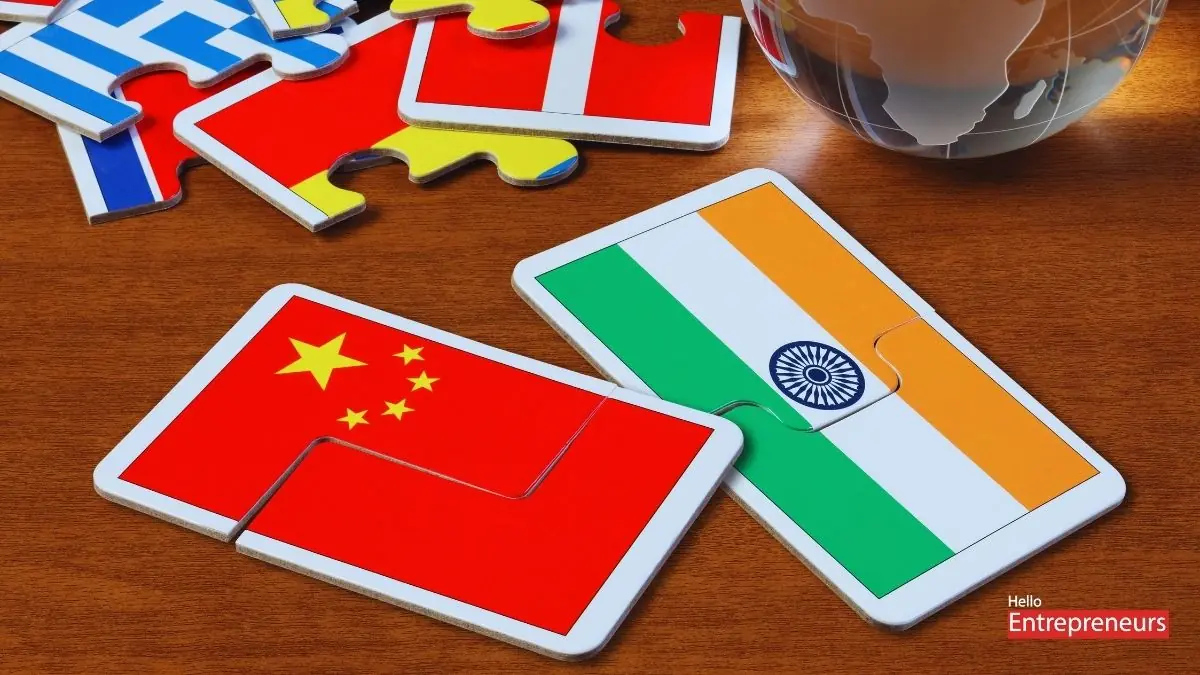
New Delhi: Up in the Himalayas, soldiers still face each other across frozen rock and thin air. Down in India’s industrial belts, machines keep running on Chinese parts. It looks absurd. It isn’t. India-China economic interdependence is not an accident of inertia. It’s a hard-edged experiment in managing rivalry without economic self-harm. Untidy. Risky. And, so far, intact.
The Border Never Really Calmed Down
The October 2025 understanding between Prime Minister Narendra Modi and President Xi Jinping eased pressure at a few friction points along the Line of Actual Control. It did not end the standoff. Anyone expecting demilitarisation hasn’t been paying attention.
Roughly 50,000 to 60,000 troops remain deployed on each side. China has poured concrete into the mountains. Roads that don’t freeze. Sensors that don’t blink. Villages that anchor claims. India answered with upgraded airbases, rail lines clawing toward the frontier, and new forward posts that didn’t exist five years ago.
Galwan rewired the relationship. The border is no longer a background issue. It’s permanent. Loud. Armed.
By textbook logic, this should have poisoned trade. Instead, commerce kept climbing.
The Economic Dependency India Can’t Pretend Away
In 2025, bilateral trade touched about $128 billion. India’s exports barely crossed $14 billion. The gap isn’t subtle.
China supplies around 30 percent of India’s industrial imports. In electronics, machinery, chemicals, textiles, the dependence shoots past 70 percent. Electric vehicles need Chinese battery cells and rare-earth magnets. Solar expansion leans on Chinese polysilicon and wafers. Pharma still relies on Chinese active ingredients. Even Apple’s India push quietly traces back to Chinese components.
Replacing all this isn’t a policy tweak. It’s a generational project. Capital-heavy. Skill-intensive. Slow.
So yes, India’s growth machine still drinks deeply from Chinese supply chains. That’s the uncomfortable core of India-China economic interdependence.
Press Note 3 and the Sudden Chill
India’s mistrust surfaced early in the pandemic. As markets crashed in 2020, the People’s Bank of China nudged its stake in HDFC Bank past one percent. It was legal. It was also a shock.
New Delhi responded with Press Note 3. Any investment from countries sharing a land border now needed government approval. China was the unspoken addressee.
The effect was brutal. Chinese investment slid from roughly $127 million in 2019 to about $3 million by 2025. Big-ticket plans, like BYD’s proposed $1 billion joint venture, evaporated.
Trade surged anyway. Investment didn’t.
Here’s the twist most analyses miss. India had almost no major corporate assets in China. Beijing had little to grab in retaliation. Europe doesn’t have that luxury. Japan doesn’t either. India did.
Structure, not sentiment, changed the game.
How China Pressures and Why It Hesitates
China hasn’t been gentle. Rare earth exports slowed. Fertiliser shipments paused. Tunnel-boring machines were blocked. Foxconn technicians were recalled. EV technology transfers tightened.
Yet electronics components kept flowing, even during the worst border tensions of 2020 and 2021. That wasn’t goodwill. It was self-interest. Cutting those supplies would have hurt Chinese firms tied into global assembly lines running through India.
This selective coercion exposes the asymmetry inside India-China economic interdependence. Beijing can inflict pain. It just can’t do so freely.
That constraint gives India space others don’t have.
Why China Looms So Large in Indian Strategy
Three realities shape New Delhi’s thinking.
First, China is a military threat. The PLA’s posture along the border has shifted the Himalayan balance for good.
Second, China is a strategic rival. During the May 2025 India–Pakistan conflict, Pakistan fielded advanced Chinese systems. Beijing’s diplomatic cover for Islamabad remains a constant irritant.
Third, China is a regional competitor. Its expanding footprint across Sri Lanka, Maldives, Nepal, Bangladesh, Myanmar, and beyond signals long-term rivalry, not a temporary chill.
Against that backdrop, decoupling is fantasy. Blind engagement is dangerous. India’s answer lives in the grey zone.
Compartmentalisation: A Deliberate Split Screen
India’s first move is compartmentalisation. Lock down the border. Don’t lock down the entire economy.
That approach is now visible. Press Note 3 is under review. Electronics firms are pushing for Chinese joint ventures capped at 26 percent. Renewable energy and auto components may allow 20 to 25 percent Chinese stakes without intense scrutiny. Draft cabinet notes suggest up to 49 percent FDI in electronics and capital goods could bypass mandatory screening.
This is happening while soldiers remain dug in at altitude. It feels contradictory. It’s intentional.
Approvals remain selective. In 2025, India received 526 Chinese FDI proposals. About 124 were approved. Over 200 were rejected. The rest are stuck. Electronics and auto manufacturing move faster than other sectors.
The system creaks. It also signals a shift. Blanket bans hurt Indian industry more than they hurt China.
Diversification: Slow, Costly, Unavoidable
The second pillar is diversification. Not decoupling. Diversification.
At home, Production-Linked Incentive schemes aim to build manufacturing depth. Results vary. Semiconductor plans are real but early. Incentives target pharmaceutical ingredients. Critical mineral exploration has begun. A PLI scheme for rare-earth magnets is now live.
Abroad, India is hedging. Semiconductor partnerships with Japan and the US. Battery mineral cooperation with Washington. The Supply Chain Resilience Initiative with Japan and Australia. Lithium and cobalt projects with Australia. Mineral diplomacy across Africa, from Zambia to Côte d’Ivoire.
Some bets will pay off. Others won’t. A July 2025 fertiliser deal with Saudi Arabia, lifting supply to 3.1 million tonnes annually, already cut Chinese leverage. Still, some inputs remain China-only.
This isn’t elegant. It’s incremental.
Who This Model Actually Fits
India’s experience matters most for import-heavy countries with limited corporate exposure in China. Several Southeast Asian economies fit that profile.
Europe doesn’t. Japan doesn’t. South Korea doesn’t. Their firms are too embedded.
The lesson is blunt. The structure of interdependence shapes strategy more than its sheer size. One-way exposure creates options that mutual entanglement kills.
India can confront China militarily while trading economically because retaliation space is uneven. Risk remains. But it’s bounded.
What’s Really at Stake
If China escalates economic coercion, India’s growth takes a hit. If security tensions spill fully into trade and investment, the damage multiplies.
If diversification trims critical dependencies while Chinese inputs remain accessible where they make sense, India validates a model of managed rivalry. Growth without submission. Competition without collapse.
That’s the wager inside India-China economic interdependence.
Conclusion
India’s China policy has shifted in phases. Before 2020, economics and security ran on parallel tracks. After Galwan, border stability became central. Today, New Delhi is testing compartmentalisation and diversification, exploiting an exposure structure that gives it unusual flexibility.
China remains indispensable. But indispensability isn’t destiny. Structure matters. Scale isn’t everything.
India’s approach is messy, tense, and unfinished. It could still fail. But it shows that in a world where full decoupling is neither realistic nor desirable, asymmetric interdependence can still carve out strategic space.
Whether India can hold that space is the question that now echoes far beyond the Himalayas.

