



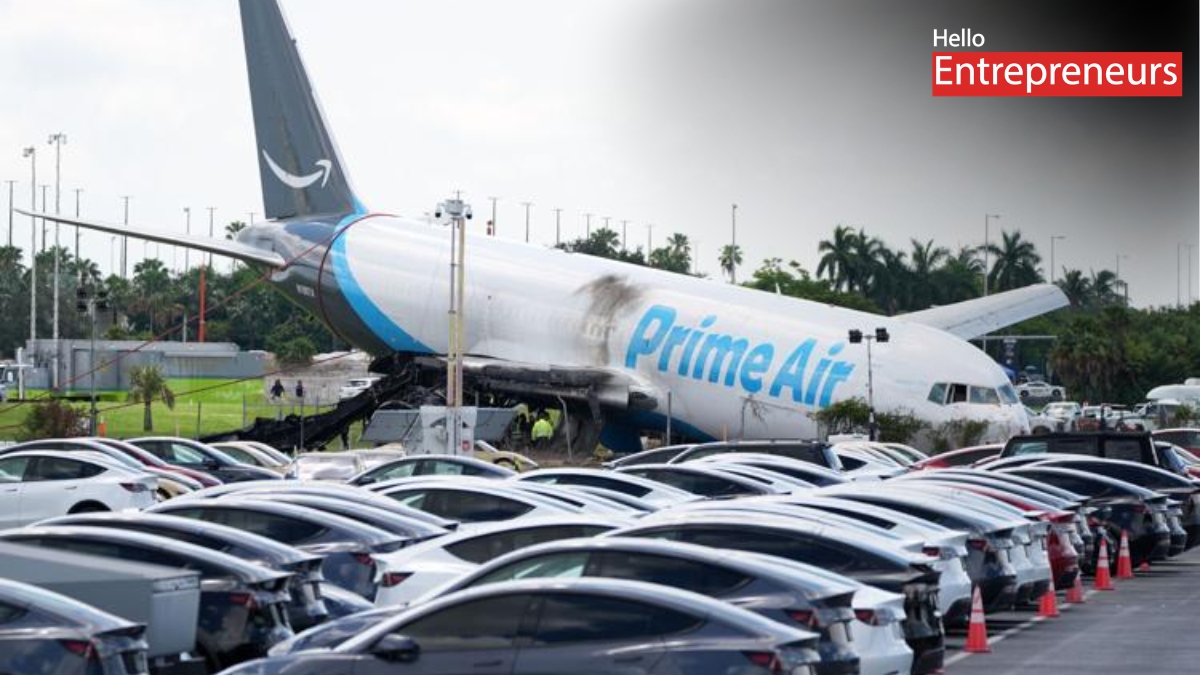
An Amazon Air Boeing 767 cargo plane ran off the runway at Miami International Airport on Sunday afternoon, crashing into vehicles past the airfield and catching fire. Five people died and five more were hurt. All those killed had been riding in a van shuttling a cleaning crew around the airport. Of the injured, two are still in critical condition and another is stable.
The National Transportation Safety Board is now leading an extensive investigation. The incident immediately threw Miami’s airport into chaos, with hundreds of flights delayed or cancelled over the past couple of days.
So what exactly happened? According to the NTSB, the plane was operated by 21 Air LLC for Amazon Prime Air. It landed fast on Runway 30, skidded about 1,300 feet beyond the runway, and smashed into two vehicles: an airport van and a Toyota SUV outside the airport fence.
Preliminary flight data pulled from the black boxes shows the pilots might’ve thought about aborting the landing right after touching down. Roughly 30 seconds before the data cut out, the nose and right main gear touched down at 158 knots (181 mph), then the left gear hit at 134 knots. Moments later, the throttles were pushed forward — like for a go-around — but then pulled back as the pilots went back to braking.
NTSB investigator Chihoon Shin said there’s no sign the pilots deployed speed brakes or thrust reversers to slow the jet down. The plane was still moving at about 65 knots when the data ended. Both pilots made it out alive and are now waiting to speak with investigators.
As for the victims, Miami-Dade officials identified those killed as employees of Professional Ocean Service Corp., the company that handles aircraft cleaning. Five others were rushed to the hospital; three were listed as critical at first, with two still in that condition as of Tuesday.
The crash happened just before 2 p.m. on an overcast day. Fire crews fought the blaze and spent all night recovering victims and tidying up the crash site, which NTSB Chair Jennifer Homendy called “utter devastation.”
Right after the accident, the airport shut down every runway and taxiway. The FAA put a ground stop in place, and the delays started piling up fast. By Sunday night, over 450 flights to and from Miami were either late or cancelled. On Monday, ground delays backed up for over five hours on average — and across the nation, 2,559 delays and 170 cancellations connected back to the Miami crash.
As of Tuesday morning, two out of Miami’s four runways were still shut down while the investigation pressed on. Travelers were told to prepare for more delays. FlightAware reported dozens of cancellations and more than 60 delays at Miami early that day, with disruption rippling out to the rest of the country.
A major focus for the NTSB is why there wasn’t an Engineering Materials Arrestor System (EMAS) — or any type of extended safety area — at the end of Runway 30. ICAO standards say long runways like Miami’s need at least 240 meters of runoff to help soften the blow of an overrun.
Homendy said a 32-person NTSB team would stay at the airport for at least a week. She warned that they won’t know the crash’s probable cause right away. The investigation will dig into everything: the pilots’ decisions, aircraft systems and maintenance, weather, and the airport’s layout. The NTSB plans to share a summary of the cockpit voice recording on Wednesday, after they talk with the pilots.
This crash has fired up another round of debate over runway safety at big US airports, especially the question of whether more runways should get EMAS beds — those special surfaces that crumble under heavy planes and help stop them. Safety advocates will likely push hard for more protections, especially at busy airports where there’s not much overrun space.
For now, anyone flying through Miami needs to double-check their flight times and be ready for slowdowns. With a major investigation still underway and runways closed, Miami’s busy airport isn’t getting back to normal just yet.

