




New Delhi: In the sticky late-summer heat of Indiana, a few dozen people gathered around a barren field to watch what looked, at first glance, like a simple military demonstration. A pickup truck rolled out with a refrigerator-sized box on its back. Within minutes, a half-dozen drones buzzed to life, rising in coordinated arcs before zeroing in on an armored vehicle in the distance. For the officials present, including Emil Michael, the newly minted Under Secretary of Defense for Research and Engineering of the United States, this wasn’t just a show. It was a glimpse into how the United States intends to transform drone warfare, American style.
For years, the Pentagon has spoken about scaling up drone forces, yet the reality has often fallen short. Experiments produced sleek prototypes, impressive one-off flights, and lots of PowerPoint promises. What was missing was coherence: a clear picture of how the U.S. military would actually conduct sustained drone warfare, and whether it would mirror the brutal, improvisational drone battles now defining Ukraine. The answer, revealed at this month’s Technology Readiness Experimentation event, or T-REX, is yes, but with an American upgrade: Ukraine’s battlefield playbook with what one could call a cheat code.
The Ukraine Effect and America’s Cheat Code
No war in recent memory has accelerated military innovation like Ukraine’s defense against Russia. Every few weeks, new battlefield hacks emerge: fiber-optic cables to avoid jamming, makeshift kamikaze drones, swarming tactics learned the hard way under fire. Soldiers, engineers, and small startups tinker and iterate in real time, often with life-or-death urgency.
Michael captured the Pentagon’s takeaway in plain words: “What’s happening in Ukraine is, the whole world’s watching. It’s a new modality for warfare… and what we’re all learning is that innovation matters. Every two to three weeks, you see something new coming out of Ukraine.”
The difference for the United States is time. America isn’t learning these lessons mid-war, with cities under siege. Instead, the Pentagon is racing to pre-build the systems, communications, doctrine, and manufacturing that Ukraine wishes it had at the start. That urgency is reshaping everything from how U.S. drones talk to one another, to how many can be built at scale, to who gets to innovate on the battlefield.
Digital Backbones and Smarter Autonomy
A drone without reliable communication is just a buzzing toy. Ukraine knows this all too well, as Russian electronic warfare constantly scrambles command signals. At T-REX, the Pentagon made clear it wants a sturdier backbone.
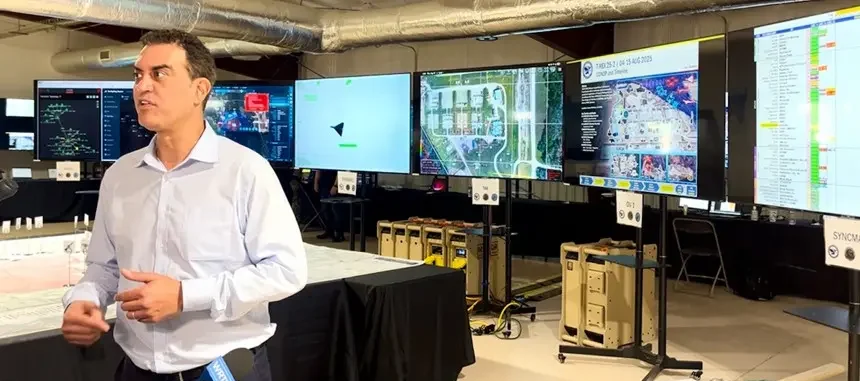
AWS and GDIT provided the digital architecture, knitting together feeds from 26 companies into a single mission framework. “Some vendors came in with low readiness levels,” AWS engineer Tony Jacobs admitted. “This gave them a chance not just to test their gear but to see how it fits into a bigger picture.”
GDIT’s routing software, DOGMA, handled what one official colorfully called “dirty internet”, those unstable, contested networks where most modern wars will be fought. The software allowed drone sensors at the edge of a battlefield to push data securely into cloud resources, even when the environment was crawling with jammers.
Just as vital is autonomy. Military officials at the event described a “full autonomous kill chain,” where a drone doesn’t just fly but can detect, discriminate, and act on targets using cues from passive sensor networks. While human oversight still governs firing decisions, the shift toward machine-led judgment is undeniable. As one officer conceded, “It’s not protocol right now. But we know eventually we’re going to have to get there.”
Building Doctrine, Training, and Factories
Technology is only half the battle. The other half is knowing how to use it and having enough of it when the fight begins. Ukraine’s forces improvised tactics under duress, but the U.S. military wants to write a playbook before the shooting starts.
Marine Corps Col. Scott Cuomo confirmed that a joint drone doctrine, developed with Army Rangers, Navy SEALs, and Special Forces, is close to announcement. That doctrine will guide everything from operator training to what gear commanders actually request. Just as important, the Pentagon is opening more live testing ranges for companies to plug into real-world drills. “The point,” Michael said, “is to have enough frequency that industry can test, get feedback, and keep iterating.”
And then there’s production. Last month, the Pentagon issued a directive to expand U.S. drone manufacturing, pushing purchasing power to lower-level commanders. The goal isn’t just more drones but faster cycles of customized builds, an industrial base flexible enough to churn out specialized designs at scale. “Mass production is a big part of this,” Michael emphasized. “But not in the old way. This isn’t about one-size-fits-all drones. It’s about rapid, tailored builds at a scale we haven’t seen before.”
The Road Ahead
The T-REX demonstration lacked the Hollywood punch of a massive live-fire exercise, but its invisible architecture, software-defined networking, autonomous decision loops, and digital integration across dozens of vendors was the real story. It signaled the Pentagon’s determination to avoid Ukraine’s early scramble and enter the next conflict with a ready-made drone ecosystem.
That doesn’t make the future less unsettling. Autonomy in warfare, once a thought experiment, is moving quickly toward reality. The United States is trying to write the rules while also preparing to break through its own limits. For now, what’s clear is that the Pentagon no longer views drones as gadgets. They are becoming the backbone of 21st-century combat, built not on improvisation but on industrial muscle, doctrine, and networks strong enough to survive in the dirtiest of digital battlegrounds.
And if all goes to plan, the next time drones rise from a field, it won’t just be a demonstration. It will be the new face of American warfare.