




New York: The dollar cracked. The yen surged. Gold didn’t wait around and blasted through $5,000 an ounce. Markets heard one word and moved fast. Intervention.
The US dollar slid to a four-month low on Monday, pressured by mounting speculation that Washington and Tokyo may be preparing coordinated action to prop up Japan’s battered currency. The shift was sharp. The reaction, brutal.
Dollar yen intervention talk now sits at the centre of global currency markets.
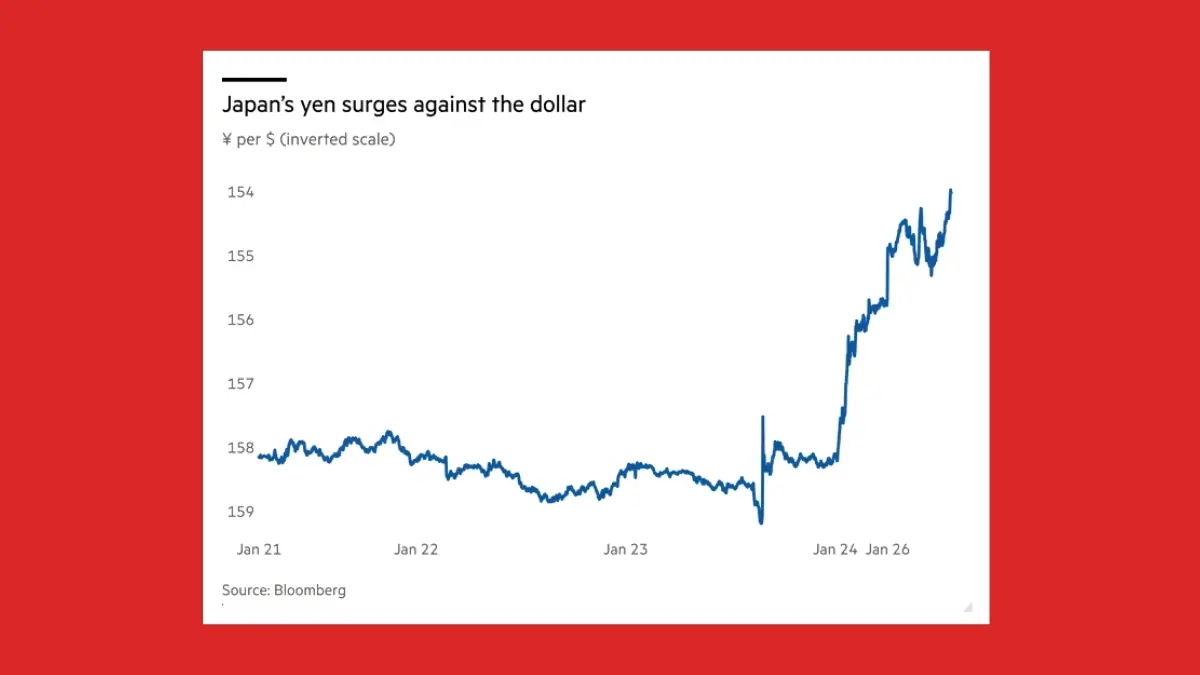
The yen jumped 1.3 per cent to just under ¥154 per dollar. Not a gentle move. A statement move. It extended gains from Friday’s chaotic trading session, which included a rare “rate check” by US authorities. Traders read that signal clearly. Rate checks tend to show up before governments step in.
The dollar lost another 0.6 per cent against major peers on Monday. That extended the damage from last week, when a political crisis linked to Greenland sent the greenback to its worst weekly performance since May. Momentum flipped. Confidence followed.
Gold saw it first.
Prices surged past $5,000 per troy ounce for the first time on record. No hesitation. A falling dollar, combined with unease over unpredictable US policy, sent investors scrambling for safety. When currencies wobble, gold doesn’t argue.
The yen’s sudden strength didn’t arrive quietly. Traders immediately began pricing in the possibility of joint US-Japan currency intervention. If it happens, it would be the first coordinated move of its kind since the G7 stepped in after Japan’s 2011 earthquake.
That history matters.
Analysts at MUFG said the yen speculation had reinforced the dollar sell-off. In their words, a coordinated intervention would send a clear message that the Trump administration wants a weaker dollar. Markets listen when governments speak in unison.
Yujiro Goto, Nomura’s chief foreign exchange strategist, went a step further. He said market rumours could already reflect real action.
Moves of this size usually need more than words.
Goto noted that currency swings on Monday were larger than expected for verbal intervention alone. That raised the possibility that Japanese authorities had already stepped into the market directly.
He added that such a sharp dollar drop would normally trigger dip-buying. It didn’t. That absence said plenty.
“Without intervention, you would probably have seen the dollar recovering this morning,” Goto said. The recovery never came.
This bounce in the yen didn’t emerge in isolation. Anxiety has been building inside Japan for weeks.
Officials and investors alike have worried about a simultaneous sell-off in the yen and the Japanese bond market. The timing is sensitive. Snap elections are set for February 8. Currency instability is not welcome.
Earlier this month, the yen sank to an 18-month low after traders reacted to a fresh stimulus package announced by new Prime Minister Sanae Takaichi. The policy was meant to support growth. Instead, it reignited concerns about fiscal discipline.
Investors now see an uncomfortable trade-off. Support the yen with higher interest rates, or keep borrowing costs low and risk deeper currency pain. Either path has consequences.
Markets aren’t pretending this is over.
A CME Group index tracking implied volatility in the dollar-yen exchange rate climbed to its highest level since last July. Traders are braced. No one is relaxed.
Japanese authorities have history here. In 2024 alone, they intervened four times in foreign exchange markets, spending close to $100 billion to support the yen as it slid towards ¥160 per dollar.
That memory still shapes behaviour.
On Monday, Japan’s top currency official Atsushi Mimura added fuel to the fire. Speaking to reporters, he said authorities would respond appropriately to foreign exchange moves and would work closely with US counterparts if needed.
That line landed hard.
It followed comments from Prime Minister Takaichi a day earlier, where she promised “all necessary measures” to counter what she described as speculative and abnormal currency movements.
The market didn’t wait for paperwork.
Traders said the reaction was driven less by confirmed action and more by shared intent. The idea that the US and Japan see the yen’s weakness as a problem changed the calculus.
Benjamin Shatil, senior economist at JPMorgan in Tokyo, put it bluntly. If markets believe Japan is acting in coordination with the US, even verbal warnings gain force. That perception alone can move prices.
And it did.
More than three months of steady yen declines reversed in hours.
Japanese equities paid the price.
The Nikkei 225 fell 1.8 per cent on Monday. A stronger yen squeezes exporters by shrinking the value of overseas earnings when converted back home. The math is unforgiving.
Shrikant Kale, strategist at Jefferies, called the move a knee-jerk reaction. But demand from clients told a deeper story.
Investors wanted clarity. Fast.
“The number-one request I’ve received in the last 24 hours,” Kale said, “is just give me the names of companies positively and negatively correlated with the yen.”
That’s what stress looks like.
For Indian investors watching global markets, the implications are immediate. A weaker dollar affects capital flows, commodity prices, and imported inflation. Gold’s breakout above $5,000 hits Indian households directly, where the metal remains both an asset and an emotion. Currency shifts abroad rarely stay abroad for long.