



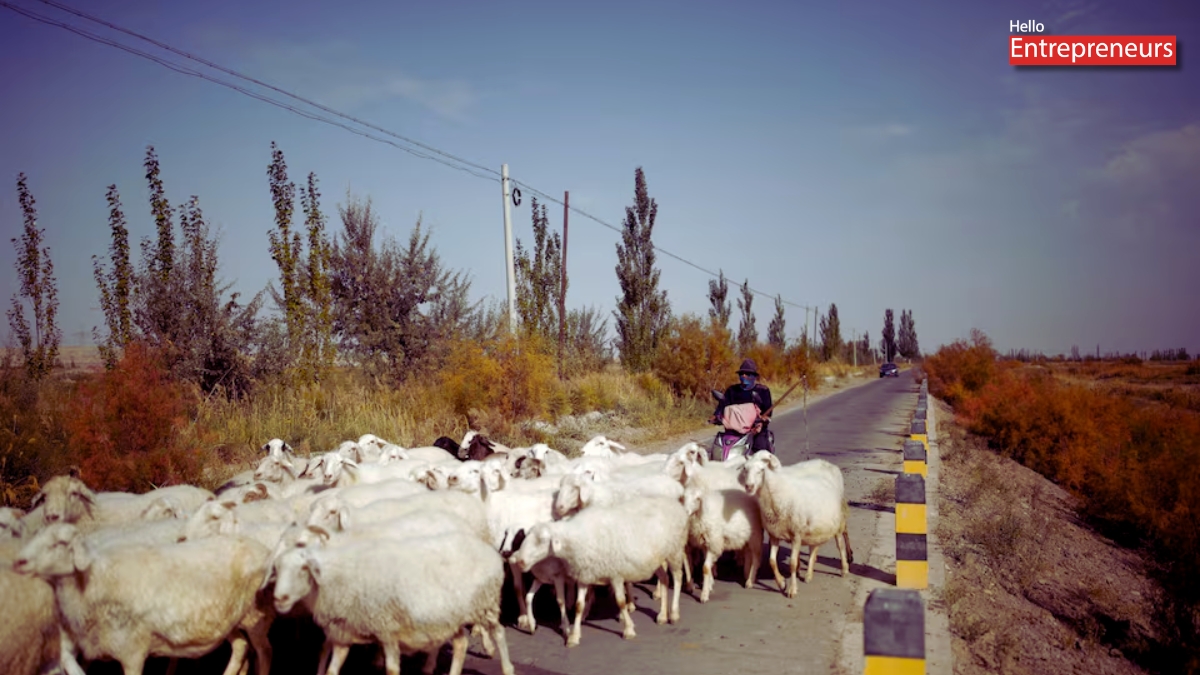
A shepherd recruitment campaign in northern China has become a viral sensation, drawing over 700 candidates and billions of views on the North China grasslands near the Gobi Desert, and has sparked a national conversation about growing economic anxiety and, possibly, white-collar exhaustion.
Originally posted as a simple recruitment notice for two sheep-herding positions, an invitation to work in “the isolation and extreme cold” of the Far North in Inner Mongolia attracted a thousand candidates in less than a month, more than you could imagine. The positions were to manage thousands of sheep on a farm spanning more than 2,000 hectares, but the buyers were presumably impressed by the “thalweg” (the deepest channel of a riverbed). The social media posts show the fire of inner class concern for the middle class.
The recruitment notes present the positions as “an action against fatigue,” and “fun” and “no stress to your life.” Applicants, however, made it flatly clear they were looking to escape the burden of their city jobs. The postings received attention, and you can find interviews with a university student, a factory worker, a busy executive, and an e-commerce professional, all of whom mention thematically shared worries.
While they never elaborate on specifics, the applicants speak of burnout, emotional exhaustion, the inability to cope with expectations, and taking a break from the “harsh” city environment. Their words reflect a growing trend of the educated working towards or having worked in the city, an increasing sense of hardship in the modern “Chinese” economy.
Technology company employees in China have long been depicted as working grueling “996” hours at night and early morning. Such a work culture has triangled the country’s economy, yet it has become synonymous with sadness, isolation, and low disposable social mobility.
Meanwhile, Chinese people have dubbed the hiring practice of shunning employees over thirty-five years old as the “curse of 35”.This in turn has made many in their mid-twenties to fifties worried about surviving. No longer is the issue unemployment but rather underemployment in this economy where the living requirements outweigh the wages earned, especially for summer workers.
Now the Chinese are doing away with the absurd Hours, as the country gears up to welcome 12.7 million university graduates over the summer ahead, at a time when the Chinese economy could use a boost after closing down, struggling consumer spending, and a weak private economy in a worsening global environment.
It is difficult to comprehend the idea of choosing to spend your life in the cheap countryside, but people tend to shy away from rural posts. Yet, unlike other industries which are killing jobs as business margins collapse, the farm owner concluded that employees could not survive on such low wages, and hired local workers who knew how to get by.
When the Chinese have started calling hard work “996”, the Chinese are required to consider whether they would be willing to be a “996” farmer, especially if they have to work under the harsh weather conditions. The farm owner furthermore stated, “The young people who applied all romanticize working life in the countryside and don’t understand how it will affect their psychology.” The farming jobs were therefore given to the long‑time farmers. The owner forewarned that “if you’ve the chance to go to the pastoral fields, you will not be able to have any meaningful social interaction for several months.”
But what’s exciting about the story is not who was hired, but who applied in the first place.
The immense response to the shepherding jobs is a wake-up call that for many young professionals in China, the emotional toll of hyper-competitive urban jobs is beginning to outweigh the physical toll and isolation of hard work.
And this odd viral headline may, in all humility, be one of the most telling signals yet of a workforce that yearns to escape the burnout-ruined economic modernity it has co-created.

