




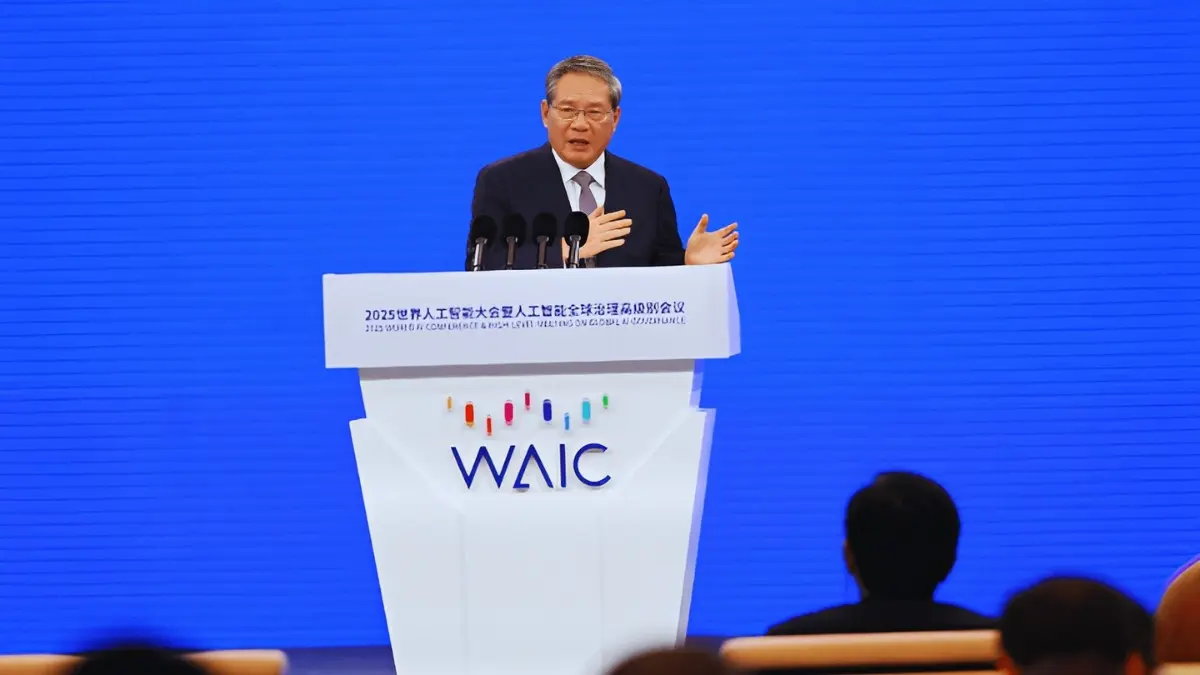
Mumbai: At a packed conference in Shanghai this weekend, something unusual happened. Instead of the typical tech celebration, China’s Premier Li Qiang stepped onto the World Artificial Intelligence Conference stage and offered not just optimism, but a warning.
It was about artificial intelligence, its potential, yes, but also its power to spiral. In his words, the risks have become too large to ignore. And the world, he said, needs to slow down just long enough to talk.
“Development and security must walk together,” he urged.
That moment came just days after US President Donald Trump pushed forward an aggressive AI strategy focused on rapid deregulation, calling red tape “the enemy of progress.” The message out of Washington was clear: let the private sector run, and get government out of the way.
In Shanghai, the tone couldn’t have been more different.
A Baby Tiger, and What Happens When It Grows
Maybe the most vivid metaphor of the day didn’t come from a politician, but from someone who’s spent his life around data, Geoffrey Hinton, a Nobel Prize-winning physicist. He compared AI to a “very cute tiger cub.” Lovely now. But what happens when it’s no longer small?
“You’d better make sure it doesn’t kill you later,” he quipped, with the weight of someone who’s spent years thinking through the math of what that means.
Premier Li echoed that concern, pointing out that while AI development has accelerated wildly, governance hasn’t kept pace. He called for a broad societal consensus, across countries, cultures, and industries, before the gap between innovation and control becomes unbridgeable.
He also introduced something big, though details remain sketchy: a new Chinese-led body for international AI cooperation, which could be based in Shanghai. According to state media, the goal is to promote shared governance and global benefit. But naturally, that raised eyebrows in some quarters.
Two Visions, One Race
Li’s call for shared progress stood in direct contrast to the Trump administration’s stance. Where China spoke of inclusion and caution, Washington leaned hard into speed and dominance.
In fact, the Trump-led plan announced this week seeks to slash regulations that might slow American AI companies down. “We won’t let bureaucrats choke our future,” the President had declared.
That mindset worries leaders in Beijing. Vice Foreign Minister Ma Zhaoxu warned against “unilateralism and protectionism,” phrases that have become common in Chinese critiques of American tech policies. And Li took it a step further, saying monopolies and exclusionary tactics would only hurt everyone in the long run.
“If AI is cornered by a few nations and companies, its promise will become a privilege,” he said, adding that China plans to share advancements, especially with developing countries that are often left out of these conversations.
Behind the scenes, though, China faces its own bottlenecks. As Li admitted, a shortage of high-end chips and computing power remains a major challenge. And with the US tightening restrictions on semiconductor exports, the competition isn’t just technological, it’s deeply geopolitical.
Divided Paths, Shared Risks
What’s interesting is how sharply the world’s approach to AI is beginning to diverge.
According to George Chen, a policy expert attending WAIC, there are now three main camps:
- The United States, prioritizing speed over structure
- China and parts of the Global South, calling for shared oversight
- And the European Union, taking a legislative route with its sweeping EU AI Act.
That fragmentation could slow progress on the very thing everyone agrees is needed: smart, adaptable global governance. At the same event, UN Secretary-General António Guterres called this the “defining test” of international cooperation in our era.
France’s envoy Anne Bouverot echoed that urgency, saying the UN must lead efforts to create a transparent, inclusive framework. Her words landed with weight, especially given that just a few months ago, the US and UK refused to sign a joint statement from a Paris AI summit that included China, France, and India, all calling for ethical standards.
Beyond Blueprints: The Values Beneath the Code
It’s tempting to think of AI as just software, code, and chips. But Saturday’s dialogue made it clear that what’s really at stake are values: who builds AI, how they use it, and what rules they’re willing to follow.
China wants to position itself as a responsible leader, especially in regions that feel caught between the US and the EU. It’s not just about prestige; it’s a diplomatic pitch to much of the world that feels sidelined from the Western-led tech narrative.
And yet, trust won’t come automatically. Some experts warn that any governance body led by China would reflect its political structure and priorities. The challenge lies in building something truly global, with seats for all, not just the biggest players.
Still, Li’s core message hit a chord: AI is already reshaping the world. The question is whether we can shape it in return.
Because once the tiger grows, you can’t pretend it’s still a cub.
Also Read: World on the Edge: 7 Alarming Global Threats We Can’t Ignore

