



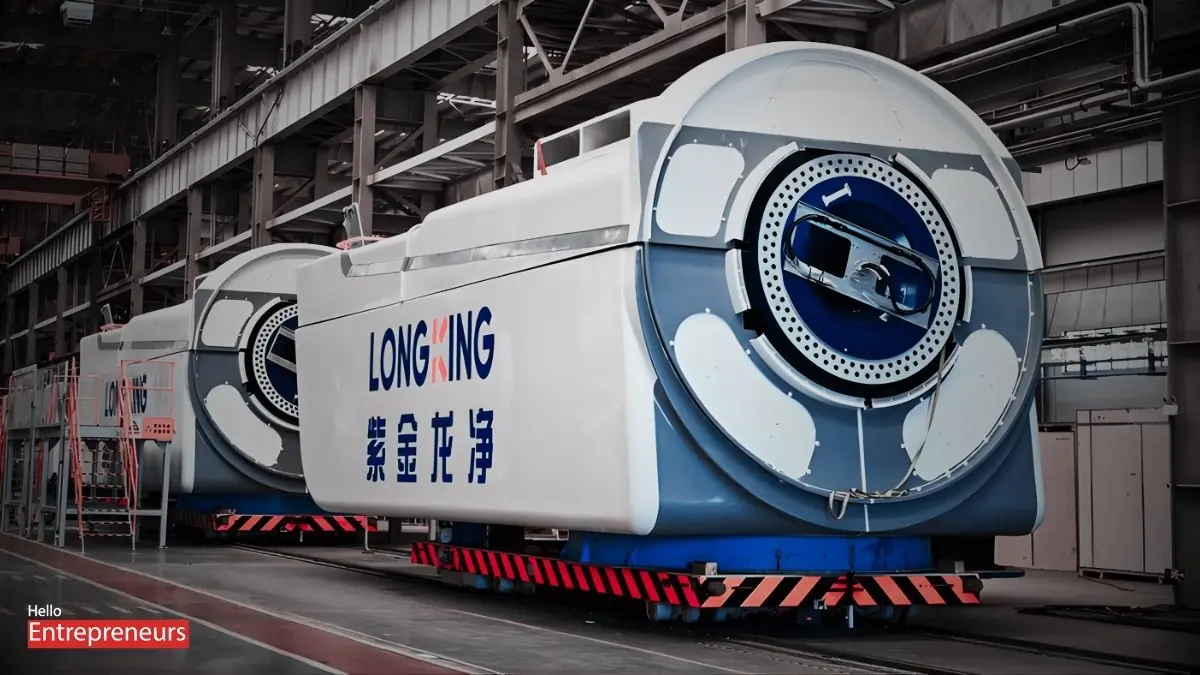
New York: China is not just building factories. It is building entire defense ecosystems. And it is doing it faster, denser, and smarter than the United States. China’s next industrial advantage does not look like a single breakthrough lab or a flagship weapons program. It looks like cities. Ordinary-looking cities that quietly link mines to motors, motors to drones, and drones to military units. All in one place. Welcome to China’s defense innovation cities.
While Washington debates how to add a rare-earth processing plant or find a place to test drones, Beijing is clustering everything at once. Mining. Processing. Manufacturing. Testing. Training. Deployment. The result is a full-stack model that compresses time, cost, and complexity. And it is already paying off. Baotou, in Inner Mongolia, shows the model in its most complete form. For decades, it has been the heart of China’s rare-earths industry. That legacy alone gave Beijing enormous leverage over global supply chains. Now Baotou is doing something more ambitious.
Processed ores move straight from nearby facilities into factories that produce permanent magnets and high-performance motors. Those motors feed production lines assembling drones, electric vertical takeoff aircraft, and even humanoid robots. No shipping across provinces. No customs delays. No fragile supplier dependencies.
City plans go further. Baotou is laying out UAV testing zones, pilot training bases, and logistics hubs. The Rare Earth High-Tech Zone anchors it all, pulling component makers and integrators into tight physical proximity. Iteration speeds up. Supply-chain friction drops. Scaling becomes routine.
This is not accidental. Local government messaging openly describes a complete chain from mining to magnet production to motor fabrication to UAV assembly. Few American cities can say the same. None can do it at this scale.
Beijing no longer treats rare earths as just a bargaining chip. They are an ignition point.
These materials enable magnets and motors with higher torque per kilogram and more lift per watt. That matters enormously for drones, robotics, and electric aviation. China understands this. So local governments now co-locate rare-earth processing zones with robotics parks and drone clusters.
In Sichuan Province, Mianyang is leaning into its defense research reputation with heavy investment in permanent magnet manufacturing. The logic is simple. If inputs are secure and nearby, innovation accelerates. Production follows.
This approach fits squarely inside Beijing’s push for what it calls “new quality productive forces.” The phrase sounds bureaucratic. The meaning is not. Advanced industrial capacity built on dense supply chains, secure inputs, and rapid scaling.
Several of these defense innovation cities are targeting one sector in particular: the low-altitude economy.
That means products, services, and infrastructure operating below 1,000 meters. Delivery drones. Surveillance platforms. Tourism aircraft. Urban air mobility. It is a massive commercial opportunity, at least on paper.
China’s Civil Aviation Administration estimates the sector could reach 2.5 trillion RMB, roughly $500 billion, within a decade. And this is not theoretical. Logistics drones already fly routes linking Jiangxi’s mountainous interior to delivery networks serving the Pearl River Delta.
Cities are racing to capture this growth.
Ganzhou, in Jiangxi Province, has built a permanent-magnet-motor park and physically linked it to a low-altitude economy park. The setup covers R&D, manufacturing, operations support, and even regulatory frameworks. Magnets, motors, airframes, and operational services sit side by side.
Another similar ecosystem is rising next door in Fujian Province. The pattern is spreading fast.
Officially, Chinese leaders sell the low-altitude economy as a win for commerce and public services. Delivery. Agriculture. Inspection. Tourism.
Unofficially, the defense angle is never far away.
Defense-affiliated commentary and local armed forces activity show how these clusters double as military assets. Some parks now design their tenant mix with defense mobilization in mind.
In Sichuan, one low-altitude park helped form two specialized militia units. One focuses on long-range UAV reconnaissance. The other specializes in rapid airfield repair. Both are civilian-facing on paper. Both are clearly wartime assets.
In Jiangsu, local People’s Armed Forces departments have organized UAV reconnaissance units that deploy for disaster surveys and water rescues. They train, organize, and equip in ways that would translate smoothly to conflict scenarios.
This structure matters. It keeps platforms, operators, and maintenance ecosystems close to China’s mobilization system. The gap between commercial capability and wartime utility shrinks dramatically.
China’s military benefits just as much as its private firms from these full-stack aviation clusters.
A recent analysis by the Royal United Services Institute pointed out a key constraint in battlefield drone production. It is not airframes. It is propulsion and actuation components.
Motors. Magnets. Control systems.
China’s defense innovation cities internalize those bottlenecks. Entire production chains sit inside single municipal footprints. If one supplier falters, another is often nearby. Scaling becomes a local problem, not a national one.
Geographic spread adds another layer of resilience. These clusters are not limited to coastal hubs. They appear inland as well. That cushions the system against environmental enforcement, energy shortages, or regional disruptions.
In wartime, it also complicates any effort to disrupt production through targeted strikes or interdiction. There is no single choke point. There are dozens.
American analysts increasingly recognize permanent magnet motors as a global chokepoint. The Pentagon’s decision to become the largest partner in MP Materials, which owns the only operational rare-earth mine in the United States, reflects that concern.
But mining is just the first step. And focusing only on production counts or ownership misses the larger picture.
While U.S. policymakers wrestle with permitting delays, community opposition, and fragmented supply chains, China is building everything at once. Processing plants. Magnet factories. Motor production. Drone assembly. Testing ranges. Training bases.
Baotou and its imitators highlight the gap. The competition is no longer about who owns a mine. It is about who controls an integrated system that turns materials into deployed capability at speed.
This is where China’s advantage widens.
China defense innovation cities are not flashy. They do not rely on secret weapons or science fiction promises. They rely on density, coordination, and patience.
The model rewards long-term planning and ruthless execution. It turns cities into platforms. It turns supply chains into strategic assets. And it quietly erodes the advantages of countries that still think in silos.
The United States is not out of the game. But it is playing a different one. Until policymakers move beyond isolated fixes and start thinking in full stacks, the gap will keep growing.

