



Mumbai: Nobody likes taking cues from a volatile digital token that jumps around like a T20 slogger on a flat pitch. Still, Bitcoin’s latest slide is flashing a clean, bright warning: markets are getting queasy again.
Bitcoin market warning signs have piled up in the past few weeks.
The world’s largest cryptocurrency has slipped by nearly a third since early October, dragging global stocks into gloomy territory every time it stumbles. For an asset long dismissed as noise, it’s suddenly behaving like a mood sensor for markets. And honestly, it’s doing a pretty decent job.
For years we heard the crypto evangelists promise the moon. Bitcoin is money. Bitcoin is an inflation hedge. Bitcoin is a safe haven. Yeah, no. What it has actually become is a real-time gauge of speculative excess. When traders get nervous, Bitcoin is the first thing they dump. When optimism spikes, it’s the first thing they chase. That makes it a surprisingly reliable early alert that the wider market might be coughing.
And lately, it’s coughing a lot.
Stocks briefly tried to regain balance this past week, buoyed by Nvidia’s powerhouse earnings. But once Bitcoin slipped again on Thursday, the optimism evaporated. Stocks followed, like they’ve been tethered to it. It’s almost funny. The asset that once existed on the financial fringe is now the mainstream’s emotional barometer. Vibes in token form.
Still, this isn’t really about Bitcoin. It’s about timing. Investors are already locked in a debate over the AI boom that has driven global markets all year. Call it a bubble, call it a supercycle, call it the “big tech is doing all the heavy lifting” problem. Whatever the term, most serious investors agree on one thing: pullbacks are not just likely, they’re overdue.
Not necessarily a crash. But a correction or two? Maybe several? You’d be brave to bet against that.
In India, too, we’ve seen the same tension. The Nifty and Sensex aren’t showing bubble behaviour, but the global AI mania absolutely influences flows into our markets. When Wall Street gets jittery, we feel the tremors. RBI policy may keep inflation in check, but metros full of crypto-curious retail investors know exactly how global sentiment can punch through the front door without knocking.
And here’s the catch: knowing that markets will correct doesn’t make the timing any easier. The boring rule says stay diversified. Which is fine, except that anyone who stayed “boringly” diversified this year probably missed out on the monster gains from big tech. Timing the exit is infuriating. Leave too early and you’re the sucker standing outside the stadium while the winning six is still in the air. Leave too late and you’re stuck in a traffic jam of selling.
Professionals hate this even more. No fund manager wants to explain to their boss that they missed a basic index rally because they were “too clever.” Catching the top is a fool’s errand. Getting back in at the right time is even harder.
Mark Haefele, UBS Global Wealth Management’s chief investment officer, sent that message loud and clear in a presentation this week. He admits the AI trade is loaded with dreams. He’s not even fully sure the boom keeps running. But instead of trying to outsmart the cycle, he’s doing what the grown-ups do: diversifying and keeping exposure steady. Even if the theme collapses eventually, it may take months or years. Sitting out entirely is like leaving the cricket stadium in the 12th over because you “feel” a collapse coming. Sure, it might come. But you might also miss the fun.
Haefele even recalled how he misjudged the dot-com bubble in 1999. He saw the crash coming and told his clients. He was right. But he was early. And in markets, early feels exactly like wrong. He said he looked like an idiot for months before vindication arrived. That’s the part textbooks forget: reputational risk moves markets too.
Vincent Mortier at Amundi is singing a similar tune. He sees pockets of overspending in AI. He sees the possibility of a turning point. But he also sees how quickly sentiment can flip. His strategy: hedge, don’t bail. Buy insurance, not regret. Options cost a bit. Looking foolish costs more.
Mortier doesn’t touch Bitcoin. But he watches it anyway, almost as a reminder that markets don’t climb forever. “Trees are not growing to the sky,” he said. A line every Indian investor who has sat through Diwali optimism knows deep in their bones.
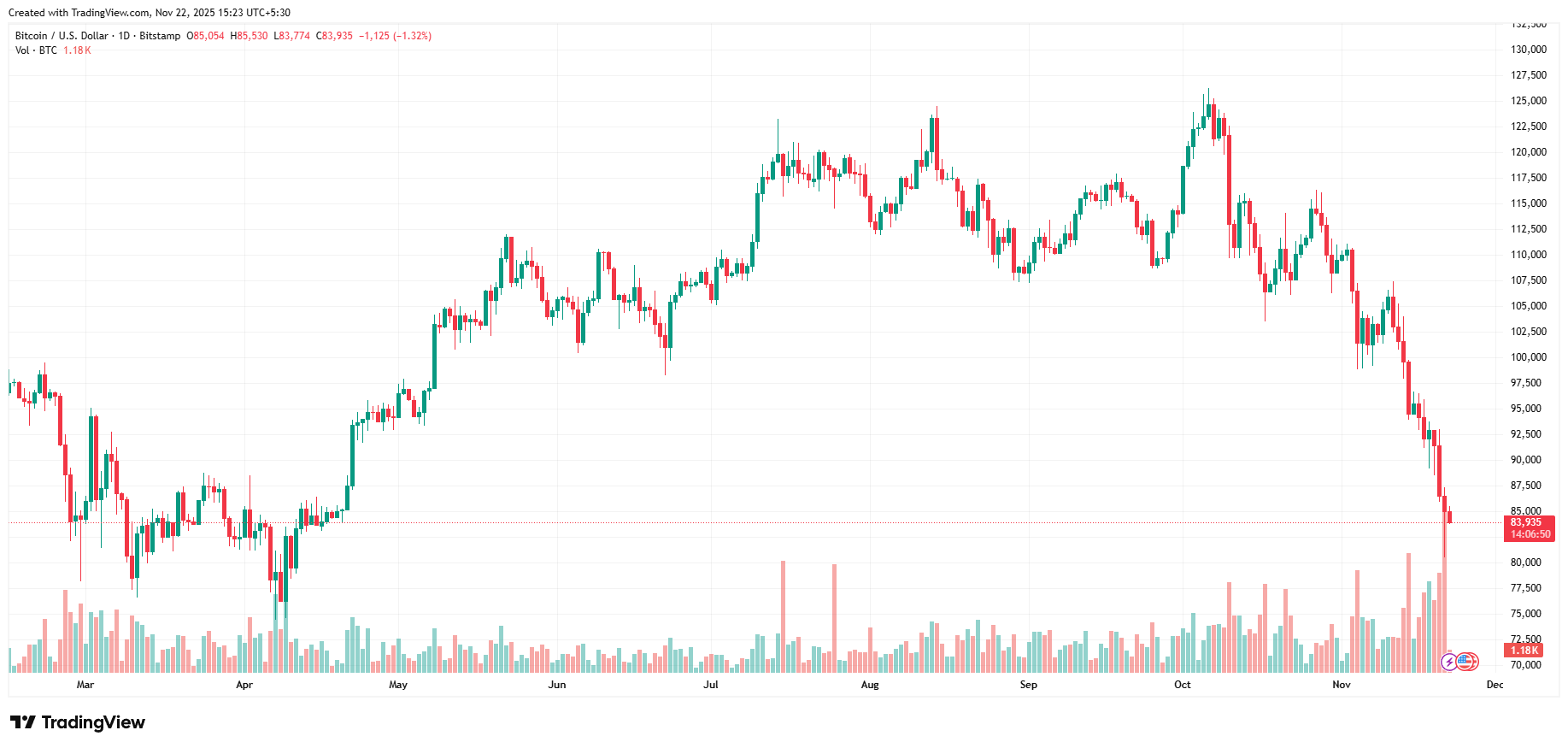
And honestly, he’s right. Bitcoin shouldn’t be the captain of this ship. But it has become the canary in the financial coal mine. When it dives sharply, risk appetite dries up. When it pumps, traders get reckless. That’s not deep fundamentals. It’s psychology. But psychology rules markets more than spreadsheets ever admit.
A full-blown crash this year or in 2026 still sits in the “tail risk” column. But pullbacks? Corrections? Those are almost certain. Watching Bitcoin doesn’t give you magical foresight. But it does tell you when crowd sentiment shifts from greed to uncertainty. And in a market where AI narratives, global liquidity, and rate expectations all collide, even a quirky warning signal is better than none.
So keep half an eye on the Bitcoin chart. Not because it’s gospel. Because it’s a decent way to sense when the herd is getting nervous. Every investor, from Dalal Street to Wall Street, could use that extra bit of intuition right now.
Also Read: The 28 Point Ukraine Russia Peace Plan Deserves a Roast for the Ages

