



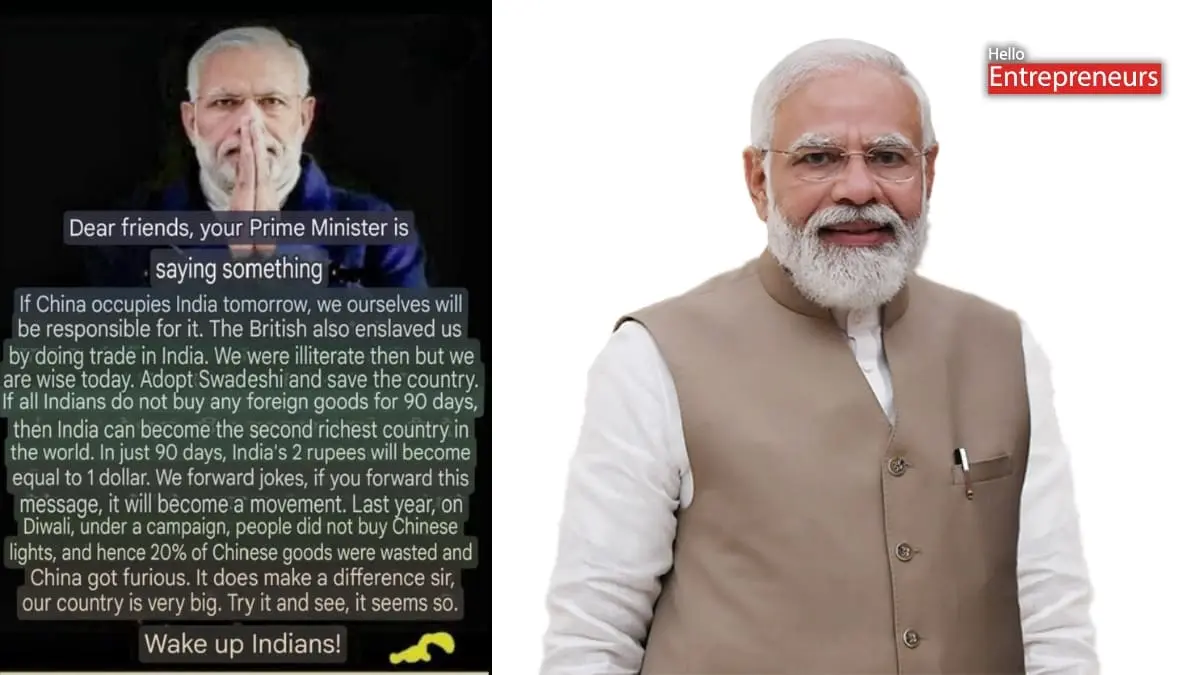
New Delhi: It begins like any viral tale, on your WhatsApp, late one night, wedged between a good-morning flower emoticon and that one ranting cousin of yours about politics. A photo of Prime Minister Narendra Modi, folded hands, looking straight at you. The text is urgent, emotional, and sounds like the sort of thing you’d imagine him saying at a rally: “Dear friends, if all Indians stop buying foreign goods for 90 days, the rupee will become 2 per dollar, and India will become the second richest country in the world.”
The message continues. It speaks of how the British enslaved India in trade, of how we are better informed now, of how boycotting Chinese products last Diwali apparently had 20% of their offerings unsold. It forewarns that “Made in China” labels are now being replaced with “PRC” to deceive buyers. And naturally, it concludes with a call to action, “Wake up Indians!”
It’s a recipe for success, ripe for virality: a dash of patriotism, a pinch of fear, a sprinkle of conspiracy theory, and an offer of miraculous economic fixes to arrive overnight. But as I’ve discovered (and blogged about time and time again), the more perfectly crafted a viral forward appears, the more you should be on guard.
How the rumor spread?
This specific forward has been doing the rounds since at least 2017, popping up during every holiday season when Chinese toys and lights take over shop shelves. Year after year, it receives a new layer of digital make-up, new emojis, slightly adjusted numbers, and a refurbished image of the Prime Minister.
Its most recent run-up occurred just ahead of last year’s Diwali. Social media forums, particularly on WhatsApp and Facebook, glowed with it. Not a coincidence, the Diwali festival season is when “boycott Chinese products” cries normally reach a peak, riding both nationalist fervor and market truths.
The reality check!
When India TV’s fact-check bureau investigated the claim, they could not find any official speech, statement, or press release by PM Modi presenting such an appeal. A perusal of the Prime Minister’s Office website, archived speeches, and reputable news sources yielded nothing. What they did discover was that this message is a hoax, presented in an attempt to appear as a government appeal when really it is another one of those chain-message fictions.
Factly, yet another well-known fact-checking agency, corroborated the same. They added that even though PM Modi has certainly exhorted citizens to patronize domestic manufacturing as part of the Atmanirbhar Bharat Abhiyan and “Vocal for Local” initiatives, he has never indicated that such steps would double the value of the rupee overnight or propel India to the second-richest position in the world.
Even if, by hypothetical supposition, all Indians refused to purchase foreign goods for 90 days, the rupee would not overnight turn into two to the dollar. Exchange rates of currency are influenced by macroeconomic variables, trade balance, reserves, world price of oil, inflation, and investors’ confidence. A boycott could affect imports somewhat, but it’s far short of causing the sort of economic shaker the message threatens.
The assertion regarding “20% of Chinese products remaining unsold” during last Diwali is also bereft of statistical evidence. As a matter of fact, trade data collected by the Directorate General of Commercial Intelligence & Statistics indicate that India’s Chinese imports have broadly increased year after year, even during festive periods when boycotts were trending on social media.
And as for the “Made in China” label being replaced with “PRC”, that’s just an alternate legal designation. “PRC” stands for People’s Republic of China. It’s not a scheme to fool buyers; it’s a standard international naming practice.
Why people believe it?
One reason that such messages are so easily circulated is that they are resonating off real feelings, pride, frustration, and a need for easy solutions. Most Indians are still very aware of the colonial history of the country, where foreign commerce was involved in economic exploitation. The prospect of “we can retake control in 90 days” is euphoric.
It’s also a good old-fashioned example of how feel-good economics functions in disinformation. The promise is easy to make, the behavior is simple (just don’t shop for certain goods), and the payoff is enormous. Reality, unfortunately, is a good deal more complicated.

