



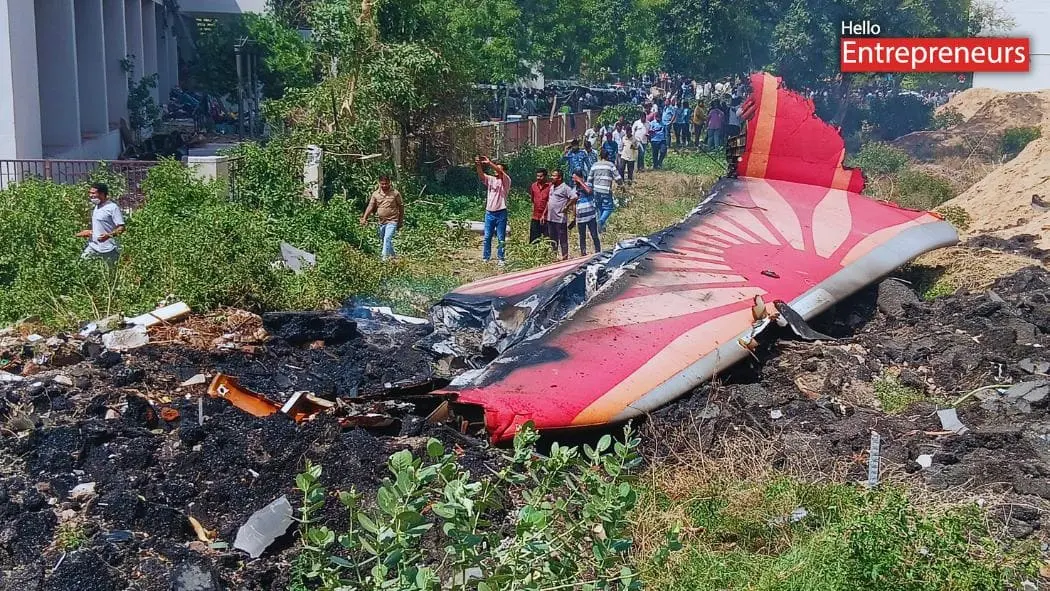
Ahmedabad/New Delhi: A month after 241 people died on an Air India flight to London shortly after takeoff, India’s Aircraft Accident Investigation Bureau (AAIB) has released a preliminary report on the cause of the crash. According to it, the engine fuel control switches were moved to the ‘Cutoff’ position just after takeoff.
This resulted in both engines losing thrust almost simultaneously, and eventually led to the plane crashing in the BJ Medical College hostel, resulting in a total of 260 fatalities, including those at the hostel. The report claims that the switch was flipped 3 seconds into the flight, even though they are designed to prevent accidental movement, according to aviation experts.
According to the aircraft’s cockpit voice recorder, one pilot reportedly asked the other ‘Why did you cut off?’ to which the other replied ‘I didn’t’. The report didn’t specify the speakers, though both pilots had 9,000 hours of flying experience on the Boeing 787 Dreamliner. Though the pilots managed to start one of the engines just before the crash, it was too late by then, as the flight crashed 8 degrees in the nose-up position in the BJ Medical College hostel.
The aircraft had valid airworthiness certifications, with no previous issues with the fuel cutoff switches reported. Air India had ignored Boeing’s optional advisory to check the fuel control switch locking mechanisms.
Air India has had a history of fatal air crashes, with this incident being the 11th instance since 1947. India’s Ministry of Civil Aviation and the AAIB have been criticised for their lack of disclosures and for their inconsistency in communication, creating intense speculation and misinformation as a direct result of this.
The AAIB will also submit this preliminary report to the International Civil Aviation Organization (ICAO) as per norms. The ICAO has been assisting the investigation to the AI171 crash after diplomatic efforts with the Indian government, even though it has declined to publicly specify its role in the investigation.
The crash has severely damaged Boeing’s reputation, which has been criticised in the past for its focus on profitability over safety. This marks the first time Boeing’s flagship 787 Dreamliner has crashed, after it was introduced for service in 2011. This comes after Boeing’s 737 Max has suffered 2 fatal crashes in Indonesia and Ethiopia in 2018 and 2019, respectively.

