


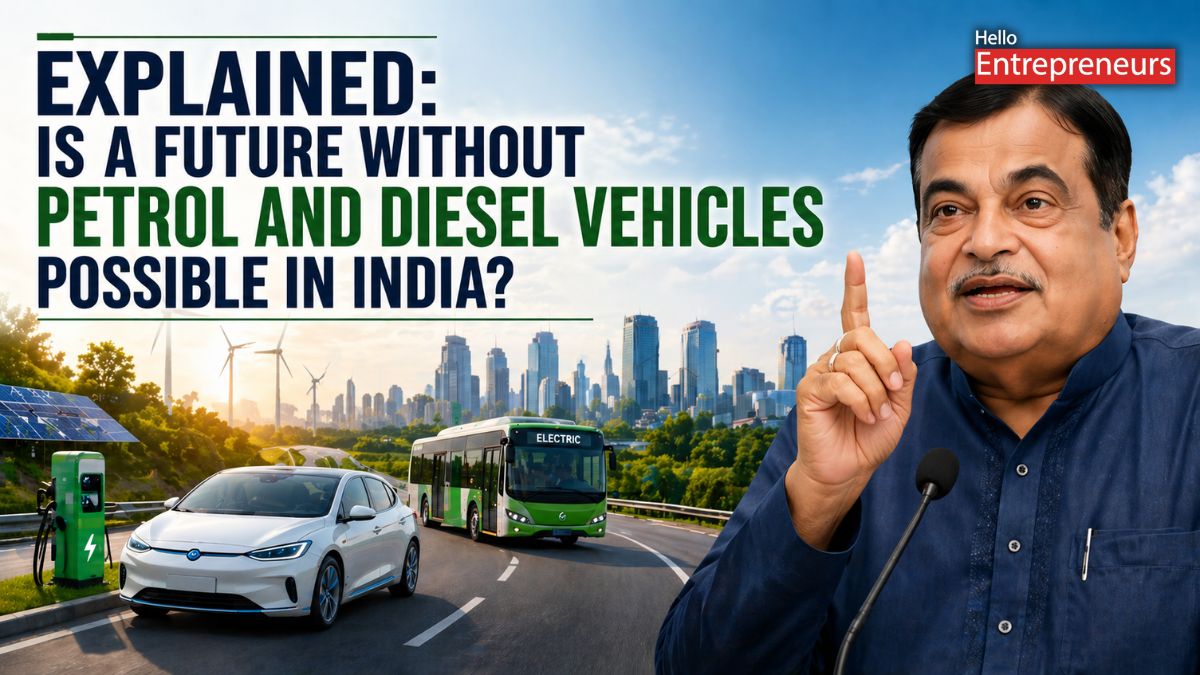
New Delhi: Union Road Transport Minister Nitin Gadkari made a bold claim recently that there is no future of petrol and diesel-powered cars in India, and he urges the automakers to consider more environmentally-friendly technologies such as electric vehicles (EVs), hydrogen, ethanol, and CNG. He cited India as being poorly dependent on imported fossil fuels and the rising pollution rates as key contributors to this push. This should not be construed as a ban on it, but rather it is a long term roadmap of the mobility and auto industry in the country.
In reality, the shift to petrol and diesel cars would be a gradual process. Millions of such vehicles already exist on the roads of India, and EV infrastructure is not developed yet, especially charging networks. The rural areas are yet to switch to modern fuels as well.
These challenges mean that petrol and diesel vehicles are not going to disappear in a day but will gradually die off. Instead, a number of technologies will co-exist during the years including EVs, hybrids, ethanol, and hydrogen.
Government initiatives to support such a shift have already been taken, including the introduction of E20 petrol (20% mix of ethanol and petrol) and experiments with hydrogen-powered buses and trucks. In the meantime, other automotive companies are moving towards more environmentally friendly mobility.
Tata Motors and Mahindra & Mahindra are laying a heavy stress on electric vehicles, as compared to Ashok Leyland which is coming up with electric and hydrogen powered commercial cars. Companies like Volvo and Toyota Motor Corporation are also investing in electric, hybrid and flex-fuel technologies, and are also taking part in Indian trials across the globe.
The big question is whether or not it is possible to eliminate petrol and diesel vehicles in India. Yes but not in the very near future. The rapid transition is not feasible taking into consideration the size of existing vehicles, the gap in infrastructure, and the use of traditional fuels. A more practical method is a gradual transformation over the course of the next few decades. Most countries around the world are considering the phase out of fossil fuel cars with most targets set by 2035-2050, but most targets are on new car sales as opposed to bans. India is also anticipated to follow suit and a full-scale phase-out would take at least 20-30 years.
According to the timeline, the transition will most probably be in phases. Adoption of EV will only grow in the period 2025-2030, with a greater volume of ethanol blending and not necessarily prohibited. After 2030, 2040 new petrol and diesel cars may be banned, particularly in urban areas, and EVs and hybrids will replace them. There is a possibility that by 2040 to 2050 the petrol and diesel cars will be a rarity but not fully phased out. The government has not given us a time when they will completely stop using petrol and diesel vehicles.
The message from Gadkari is really about what India wants to do in the term not what they want to change right now. The petrol and diesel vehicles will not disappear all of a sudden and the future of transport in India will use different types of fuel not just one type of fuel.
The future of transport, in India will be based on using petrol and diesel vehicles and other types of fuel like the Gadkari message said and this is what the government is working towards for the mobility of India.

