



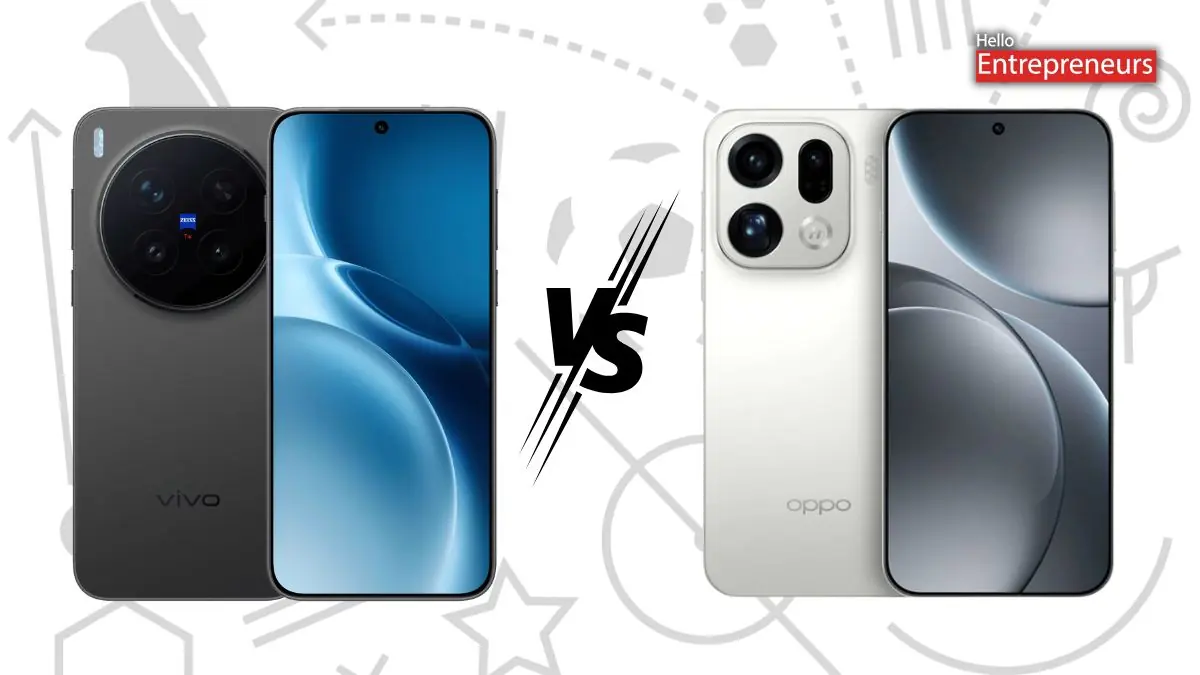
New Delhi: In these 2026 we have two India’s most impressive camera devices which are arrived the Vivo X300 Pro and Oppo Find X9 Pro. Both the devices represent the peak of mobile photography in their segment, making the choice between them remarkably difficult.
Design and Build
The Vivo X300 Pro continues with its signature circular camera module, a design language we’ve grown accustomed to seeing from the brand. While familiar, it feels somewhat little bit predictable in the contrast, the Oppo Find X9 Pro brings a more modern and refreshing design approach.
A notable difference lies in the camera module thickness, when placed flat on a surface, the Vivo’s significantly thicker camera bump causes the phone to tilt considerably, while the Oppo sits more-flush. Both phones include an action button similar to Apple’s implementation, though Vivo enables two simultaneous actions to be assigned. Whereas Oppo counters with the dedicated camera control button along with its action button mirroring to the iPhone’s camera control feature. The Vivo offers superior speakers, while Oppo delivers stronger haptic feedback. Both feature ultrasonic fingerprint scanners, representing quality technology across the board.
Camera Battle
Both phones sport identical 50MP + 50MP + 200MP camera setups. Interestingly, they share the same main sensor the LYT 828 and identical 50MP ultra-wide lenses, though Oppo’s is slightly more advanced. The real difference which emerges in the telephoto sensors where Vivo uses the superior HPB sensor with a larger size, while Oppo employs the HP5, typically found in mid-range devices. This gives Vivo better low-light telephoto performance due to superior light-gathering capability.
However, Oppo’s 3X telephoto has proves to be a sweeter focal length compared to Vivo’s 3.5X, requiring less physical distance from subjects. Oppo captures 50MP photos by default, delivering exceptional detail in every shot. Vivo offers the same option but requires additional processing time. In daylight HDR, Vivo has maintains its crown with the more consistent performance in camera, though Oppo has impressively closed that gap for the users. In low-light photography favors Vivo with the better shadow retention and highlight control, particularly noticeable in the managing bright texts.
A determined the criticism of Vivo emerges in the 35-50mm focal range, where images appear overly smoothed there are some of the users who love that smoothness but the real photographers wanted a clear and real images. Oppo preserves better detail here, though many users actually prefer Vivo’s skin-smoothing approach. For periscope portraits, Vivo’s superior hardware translates to better detail. The brand’s extensive work on bokeh styles and effects makes it the portrait king, offering artistic and dramatic options unavailable elsewhere.
Macro photography sees Oppo getting closer to subjects, while Vivo’s larger sensor produces more cinematic shots. In the crucial 10X-30X zoom range, Vivo performs better Oppo introduces AI smoothing beyond 10X that degrades quality. Vivo takes a clear lead in video while both shoots in 4K video at 120fps, Vivo adds 8K recording and 4K 60fps portrait video, when it is compared to the Oppo’s 4K 30fps limitation in portrait mode. Lens switching proves smoother on Vivo, though Oppo handles backlit HDR scenarios better.
Display and Battery
Both phones feature LTPO panels with 1.5K resolution. Outdoor brightness slightly favors to the Vivo because it comes with the 2000 nits, whereas Oppo comes with a 1800 nits, with noticeably better HDR playback brightness.
Battery is where Oppo dominates: its massive 7500mAh capacity fairly Vivo’s 6510mAh has nearly 1000mAh difference. Despite Vivo’s faster 90W charging vs Oppo’s 80W, the larger battery means Oppo takes at least 1 hour 15 minutes to fully charge compared to the Vivo’s 50 minutes that actually of the users wanted in the device the extra capacity makes Oppo the clear winner for battery life.
Performance and Software
Identical processors, RAM, and storage yield similar benchmark scores, both handle the most demanding games, though real-world testing reveals different tuning philosophies: Vivo has prioritizes more higher frame rates at the cost of temperature 59.2 average FPS in Genshin Impact, while Oppo has takes a conservative approach for the thermal management 51.9 average FPS.
Origin OS on Vivo has improved much dramatically but still shows occasional bugs. ColorOS on Oppo remains much smoother and more stable. Oppo has claims for 5 years of OS updates + 6 years of security patches updates, while the Vivo offers for 5 years of OS updates +7 years security patch updates.
Final Review
The Vivo X300 Pro remains the superior camera device with the more features, consistent color processing, and exceptional portrait capabilities and that’s why Vivo X300 Pro getting much hype in the public and in the Indian smartphone market. However, the Oppo Find X9 Pro emerges as the more balanced overall package with superior battery life, more stable software, and a refreshing design while delivering nearly matching camera performance. Choose Vivo for camera excellence, Oppo for daily versatility.