



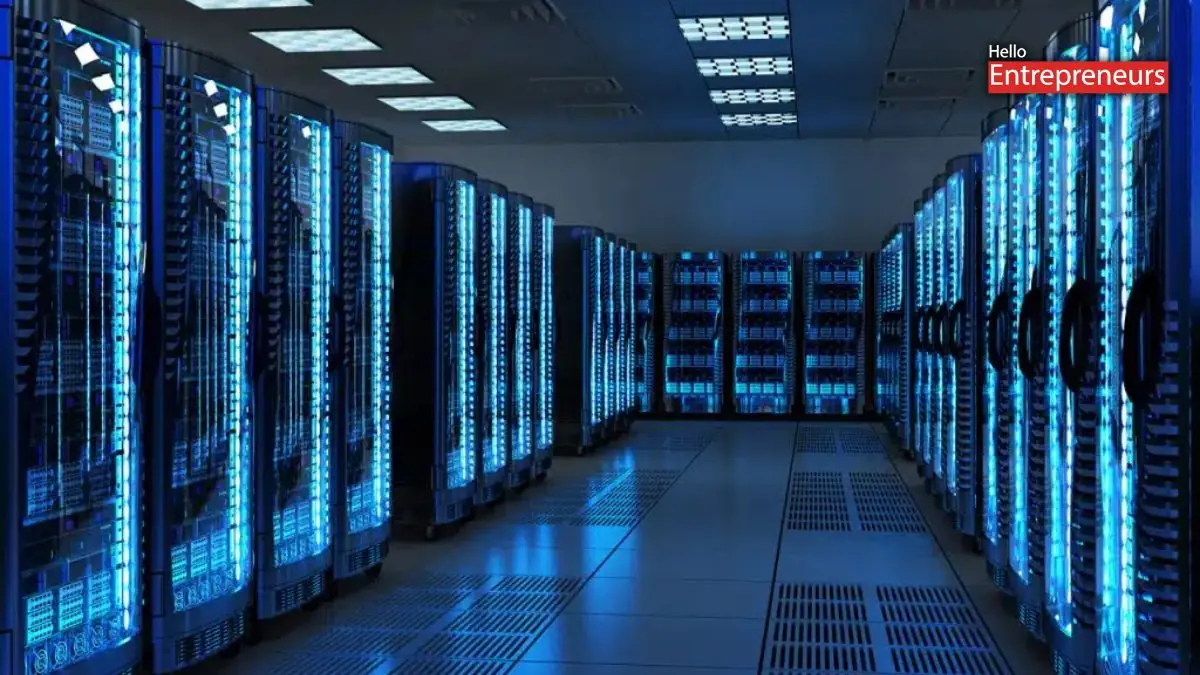
We all know that Data Center is one of the leading technologies in India and globally, we also know that Data Center performs a most crucial role in various kinds of technology but there are only a few people who know that Data Center can be a reason for the water shortage. Yes we are talking right Data Center are now becoming a reason for the water shortage in India. So, let’s know how Data Center can becomes a reason behind the water shortage. On January 24, 2025, Mukesh Ambani announced ambitious plans to transform Jamnagar into a world-class data center hub, declaring his intention to establish gigawatt-scale AI-ready data centers and position Jamnagar as a global leader in the information technology age.
Similarly to this kind of announcement, Gautam Adani has also committed to investing 10 billion dollars in building data centers across Andhra Pradesh, Gujarat, and Tamil Nadu. But while these announcements appear to signal India’s enthusiastic embrace of the artificial intelligence (AI) revolution which can help those technology development in India, they mask a potentially catastrophic consequence that could threaten the water security of millions of Indians. The intersection of India’s digital ambitions and its existing water scarcity presents a complex challenge that demands immediate attention and strategic planning.
To understand the scale of this challenge, it is essential to comprehend how data centers function and why they consume such enormous quantities of water so to understand simply we have an example just imagine if you are streams an IPL match on Jio Hotstar, their phone sends a request through the internet to the platform’s data center, a massive facility housing thousands of servers running continuously in climate-controlled environments. Within milliseconds, a load balancer directs the request to an available server, which verifies the subscription, locates the video file, checks internet speed to select appropriate quality, and breaks the video into data packets that travel through high-speed fiber cables back to the user’s device. This entire process, which occurs in less than one second for every WhatsApp message, UPI payment, Instagram post, or even a simple Google search, it requires enormous computational power and generates substantial heat that must be continuously managed through water-intensive cooling systems.
The explosion in data generation provides an crucial context for understanding why all of the data centers are increasing so rapidly. In the year 2010, the entire digital universe contained just 2 zettabytes of data, with one zettabyte representing roughly a billion terabytes. However, by 2026, humanity will be managing 221 zettabytes of data, representing a hundredfold increase in merely sixteen years. This exponential growth has accelerated dramatically, with data doubling every two years from 2010 to 2014, tripling every three to four years from 2014 to 2020, and then taking a hockey stick growth curve with the advent of AI and IoT technologies. By 2026, we will be generating more data every forty-eight hours than all of human civilization produced in its first ten thousand years combined. This data explosion is driven by four major factors: artificial intelligence, cloud computing, video streaming, and cryptocurrency mining, with AI emerging as a particularly massive energy consumer.
The energy and the water consumption of AI-driven data centers is staggering and often underestimated. Every time someone asks ChatGPT to write an email or generate an image, a data center must supply power and subsequently shed the heat generated by those computations. Producing a hundred-word AI-generated response consumes approximately 0.14 kilowatt-hours of electricity, equivalent to running 14 LED bulbs for an hour, and requires half a liter of water for cooling. When multiplied by millions and billions of prompts, these individual requests create an enormous cumulative demand. In the United States, an average hundred-megawatt data center uses more power than seventy-five thousand US homes combined and consumes 2 million liters of water every single day, equivalent to the water usage of 65 hundred US households. The alarming fact is that most of these facilities use drinking water for cooling purposes.
The irony of India’s data center expansion plan becomes apparent when examining the current water situation in cities targeted for these facilities. And these Data centers are being planned for Navi Mumbai, Bengaluru, Delhi NCR, Chennai, Hyderabad, and Kolkata, yet all these cities already face massive water shortages. Navi Mumbai is already short of eighty million liters per day, Delhi NCR faces a deficit of eleven hundred million liters per day, Chennai falls short of seven hundred thirteen million liters per day, and Hyderabad is short of three hundred million liters per day. While the country aims to build water-guzzling data centers across these regions, one hundred sixty-three million Indians still lack access to clean water which is not an good for the Indian people and for the development so this kind of problem and situation are not good at all and groundwater conditions continue to worsen with each passing day. Projections indicate that forty percent of Indian cities might run out of drinking water by 2030, making the timing of this data center expansion particularly concerning.
The American experience provides a sobering preview of what could happen in India if data centers are built without adequate planning and regulation. Georgia has become ground zero for America’s data center boom, with Meta, Google, and Amazon building massive facilities across the state. In 2025 alone, Georgia has seen forty billion dollars in investment and millions of square feet of data centers. While governments initially celebrated these announcements expecting billions of dollars in investment, new jobs, and increased tax revenues, the reality has been far more troubling for the Indian people. Georgia’s rivers are literally drying up, residents face water shortages, noise from cooling towers disrupts sleep, and people are been forced to use contaminated water for daily needs. Similarly, Northern Virginia’s Loudoun County alone has two hundred data centers consuming 4.14 gigawatts of power, with nineteen million liters of water going into running data centers every single day while residents struggle to find clean water. The power company Dominion Energy has warned that Loudoun will need six more gigawatts by 2028, double its current capacity. From Australia to Brazil to Africa, countries worldwide are facing similar problems as the dark side of the data center boom reveals itself.
India is walking straight into this same danger zone, and the numbers are alarming. The United States has over fifty-three hundred data centers, the UK has five hundred fourteen, China has four hundred forty-nine, Australia has three hundred seven, and India currently has only two hundred seventy data centers. However, since India produces twenty percent of the world’s data, the number of data centers is about to explode. Data centers are projected to consume fifty-seven terawatt-hours of power by 2030, which is double the twenty terawatt-hours currently consumed by Indian Railways. Additionally, data centers have a massive carbon problem, threatening to derail India’s carbon targets and cause large-scale environmental damage if they continue to run on fossil fuels.
Despite these alarming risks, opposing data centers entirely is not a viable solution because having data centers is not a choice but a necessity for India’s sovereignty and security. In the year 2013, Edward Snowden has exposed that how US intelligence agencies used tech giants like Google, Facebook, and Microsoft to conduct mass surveillance through foreign data centers, accessing data stored in US-based servers under the Patriot Act. This included communications from foreign citizens, leaders, and governments. If India’s emails, defense, or payment data reside on foreign servers, they become subject to foreign laws, making the country vulnerable to espionage or blackmail. Furthermore, a 2013 case involving Microsoft demonstrated that when the US government issued a warrant demanding emails stored on a server in Ireland, Microsoft refused because the data was subject to Irish and EU privacy laws, showing that Indian law enforcement could face similar obstacles if critical data is stored abroad. During a war, if India’s digital backbone relies on foreign servers, systems from Aadhaar to UPI to defense logistics could be shut down overnight by foreign forces. A nation that doesn’t own its data cannot own its destiny, which is why the Reserve Bank of India already mandates that payment system data be stored only within India. Despite producing twenty percent of the world’s data, India barely stores three percent of its own, creating an unacceptable strategic vulnerability.
The solution lies is not in rejecting data centers but in implementing them responsibly with sustainable practices from day one. The government must push all major companies to use sustainable water sources to avoid risking citizens water security. Amazon’s plan to use recycled water to cool more than 120 US data centers by 2030, which will save over 530 million gallons of fresh water annually for the people in India, and it will demonstrates that sustainable approaches are possible. India must go bullish on renewable energy, whether solar, hydro, or wind, quickly building capacity to ensure that as global energy demand explodes, the country doesn’t find itself at the crossroad of development and energy security. Most importantly, the government must ensure that development always happens to improve citizens’ lives rather than destroy them, because the problem with unchecked capitalism is that it often compromises life for cash flow when the very purpose of cash flow is to create a better life. India stands at a critical moment where the decisions are been made today about data center regulation, water management, and energy sources will determine whether the digital revolution becomes a blessing or a curse for millions of Indians who already struggle daily for access to clean water.

