



Mumbai: There was a time—not too long ago—when a new smartphone launch felt like a small technological revolution. Bigger screens, sharper cameras, faster processors. Each year brought something tangible, something you could point at and say, yes, that’s new.
Now?
The excitement hasn’t disappeared. It’s just… quieter. Almost polite.
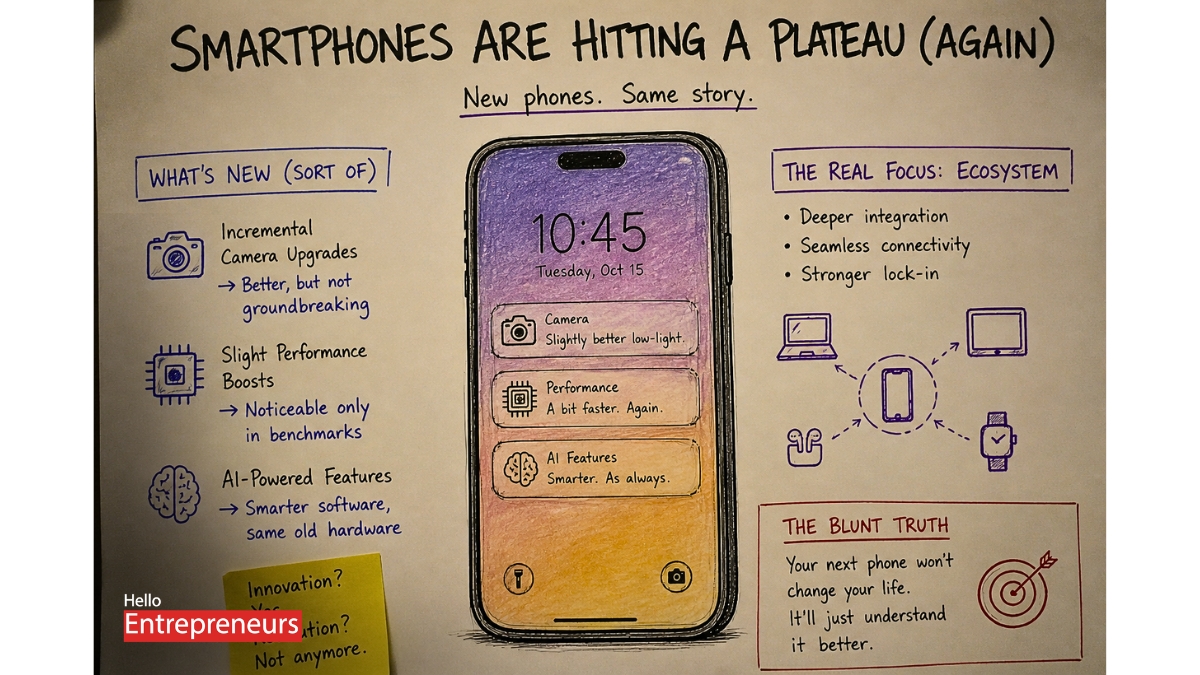
The latest leaks surrounding flagship devices from Samsung and Apple suggest a pattern that is becoming difficult to ignore:
- Incremental camera improvements
- Slight performance upgrades
- Another layer of AI-powered features
In other words, your next phone won’t reinvent your life.
It will simply… understand it better.
And apparently, that’s the upgrade.
The Plateau Nobody Wants To Admit
Let’s address the obvious: smartphones have matured.
- Displays are already high-resolution and smooth
- Cameras rival professional equipment in certain conditions
- Processors handle most tasks effortlessly
There’s only so much you can improve before improvements become… subtle.
Which is where we are now.
The industry hasn’t stopped innovating.
It’s just reached a point where innovation is less visible and more experiential.
The Shift From Hardware To Intelligence
If hardware is plateauing, something else has to take its place.
That “something” is AI.
Modern smartphones are increasingly defined by:
- Context-aware suggestions
- Real-time photo enhancement
- Voice and text prediction systems
- Personalized app experiences
The focus has shifted from what the device can do to how well it understands what you want it to do.
It’s less about power.
More about perception.
The Ecosystem Strategy (Because One Device Is No Longer Enough)
Companies like Apple and Samsung are no longer just selling phones.
They’re selling ecosystems.
- Smartphones connected to smartwatches
- Seamless integration with laptops and tablets
- Cloud synchronization across devices
The phone is no longer the center.
It’s the connector.
And that changes the way innovation is delivered.
The Positive Case: Stability, Reliability, Maturity
Let’s not pretend this is entirely disappointing.
A plateau has its advantages.
- Devices are more reliable
- Performance is consistently strong
- Users don’t feel pressured to upgrade annually
From a consumer perspective, this is… refreshing.
Technology that works well, consistently, without demanding constant replacement.
Almost suspiciously reasonable.
The Slightly Less Exciting Reality
Of course, there’s a flip side.
- Upgrades feel less compelling
- Innovation appears slower
- Premium pricing becomes harder to justify
When improvements are incremental, perception becomes critical.
And perception, as we know, is not always forgiving.
The Backstory: How We Got Here
Smartphones didn’t plateau overnight.
- Early years focused on rapid hardware advancements
- Competition drove aggressive innovation
- Consumer demand encouraged frequent upgrades
Eventually, the fundamentals were perfected.
- Screens reached optimal quality
- Cameras achieved high versatility
- Performance exceeded everyday needs
At that point, the industry had a choice:
Push hardware further… or redefine innovation.
It chose the latter.
The Economics Of Incremental Innovation
There’s a financial logic behind this shift.
- Developing groundbreaking hardware is expensive
- Incremental upgrades are more cost-effective
- AI features can be scaled across devices
Meanwhile:
- Flagship phones still command premium prices
- Ecosystem lock-in increases long-term revenue
- Services and subscriptions add recurring income
It’s not just about technology.
It’s about sustainability, financially and strategically.
The AI Layer: Subtle, Persistent, Slightly Unavoidable
AI isn’t replacing hardware.
It’s compensating for its limitations.
- Enhancing photos instead of upgrading sensors dramatically
- Improving performance through optimization rather than raw power
- Anticipating user needs instead of reacting to them
This creates a different kind of experience.
Less visible. More intuitive.
And occasionally… a little intrusive.
The Sarcasm (Because It’s Earned)
There’s something almost poetic about the situation.
We spent years asking for smarter phones.
Now we have them.
And they’ve decided the best way to impress us is by:
- Suggesting replies
- Editing our photos automatically
- Predicting what we’re about to do
Revolutionary? Perhaps not.
Efficient? Undeniably.
The Consumer Dilemma
For users, the decision becomes… complicated.
- Upgrade for minor improvements?
- Keep existing devices longer?
- Invest in ecosystems rather than individual products?
The traditional upgrade cycle is weakening.
Not because devices are worse.
But because they’re already good enough.
The Innovation Trade-Off
Every shift comes with compromises.
Pros:
- Consistent performance
- Enhanced user experience through AI
- Strong ecosystem integration
Cons:
- Reduced hardware excitement
- Incremental upgrades
- Increasing reliance on software-driven differentiation
It’s not stagnation.
It’s evolution, just not the kind that headlines easily.
The Industry Perspective: A Different Kind Of Progress
From a business standpoint, this plateau isn’t a problem.
It’s an opportunity.
- Focus shifts to services and ecosystems
- AI becomes a differentiator
- Customer retention improves
The goal is no longer to sell a device.
It’s to create an environment that users don’t want to leave.
The Bigger Pattern: Technology Becoming Invisible
What’s happening with smartphones reflects a broader trend.
Technology is becoming:
- Less noticeable
- More integrated
- Increasingly intuitive
The best devices are no longer the most powerful.
They’re the ones you don’t have to think about.
Which, ironically, makes them harder to market.
So, Is This The End Of Innovation?
Not quite.
It’s a transition.
- Hardware innovation will continue, but at a slower pace
- Software and AI will drive differentiation
- Ecosystems will define user loyalty
The excitement hasn’t disappeared.
It’s just… changed form.
The Final Thought: When Technology Stops Trying To Impress
The current smartphone plateau isn’t a failure.
It’s a sign of maturity.
Devices have reached a level where they don’t need to prove themselves.
They simply need to perform.
And perhaps that’s the real shift:
From technology that demands attention…
To technology that quietly earns it.
Which is efficient.
Elegant.
And, if we’re being honest, just a little less thrilling.
Read More: Chips With Passports

