



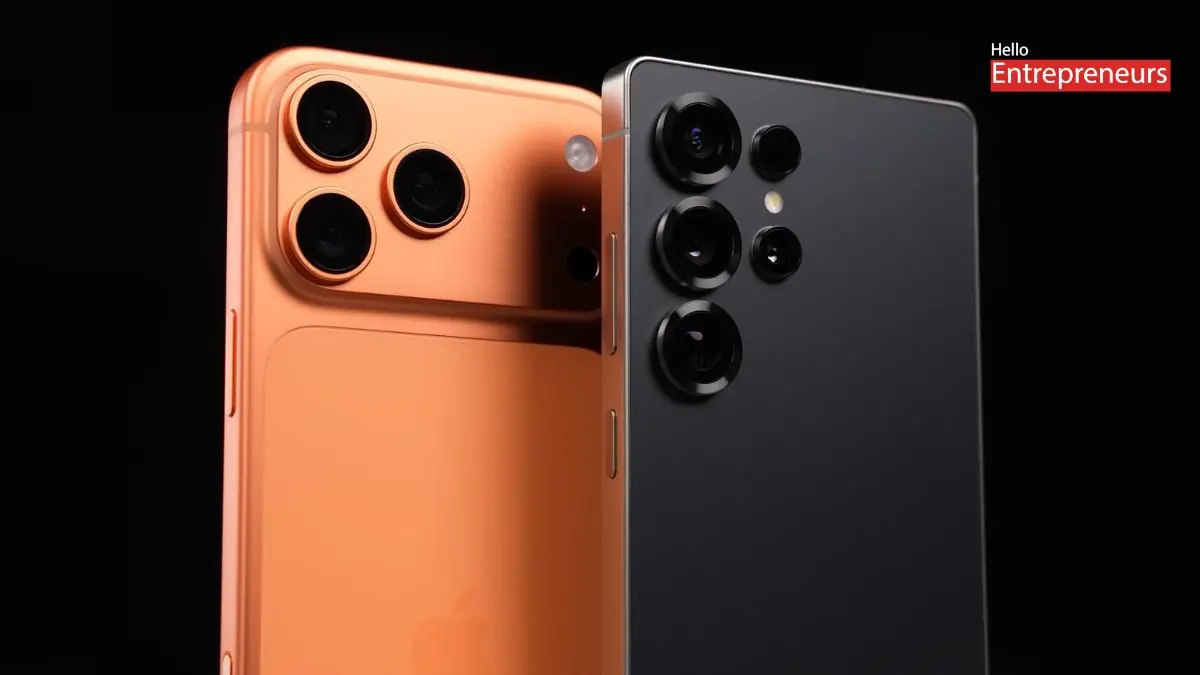
In 2025, the smartphone battle will be more intense than ever. This year kicked off with Samsung’s Galaxy S25 Ultra, followed by Apple’s heavily updated iPhone 17 series. After using both devices extensively for over a month, letting them stabilise with updates, it’s time to settle the debate: which flagship truly deserves your money?
Design and Build
Pick up either phone, and users immediately feel premium quality in users hands, but there are some significant differences worth noting. The S25 Ultra weighs around 218 grams, while the iPhone 17 Pro weighs 206 grams. Interestingly, Apple switched back from titanium to aluminium this year, seemingly acknowledging what other manufacturers have long known. The most talked-about feature is undoubtedly the iPhone 17 Pro’s massive horizontal camera bump. Love it or hate it, this bold design choice serves a purpose beyond aesthetics. The increased space allows for better heat dissipation through a vapor cooling chamber and accommodates a larger battery. The cosmic orange colour particularly makes this design stand out.
Samsung stuck with their refined boxy titanium design, protected by Corning Gorilla Glass Armor. It feels more incredibly premium and has proven its durability throughout the year. However, multiple of reports show that the iPhone 17 Pro’s camera plate edges scratching easily. Even with careful handling, our test unit developed visible scratches where the blue colour chipped off, despite spending most of its time in a protective case. Keep this phone away from keys and coins unless you want permanent reminders of user’s pocket contents. The S25 Ultra, used heavily throughout the year for photography and video work, shows minimal wear despite a few accidental drops. Both phones feature IP68 water resistance, but when it comes to durability, Samsung takes the crown here.
Display
Both devices sport massive, gorgeous screens, the S25 Ultra features a 6.9-inch display, while the iPhone 17 Pro has a 6.3-inch screen. Both run at buttery-smooth 120Hz refresh rates. Samsung claims 2,600 nits peak brightness, while Apple boasts 3,000 nits and in real-world testing reveals that the iPhone gets slightly brighter outdoors, but honestly, both excel in direct sunlight. The anti-reflective coatings on both devices are genuinely change the game. The S25 Ultra’s Gorilla Glass Armor gives it a slight edge for reduced glare, but when watching HDR content indoors, there will be minimal difference users can find of the devices. Both displays deserve top marks, and most 2025 flagships have mastered display technology.
Software
This is where preferences really matter, the S25 Ultra runs One UI 8 based on Android 16, while the iPhone 17 Pro ships with iOS 26. These represent fundamentally different philosophies. One UI 8 offers incredible customisation through Good Lock modules. Users can even control which apps run at 60Hz to save battery. The level of personalisation available is genuinely impressive. iOS 26 introduces a liquid glass design with more customisation options than ever before. Users can finally set any audio file as your ringtone, something Android users have enjoyed for years. Call screening and hold assist features are genuinely worthwhile additions that Android should consider adopting.
But here’s where things get uncomfortable for Apple fans: artificial intelligence. Galaxy AI and Google Gemini on the S25 Ultra demolish Apple Intelligence. The S25 Ultra generates perfect, grammatically correct text instantly. On the iPhone, writing tools are available only in native Apple apps and select third-party apps. Google’s Gemini assistant can guide you through cooking by watching through the camera or help locate lost items on your desk. Meanwhile, Siri struggles with basic queries, often misunderstanding simple questions. The gap in AI capabilities is significant and embarrassing for Apple. Both the devices promises seven years of updates, which is excellent for long-term ownership.
Performance and Battery Life
The S25 Ultra packs the Snapdragon 8 Elite processor, while the iPhone 17 Pro features Apple’s new A19 Pro chip. Both have 12GB of RAM. Benchmark numbers show the iPhone edges ahead in CPU performance, but the S25 Ultra leads in GPU tests. Real-world testing tells a more interesting story. Rendering a 4K video project in Instagram happens twice as fast on the S25 Ultra. Gaming performance is impressive on both, with no noticeable frame drops. However, the S25 Ultra offers advanced graphics options, including Vulcan rendering and frame interpolation, allowing games like Wuthering Waves to run at 120 FPS with ultra-high graphics at just 38 degrees Celsius. Battery life is solid on both devices. The S25 Ultra’s 5,000mAh battery with 45-watt charging lasts slightly longer than the iPhone 17 Pro’s 3,998mAh battery, though Apple now offers 40-watt fast charging. Samsung’s reverse wireless charging remains a convenient way to charge watches and earbuds on the go.
Camera
The S25 Ultra features four rear cameras, while the iPhone 17 Pro has an upgraded 48MP triple-camera system. Despite Apple’s claim of having “eight lenses,” there are only three. The S25 Ultra captures natural colours, while the iPhone produces punchier, more social-media-ready shots straight out of the camera. Samsung maintains its advantage in zoom photography, with the sharper text rendering and AI-enhanced image processing at higher zoom levels. The iPhone’s zoom has improved significantly, but still trails Samsung’s periscope capabilities. For video, both shoot in 4K at 120 fps. Samsung offers more versatile dual-capture options, including telephoto-to-main camera recording and the ability to save videos separately.
Final Thought
The Samsung Galaxy S25 Ultra wins this comparison. While the iPhone 17 Pro has improved considerably, Apple needs serious work in three areas: software refinement (iOS 26 is surprisingly buggy), artificial intelligence capabilities, and professional camera controls for creators. Samsung has refined their hardware and software combination beautifully, and with Galaxy AI, they’re miles ahead. For value, the Samsung’s S25 Ultra often drops below 1,00,000 rupees with discounts. If users absolutely need an iPhone, consider the iPhone 16 Pro Max at a similar price point, or if the users want the latest, go for the iPhone 17 Pro rather than the Pro Max. The choice ultimately depends on users ecosystem preference, but objectively, Samsung delivers more complete flagship experience in 2025.

