



New Delhi: There was a brief moment—fleeting, optimistic, almost naive- when the world believed the semiconductor crisis had settled down. Supply chip chains were stabilising, production was recovering, and consumer tech was slowly returning to normalcy.
And then Artificial Intelligence happened.
Not gently. Not gradually. But with the appetite for something that doesn’t intend to wait its turn.
Now, the shortage is back. Only this time, it’s not chaotic, it’s selective.
And that makes it far more interesting… and inconvenient.
The Shift From Scarcity To Prioritisation
The previous chip shortage was indiscriminate. Cars, consoles, smartphones, everything suffered.
This time, the supply isn’t disappearing. It’s being redirected.
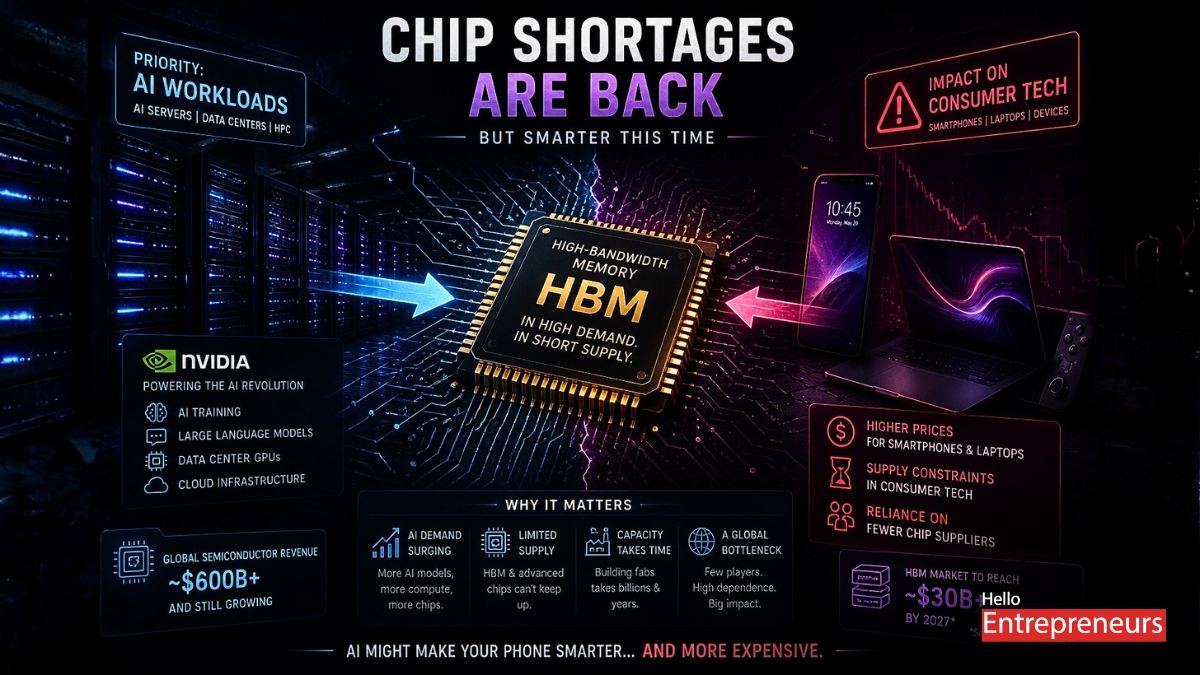
Companies like Nvidia are focusing heavily on Artificial Intelligence workloads, particularly high-performance chips and high-bandwidth memory (HBM).
Which means:
- Artificial Intelligence I servers get priority
- Data centers get the best hardware
- Consumer devices… wait
It’s not a shortage in the traditional sense.
It’s a hierarchy.
The Rise Of HBM: The Star Nobody Saw Coming
High-bandwidth memory, or HBM, has quietly become one of the most critical components in Artificial Intelligence infrastructure.
- Essential for training large Artificial Intelligence models
- Enables faster data processing
- Works closely with GPUs in Artificial Intelligence servers
Demand for HBM has surged dramatically.
Supply, however, hasn’t kept pace.
This creates a bottleneck—not across all chips, but in the ones that matter most for Artificial Intelligence.
And when one component becomes critical, the entire system adjusts around it.
The Economics Of Allocation
Let’s talk numbers, because they’re telling.
- Artificial Intelligence-focused GPUs can cost $10,000 to $40,000 per unit
- Data center investments are reaching hundreds of billions globally
- Semiconductor manufacturing expansion requires multi-year, multi-billion-dollar commitments
In comparison:
- Consumer devices operate on tighter margins
- Volume is high, but per-unit value is lower
So when supply is limited, allocation follows profitability.
It’s not personal. It’s mathematical.
The Positive Case: Smarter Systems, Faster Progress
To be fair, this shift is enabling significant advancements.
- Faster development of Artificial Intelligence models
- Improved cloud services
- Enhanced capabilities across industries
From healthcare to finance to logistics, Artificial Intelligence infrastructure is accelerating innovation.
And without prioritizing resources, that acceleration would slow.
In other words, the system is optimizing for impact.
Even if the side effects are… noticeable.
The Slightly Expensive Consequence
Now for the part consumers will feel.
- Smartphones may become more expensive
- Laptops could see price increases
- Availability of certain devices may fluctuate
Not dramatically. Not immediately.
But gradually.
Because when component costs rise, they rarely stay contained.
They travel—quietly but effectively—down the supply chain.
The Backstory: Why This Was Almost Inevitable
The semiconductor industry operates on long timelines.
- Chip fabrication plants take years to build
- Capacity planning is based on projected demand
- Sudden spikes are difficult to accommodate
Artificial Intelligence demand wasn’t sudden—but its scale was underestimated.
What started as a growing sector quickly became the dominant one.
And infrastructure, as it turns out, doesn’t pivot overnight.
The Supply Chain Reality
Semiconductor production is… concentrated.
A few key players dominate:
- Advanced chip manufacturing
- Memory production
- Packaging and integration
This concentration creates efficiency—but also vulnerability.
- Limited alternatives
- High dependency on specific suppliers
- Increased risk of bottlenecks
In a system this interconnected, pressure in one area affects the whole.
The Industry Perspective: Strategic, Not Reactive
From a corporate standpoint, prioritizing Artificial Intelligence makes sense.
- Higher margins
- Greater long-term impact
- Stronger competitive positioning
Companies like Nvidia aren’t just responding to demand—they’re shaping it.
Because in the current landscape, leading Artificial Intelligence development isn’t optional.
It’s existential.
The Sarcasm (Because It’s Deserved)
There’s something almost poetic about the situation.
Artificial Intelligence is designed to make devices smarter, faster, and more efficient.
And in the process, it might make those same devices:
- More expensive
- Less available
- Slightly harder to upgrade
Progress, it seems, comes with a premium.
Who could have predicted that?
The Consumer Dilemma
For everyday users, the impact isn’t dramatic, but it’s noticeable.
- Upgrade cycles may extend
- Price sensitivity increases
- Expectations shift
Consumers adapt.
They always do.
But adaptation doesn’t mean indifference.
It just means prioritization changes.
The Innovation Trade-Off
Prioritizing Artificial Intelligence infrastructure has broader implications.
Pros:
- Accelerated technological progress
- Improved global capabilities
- Stronger digital ecosystems
Cons:
- Reduced focus on consumer hardware innovation
- Increased costs across devices
- Greater centralization of resources
It’s not a zero-sum game.
But it’s not perfectly balanced either.
The Global Angle: A Concentrated Future
As demand grows, so does the importance of supply control.
- Countries investing in semiconductor manufacturing gain a strategic advantage
- Companies securing long-term supply agreements strengthen their position
- Smaller players face increasing barriers to entry
The result?
A more concentrated, more competitive ecosystem.
One where access matters as much as innovation.
So, Is This Temporary?
Short answer: partially.
Long answer: It depends on capacity expansion.
- New fabrication plants are being built
- Investments in memory production are increasing
- Supply chains are gradually diversifying
But these solutions take time.
Until then, prioritization remains the default strategy.
The Final Thought: When Intelligence Competes With Accessibility
The current chip shortage isn’t chaotic.
It’s deliberate.
Resources are being allocated where they create the most value, at least from an industry perspective.
And right now, that value lies in Artificial Intelligence.
Which leaves consumers in an interesting position.
Benefiting from smarter systems… while paying a little more for the devices that access them.
It’s not a contradiction.
It’s a consequence.
Because in a world where intelligence is scaling rapidly, accessibility doesn’t always keep pace.
Read More: The Billion-Dollar Arms Race

