



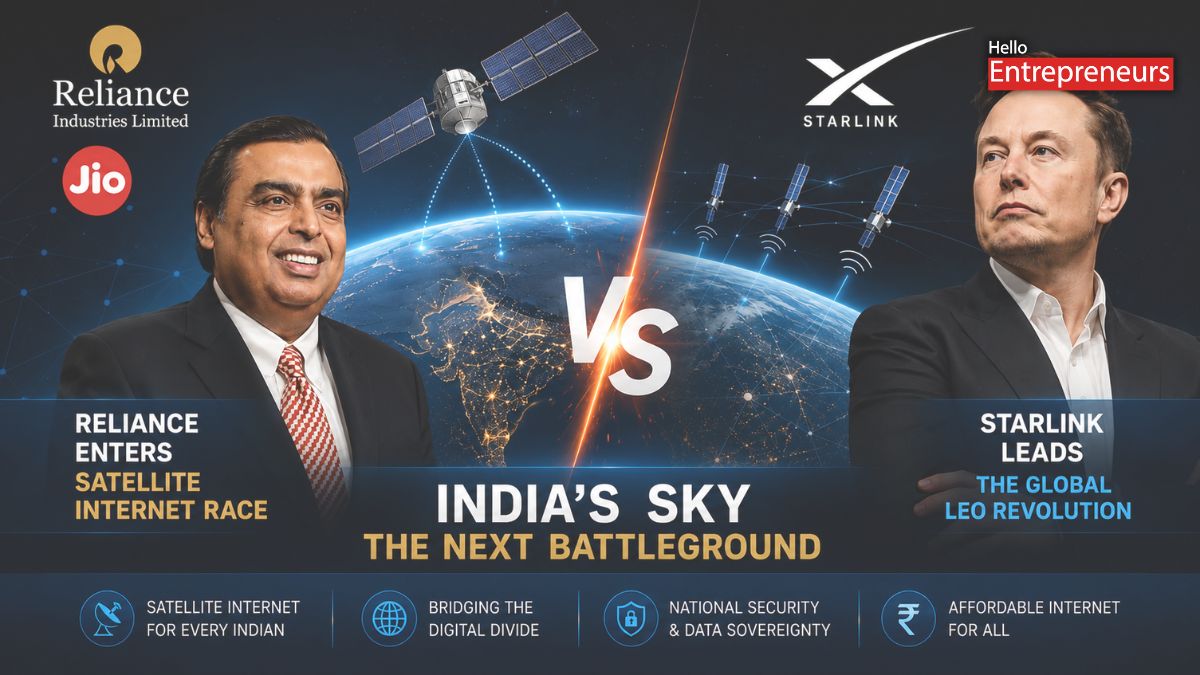
New Delhi: Reliance Industries, led by Mukesh Ambani, is getting ready for a big push into satellite internet. This could lead to a high-stakes showdown with Elon Musk’s Starlink in a rapidly growing digital economy.
Reliance has long wanted to expand Jio beyond dominant terrestrial telecoms and into space-based broadband using Low Earth Orbit (LEO) satellite tech. Now, it’s finally happening.
A Gap-Driven Market
Even with fast digital adoption, much of India still struggles with connectivity. Fiber rollout in remote and rural areas remains slow and costly. Satellite internet’s promise of beaming connectivity straight from space has made it a serious option.
As LEO satellites orbit much closer to earth than traditional geostationary systems, industry watchers say they can deliver much lower latency to enable faster, more reliable internet, similar to ground-based broadband.
Starlink’s Regulatory Woes
Starlink may already have launched thousands of satellites globally, but regulatory scrutiny has stalled its India foray. The government has brought up questions of data, spectrum, and foreign ownership, holding back commercial rollout licenses.
That has opened a window for homegrown businesses.
Reliance’s Dual Strategy
According to reports, Reliance has formed several specialized teams to speed up its satellite plans, focusing on satellite design, launch abilities, and consumer equipment.
The company is using a two-part plan:
- Talking with the Department of Telecommunications (DoT) for spectrum and orbital slot approvals
- Looking into buying current satellite companies to quickly get technology and operational licenses
- This kind of plan could greatly shorten timelines in a field where building infrastructure is usually slow and costly.
National Security and Strategic Needs
The move into satellite internet also fits with India’s bigger goal on digital control. With worldwide companies like Amazon moving forward with projects such as Project Kuiper, satellite communications are more and more seen as important systems with effects for national security.
A locally managed satellite network could lower dependence on foreign networks and boost India’s place in the changing global space market.
Disruption Potential
Reliance’s history in telecom—especially its price-cutting plan during Jio’s start—shows it might use a similar plan in satellite broadband. Experts think low prices will be a big area, especially as Starlink’s equipment costs stay fairly high for widespread use in India.
While Starlink keeps a technology edge, Reliance’s strong market knowledge, regulatory fit, and size could change how the competition works.
Future Perspective
The rising battle between Reliance and Starlink highlights a wider change in India’s digital world—from land-based systems to space-based connections.
With competition heating up, experts predict better service and lower prices for users, which could help spread internet use in less connected areas.
India’s next chapter in connectivity, it seems, won’t just be constructed on earth—but in the skies.

