



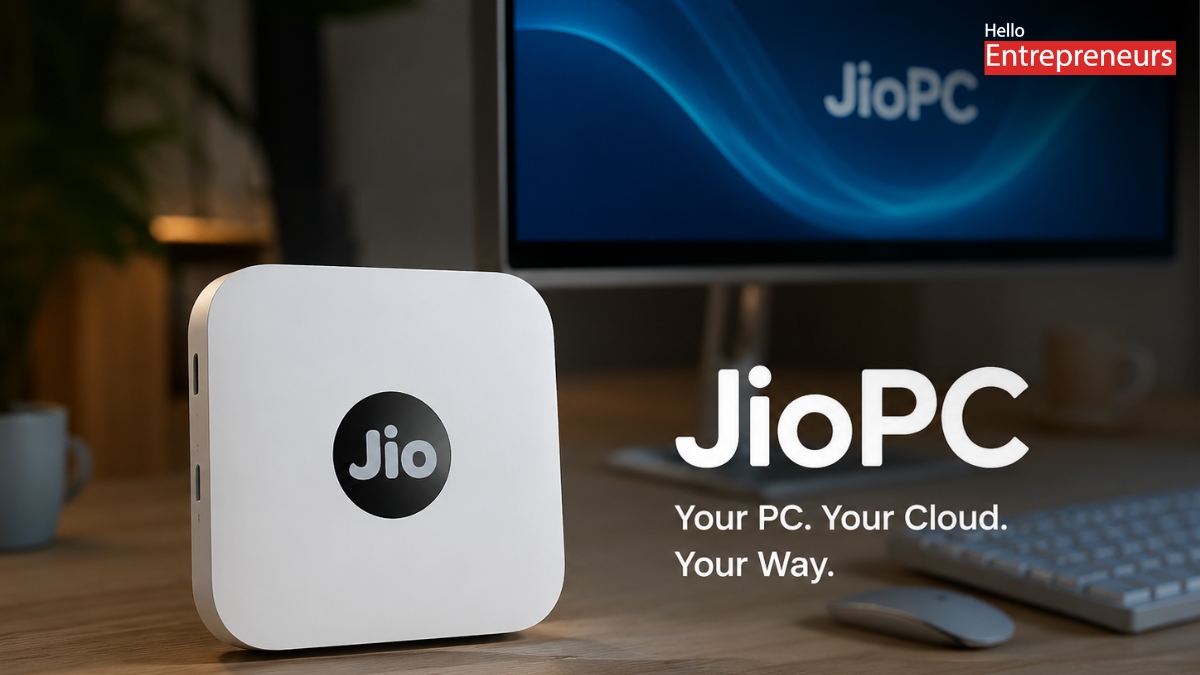
Reliance Jio has opened its JioPC cloud computing service to all internet users in India, removing the earlier restriction that limited access to JioHome broadband subscribers. The move, announced on Wednesday, positions the telecom giant as a provider of AI-ready virtual desktops for millions of Indians using aging hardware, with entry-level plans starting at around $11 for two months.
Pricing and Plans
JioPC streams a full virtual Windows desktop from Jio’s cloud infrastructure to a user’s existing computer, laptop, or thin client. The service is now available as a standalone subscription, independent of the user’s internet service provider.
The company has rolled out three main annual plans, along with a short-term option:
₹1,000 for 2 months: 4 vCPU, 8GB RAM, 256GB storage
₹4,000 for 12 months: 4 vCPU, 8GB RAM, 500GB storage
₹4,500 for 12 months: 6 vCPU, 12GB RAM, 750GB storage
₹5,000 for 12 months: 8 vCPU, 16GB RAM, 1TB storage
These configurations aim to cover everything from basic office work and online classes to more demanding tasks such as coding, design, and light video editing. Users can subscribe and activate the service in under five minutes through the JioPC app or website.
Stretching PC Lifecycles in India
The expansion comes as PC replacement cycles in India lengthen. Industry researcher IDC estimates that India had more than 65 million PCs in use in 2025, split between roughly 34 million consumer and 31 million commercial machines. Consumers and small businesses now replace hardware every five to six years, up from four to five years in 2022, IDC senior market analyst Bharath Shenoy told TechCrunch.
Jio says JioPC can give computers as old as eight years the performance needed for modern applications, including AI tools, without requiring a hardware upgrade. For households and small enterprises that cannot justify spending ₹30,000–₹60,000 on a new machine, a cloud PC at ₹1,000–₹5,000 a year offers a low-cost alternative.
Prabhu Ram, vice president of the industry research group at CyberMedia Research, told TechCrunch that Jio is “broadening its value proposition by opening JioPC to non-Jio users, while also challenging the traditional hardware upgrade cycle.” He added that the model is unlikely to replace conventional PCs entirely, but could serve students, home users, and micro-businesses “for whom buying a new AI-capable PC was never really on the table to begin with.”
Connectivity and Competition Challenges
Despite the promise, JioPC’s dependence on a stable internet connection remains its central vulnerability. Any network disruption can interrupt the experience, unlike a traditional PC that continues to work offline. This is particularly relevant in smaller cities and towns, where affordable computing has significant growth potential but network quality can be inconsistent.
Refurbished and second-hand PCs also compete at the low end, offering ownership without reliance on continuous connectivity, Shenoy noted. For some users, a one-time purchase of a used machine may still feel more predictable than an ongoing subscription tied to network performance.
In addition, Jio has not disclosed the exact hardware powering JioPC’s cloud infrastructure. Its published specifications do not mention dedicated AI accelerators for on-device generative AI workloads — a key selling point of the latest “AI PCs” from global vendors. The real test, Ram said, is whether Indians come to see cloud computing as a “daily utility” rather than an “opportunistic workaround.”
Strategic Implications for Jio and India’s Tech Market
For Reliance Jio, opening JioPC to all users strengthens its push into enterprise and prosumer services beyond consumer mobile and broadband. The company already operates one of India’s largest 5G networks and has been investing heavily in data centres and cloud infrastructure. JioPC allows it to monetise that infrastructure directly, while locking more users into the broader Jio ecosystem of apps, payments, and digital services.
At a national level, the service aligns with India’s push for digital inclusion and productivity. By lowering the effective cost of a “modern” computer, JioPC could help more students, freelancers, and small businesses access software and AI tools that previously required expensive hardware. If adoption scales, it may also influence how Indian IT departments think about desktop provisioning, especially for remote and hybrid work.
What Users Need to Know
To use JioPC, users need:
A Windows, macOS, or Android device (even an old laptop or low-spec PC)
A stable broadband connection (Jio recommends at least 10–15 Mbps for smooth performance)
A JioID account and the JioPC application
Once subscribed, users log in to a virtual desktop that behaves like a normal PC, with persistent storage and the ability to install supported applications. Data is stored in Jio’s cloud, not on the local device.
For journalists, content creators, and small offices in cities like Surat, the service could be particularly useful for running multiple browser tabs, office suites, and design tools on older machines, provided internet connectivity is reliable.
As cloud computing matures in India, JioPC’s open launch marks one of the first large-scale attempts to make virtual desktops a mass-market product. Its success will depend on network reliability, pricing perception, and whether users trust the cloud enough to run their daily workloads there.

