



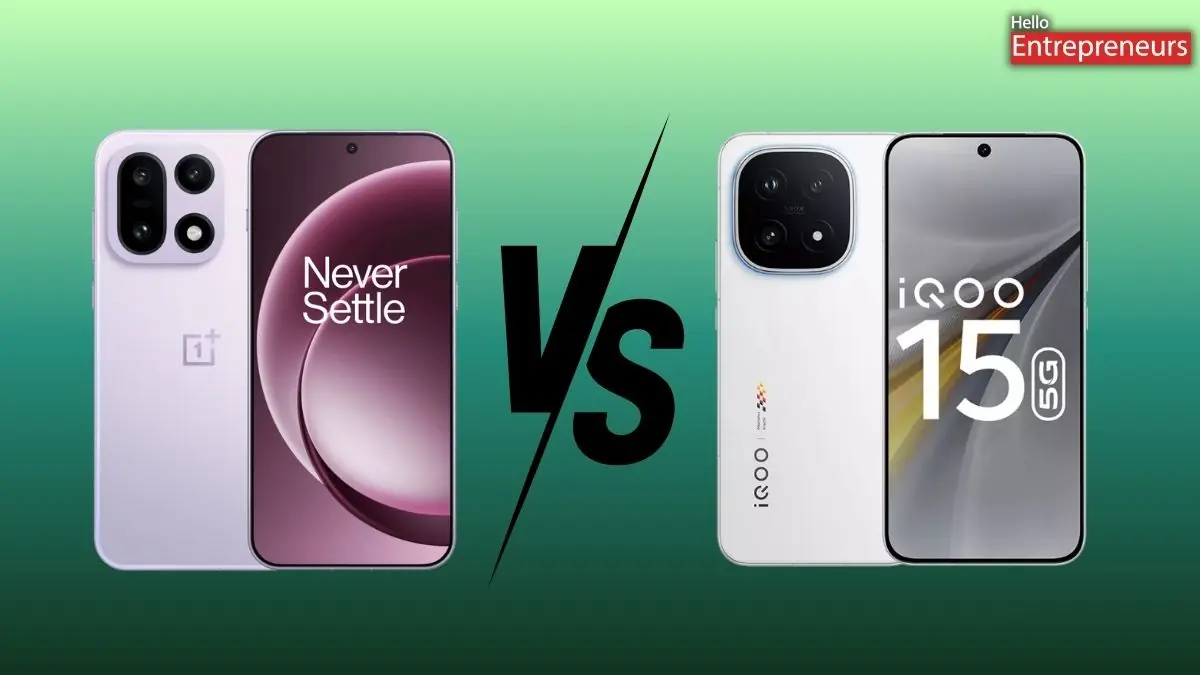
New Delhi: The flagship smartphone market just got more interesting with the recently launch of two powerhouses: the OnePlus 15 and the iQOO 15. Both phones pack the same Snapdragon 8 Elite chip, but they take different approaches to what a flagship should be. The OnePlus 15 has faced some criticism for certain downgrades despite of its premium price tag of ₹72,000, while the iQOO 15 comes with the slightly cheaper while upgrading several features. This comparison breaks down everything for the users that need to know to make the right choice.
Design and Build
At first glance, these phones look like they rolled off the same assembly line. Both feature flat fronts, flat aluminum frames, and rounded corners. Users can get either in glass or fiberglass depending on your color preference. However, the OnePlus 15 feels noticeably lighter in hand, regardless of which material you choose.
The iQOO 15 carries forward with the gaming-focused design language from its previous models, complete with a racing flag motif on the back and a large camera island. The standout feature is the RGB ring light that glows for calls, music, and notifications just like the Nothing designs. It’s flashy and eye-catching, perfect if users want their phone to stand out in public.
The OnePlus 15 takes the opposite route with a minimal, understated aesthetic. The design feels more premium and classy, though that’s certainly subjective. Instead of the RGB lights, users get the Action Button or Plus Key that provides quick access to AI features and customizable shortcuts. This practical addition is something the iQOO simply doesn’t offer to the users that OnePlus is offering.
For durability, the OnePlus 15 features micro arc oxidation on the frame for extra toughness, Gorilla Glass Victus 2 on the front, and Gorilla Glass 7i on glass-back models. It boasts comprehensive IP ratings including IP68, IP69, and even IP69K the highest protection users seen on a smartphone. The iQOO 15 counters with Schott Xensation Alpha glass on the front, Schott Xensation Up on the back, and IP68/IP69 ratings, which is still flagship-grade protection and by this device will be protected from several damages that usually get on the device after long term of usage.
Display
This is where things get really interesting. The OnePlus 15 sports ultra-thin, perfectly symmetrical bezels that give it a more expensive look. The iQOO 15 has slightly thicker bezels with a marginally larger chin, though you need to look closely to notice. The iQOO 15 uses Samsung’s new M14 LTPO OLED panel in a 6.85-inch configuration with 144Hz refresh rate, 2K resolution, and brightness reaching up to 2,600 nits in high brightness mode. It also comes with an anti-reflective film out of the box that does an excellent job canceling glares.
The OnePlus 15 features a slightly smaller 6.78-inch LTPO AMOLED display with a faster 165Hz refresh rate, but the resolution drops to 1.5K and peak brightness hits 1,800 nits. Both displays support HDR10+, Dolby Vision with Netflix certification, 1-nit minimum brightness, and 2160Hz PWM dimming. The iQOO 15’s display wins in most areas because it’s brighter, sharper, and more vibrant with richer accurate colors this device offers while streaming or doing any other tasking. The OnePlus 15 delivers more color-accurate output in default modes and slightly better HDR video playback with cleaner highlight control. While the OnePlus offers 165Hz, it only works in select games, and both phones support frame interpolation anyway. Given that users appreciate the sharper resolution every single day, the iQOO 15 takes this round.
Audio and Haptics
Both phones feature dual symmetrical stereo speakers with dedicated units on the top and bottom frames. They both gets impressively loud, but the OnePlus 15 sounds more wider, airier, and delivers better bass response whereas iQOO don’t offer that to the users. The haptics tell a some different story. OnePlus has long been known for excellent haptic feedback, and the OnePlus 15 delivers crisp, strong vibrations, though it’s a slight downgrade from the OnePlus 13. The iQOO 15, however, is on another level entirely with its dual-axis vibration motor. It feels stronger, more precise, and ranks among the best haptics available on any smartphone today.
Performance
Both phones run the Snapdragon 8 Elite paired with either 256GB or 512GB of UFS 4.1 storage and 12GB or 16GB of LPDDR5X RAM. The iQOO 15 includes a dedicated Q3 supercomputing chip and the largest vapor chamber cooling system we’ve seen on a phone. The OnePlus 15 uses its OP Gaming Core technology with a 360-degree Cryo Velocity cooling system featuring a smaller vapor chamber but with additional cooling layers under the display and back cover.
Benchmark results show that the iQOO 15 scoring 3.8 million in AnTuTu points compared to the OnePlus 15’s 3.5 million. In real-world gaming, both the phones deliver much fantastic performance. The OnePlus 15 can run certain games at 165 FPS natively, while the iQOO 15 maxes out at 144 FPS. However, the iQOO 15 stayed cooler during intensive gaming sessions and it also delivered slightly higher FPS with better smoothness in most titles. The iQOO 15 also supports ray tracing in Genshin Impact for better reflections and shadows, something the OnePlus doesn’t offer.
Camera
The camera department has been controversial, with the OnePlus 15 facing criticism for hardware downgrades. Both phones feature triple 50-megapixel rear cameras and 32-megapixel front cameras, though the OnePlus adds autofocus to the selfie camera. The iQOO 15 produces contrasty, colorful photos but loses some detail. The OnePlus 15 captures more detail with the slightly warmer, more realistic colors and better HDR. In low light, the OnePlus has generally delivers more sharper, cleaner shots with more natural accurate colors.
The telephoto camera is where the iQOO fights back with its 3x camera featuring a wider aperture and bigger sensor. It also captures more detail and dynamic range of pictures, particularly in the portrait mode with better edge detection. However, the OnePlus produces more accurate skin tones. For video, the OnePlus 15 supports 8K at 30fps, 4K at 120fps, Dolby Vision, and log recording. The iQOO 15 is limited to 8K at 30fps and 4K at 60fps with no HDR or log support. Overall, the OnePlus 15 has proves to be the most better all-around camera device.
Software and Updates
Oxygen OS on the OnePlus 15 remains smoother and more refined than iQOO’s Origin OS. While Origin OS looks modern and includes useful features, it doesn’t quite match Oxygen OS in polish and animation fluidity. Both phones come with some bloatware, though the iQOO includes ads in global search and additional notifications. The iQOO 15 wins the update battle with five years of OS updates and seven years of security patches, compared to the OnePlus 15’s four years of OS updates and six years of security patches.
Battery Life
The iQOO 15 packs a 7,000mAh battery while the OnePlus 15 has a slightly larger 7,300mAh battery, both using silicon-carbon technology. The OnePlus 15 demonstrated better battery efficiency in testing. It charges fully in 45 minutes with its 120W charger, while the iQOO 15 takes about 55 minutes with its 100W charger. The OnePlus has also offers faster 50W wireless charging compared to the iQOO’s 40W wireless charging in this OnePlus get’s an point.
Final Decision
Both phones ended up remarkably close in this comparison, each excelling in different areas. The iQOO 15 offers a brighter display, superior haptics, slightly better gaming performance, and longer software support. The OnePlus 15 counters with the more polished software, with the better overall cameras, longer battery life, and with the faster charging support. User choice will ultimately depends on their priorities what they actually want in their device. Gamers who value display quality and cooling performance should lean toward the iQOO 15. Those wanting refined software, versatile cameras, and a more understated design will prefer the OnePlus 15. Both are excellent flagships that won’t disappoint.