



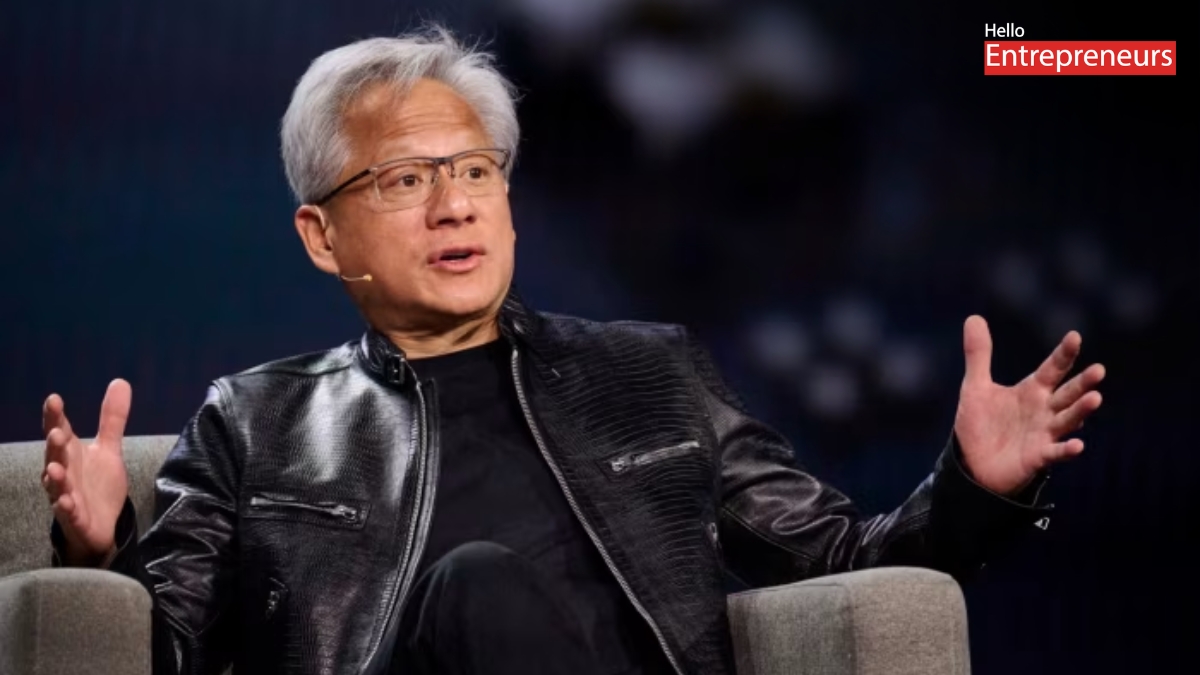
Nvidia CEO Jensen Huang has urged India to accelerate its artificial intelligence (AI) ambitions, saying the country’s deep-rooted IT industry gives it a strong base to build a domestic AI economy.
“AI is moving fast, so every country has to move faster,” Huang told reporters on the sidelines of the G20 Innovation Ministerial here on Wednesday.
Huang described AI as the start of a new technology platform and said India, as one of the world’s leading IT powers, is well placed to leverage this moment. “I’m really anxious to see and very excited to see the local companies and the local startups starting in India, starting to take advantage of the technology, contributing to the technology, and then building the local AI economy with it,” he said.
A decade-long conversation with Modi
The Nvidia chief recalled early discussions with Prime Minister Narendra Modi on AI, underscoring that India’s push in the field is not new. “I had the benefit of seeing Modi ji a decade ago talking about AI,” Huang said.
His comments come as India steps up efforts to expand its semiconductor and AI capabilities. The government has committed more than Rs 10,000 crore to the IndiaAI Mission launched in 2024, while Modi recently announced AI-skills training for 10 million young Indians during his Independence Day speech this year.
Minister of State for Commerce and Industry and Electronics and IT Jitin Prasada, who is leading the Indian delegation at the ministerial, welcomed Huang’s remarks. “It is the result of the visionary leadership of the Honorable Prime Minister Shri Narendra Modi ji that today India is leading the next wave of the global technology and AI revolution,” Prasada said.
AI as infrastructure, not just technology
In a fireside chat with US Commerce Secretary Howard Lutnick at the ministerial, Huang framed AI as essential economic infrastructure, on par with water, roads, electricity and the internet.
He described AI as a “five-layer cake” — energy, chips, infrastructure, AI models, and data and applications — and said countries should choose which layers to invest in rather than trying to build all of them. “You can’t outsource all of your intelligence to somebody else,” Huang said. “You have to use as much of it as you can, build as much as you need to.”
While the United States aims to lead by building the full stack, Huang said other nations could develop their own AI economies by selecting components suited to their strengths. For India, he pointed to a combination of existing software and IT capabilities with AI computing, applications and startups as a viable path.
Regulate harm, not hypotheticals
On AI regulation, Huang cautioned governments against rules based on speculative risks. “The advice that I would have is to regulate practical and actual harm and not regulate theoretical and hypothetical harm,” he said.
He argued that AI is still in its formative stage and that regulation should allow the technology to develop while addressing genuine risks. Huang compared AI safety to improvements in automobile technology over the past century, saying more advanced systems would become safer, not more dangerous.
“Every single company has to take it upon themselves to develop the technology safely,” he added, noting that AI systems had already improved considerably over the past two years, with fewer hallucinations and better factual grounding.
Global push for AI infrastructure
Huang’s remarks came as G20 ministers gathered in Chapel Hill for a summit focused on AI development, regulation and cooperation. Alongside Huang, other top AI executives, including OpenAI CEO Sam Altman, addressed ministers on how the world’s largest economies should approach the technology.
Huang urged G20 countries to build more data centres to support the AI revolution, warning that leaders who overemphasise the technology’s dangers risk leaving their nations behind. “In the end, what every single country will have to recognize is that (AI) is infrastructure… Every single country needs to build infrastructure so that you can support your own local economy,” he told ministers.
India’s AI moment
For India, Huang’s message is both an endorsement and a challenge. The country’s established IT sector, large pool of engineers and growing startup ecosystem provide a strong foundation. But with AI advancing rapidly, the window to shape a domestic AI economy — rather than simply consume foreign models — may not stay open for long.
As Prasada put it, India is moving forward with “full commitment to building a robust indigenous AI ecosystem through the capabilities of our local innovators and youth.”
For Huang, the next decade will determine whether India translates its early conversations about AI into a homegrown technology stack that powers its own economy — and contributes to the global AI landscape.

