



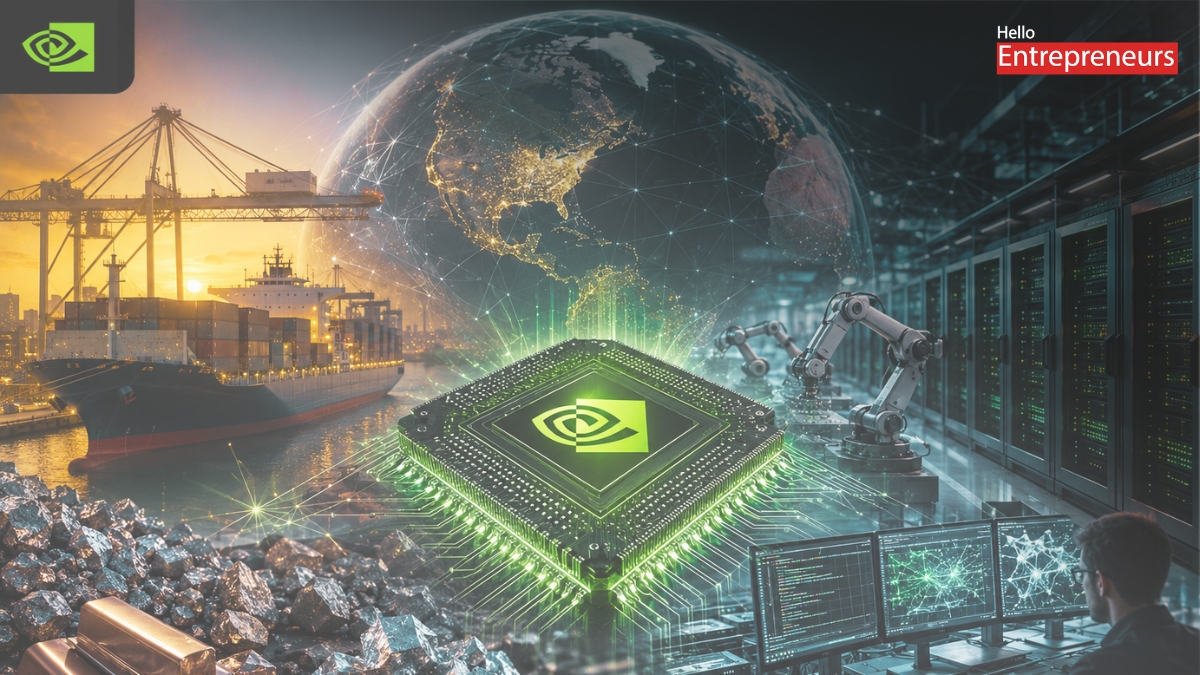
The number is almost too large to process: $58.3 billion.
Not dealt in annual revenue. Not an experiment with a decade-lived investment fund. A single quarter’s profit from a single company, Nvidia, powered by the charged global rush to rule artificial intelligence.
For months, we have since been buried under breathless rhetoric from the endlessly excited about AI re-decoding human society. Much of it sounded like marketing copy pretending to be prophetic. But nontheless, profit margins this huge have made it impossible to miss in all of it. Women of this magnitude are not marketing; they are proof. They are industrial beacons.
And the beacon coming from Nvidia is clear: the biggest corporations in the world are no longer playing with artificial intelligence. They are reconstructing the pillars of the global economy to use it.
People still think of AI mostly in terms of novelty. Chatbots. Image generators. Automatic summaries. Smart digital minions that shave off minutes of repetitive tasking. But the real drama happening in boardrooms and data centers is far more significant.
The technology industry is now sprinting toward fully autonomous enterprise systems , software ecosystems that navigate processes, execute decisions, optimize logistics, run operations and function with minimal human involvement. This is not about asking your chat assistant to write an email. This is about the creation of digital infrastructure that will manage supply chain logistics, finance, production robotics, cyber attacks and eventually entire layers of commerce on their own.
This degree of machine autonomy requires something massive underneath: computational power at a historic scale.
Nvidia has become the industrial armature of that vision.
Their chips have become strategic infrastructure. They are the kind of rail steel during the railroad era, or crude oil during the era of the automobile, on which governments and markets and arguably the most powerful technology companies in the world have always had an understanding. That is why billions of dollars are now pouring in for AI hardware with the kind of urgency national defense thinking and national energy transition thinking usually requires.
The more ironic detail is that the so-called virtual AI economy is becoming one of the most physical industries in the world.
Every AI model relies on sprawling data centers that use huge quantities of electricity and water. Every state-of-the-art semiconductor relies on delicate supply chains that span the planet. Undersea cables, cargo shipping, geopolitically fraught trade routes, rare earth metals, complex lithography machines and cooling equipment all lie under the machine that is artificial intelligence.
The cloud has always been physical. AI is just a magnitude to that fact.
A 211 percent profit increase does not happen in a vacuum. It cascades across copper markets, power grids, shipping lanes and national defense concerns. It rewires diplomatic calculations. It influences how governments view semiconductor sovereignty. It is no longer an economic refrigeration event that only happens in Silicon Valley. It is an emerging geopolitical contest over compute itself.
That is also why semiconductor policy has become part of strategic statecraft.
The United States wants to maintain technological dominance. China wants to diversify away from the crib of Western chip ecosystems. Europe wants digital sovereignty. And India wants to be an engine for the manufacturing side and a talent engine for the AI side of the next industrial cycle. Whatever you might say to the contrary on the surface, what people really want from public addresses on innovation is the same. We desperately want to produce on a scale that will shape our world in the coming decades. Of those who can control the infrastructure for advanced compute, they will control the future of general economic power.
But it’s not all abstract and theoretical.
Despite the enormous corporate wealth involved, this is rapidly becoming tangible.
These are the systems that will eventually be around us in ways that will have far more impact on our lives than the stock market and quarterly earnings calls. AI-powered logistics networks will reduce food waste and stabilize global supply chains, advanced simulation systems will fuel drug development and materials research, autonomous industrial systems will revolutionize manufacturing productivity, and whole new professions will appear which are no longer focused around repetitive, manual labor but rather on collaboration with machines.
That is why Nvidia’s earnings are relevant outside of Wall Street.
Nvidia’s unprecedented growth story is not just a story about investors’ confidence; it’s a story about how aggressively humanity is now funding the building of its new operating system.
History disguises industrial revolutions as they are happening. The railroad rush looked disordered before it looked inevitable. The internet seemed over-hyped before it seemed impossible to live without. Artificial intelligence is now arriving at that same transition point, leaving the realm of speculative hype and entering the realm of physical infrastructure deployment.
The gold rush phase is coming to a close.
The heavy machinery has made its debut.
And somewhere inside warehouses full of servers, inside cleanrooms creating microscopic circuitry, and inside data centers whirring through the night, the ground for the next economic era is already being poured.

