



Mumbai: Nvidia spent years selling the shovels in the artificial-intelligence gold rush. Apparently, being fabulously rich from shovels was no longer sufficiently interesting.
The chip giant has agreed to acquire Hugging Face for $12.93 billion, giving Nvidia control of one of the most important platforms used by developers to discover, test, customise and deploy open AI models. The transaction is expected to close in the first half of 2027, subject to regulatory approvals and other customary conditions.
The headline says acquisition. The more consequential story is distribution.
Nvidia already dominates the infrastructure used to train and run artificial intelligence. Hugging Face places it much closer to the moment developers actually decide which model to use, how to deploy it, and eventually what computing infrastructure sits underneath it.
Owning the engine was lucrative. Owning part of the road map is rather more interesting.
What Nvidia Is Actually Buying
Hugging Face is considerably more than a repository with an unusually cheerful emoji.
According to Nvidia, the platform is used by more than 18 million developers, researchers and creators, as well as over 200,000 companies. Its ecosystem contains more than 3 million models, 500,000 datasets and 1 million applications.
The acquisition agreement values the transaction at precisely $12,930,300,000. Nvidia’s regulatory filing says approximately $11.9 billion will go to Hugging Face shareholders, while as much as $1 billion has been earmarked for an equity-based retention programme for employees who join Nvidia.
That is quite a leap for a company valued at $4.5 billion in its 2023 funding round. Hugging Face had raised roughly $400 million from investors before the transaction.
In startup mathematics, apparently, three years can turn $4.5 billion into nearly $13 billion. Compound interest wishes it had that sort of personality.
Why OpenAI Suddenly Matters So Much
The deal arrives as the economics of artificial intelligence begin to evolve.
Open-weight models allow companies to download, customise and deploy AI systems with considerably more control than many closed platforms provide. For enterprises trying to contain inference costs or keep sensitive workloads closer to their own infrastructure, that flexibility is becoming strategically valuable.
Nvidia benefits whichever model wins, provided enough of those models ultimately consume Nvidia computing.
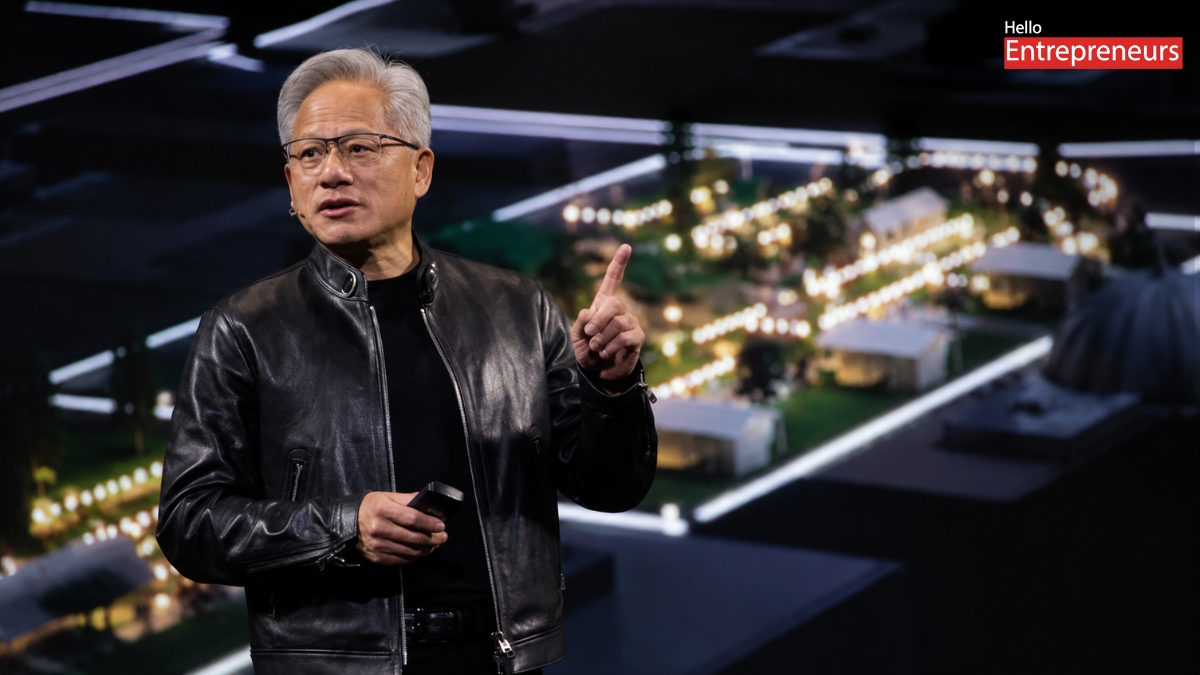
CEO Jensen Huang has therefore made an important promise: Hugging Face will remain open. Developers will continue to be able to choose competing models, clouds, inference providers and hardware, and Nvidia compute will not be mandatory.
That commitment is not decorative. It may determine whether the acquisition succeeds.
The Attractive Part Of The Deal
For Hugging Face, Nvidia brings capital, infrastructure and extraordinary computing resources. The platform could scale faster, strengthen reliability and offer developers deeper tools for training and deployment.
For Nvidia, the benefits stretch beyond immediate revenue. Hugging Face provides proximity to millions of developers and visibility into what the AI community is actually building.
That information can influence future chips, software frameworks, inference products and enterprise services.
The financial muscle is certainly available. Nvidia reported $96.2 billion in quarterly revenue for its fiscal second quarter of 2027, including $89 billion from Data Center, both more than double their year-earlier levels.
Its shares closed at about $230.35 on September 4, putting its market capitalisation around the $5.5 trillion mark.
Against that backdrop, $12.93 billion is enormous in normal-company terms. For Nvidia, it is closer to a very expensive strategic chess piece.
And Then Comes The Awkward Question
Can a platform celebrated for openness remain genuinely neutral after being owned by the world’s dominant AI-chip supplier?
That is the obvious tension.
Hugging Face currently works across competing silicon, cloud platforms and AI frameworks. Developers trust it partly because the ecosystem is broader than any single vendor.
If Nvidia begins favouring its own hardware too aggressively, it could damage precisely the neutrality that made Hugging Face valuable.
Regulators may also scrutinise whether combining Nvidia’s hardware position with such an influential developer platform gives the company excessive influence across the AI stack. The transaction has not closed yet, and regulatory approval remains a condition.
So Nvidia inherits an unusual problem: it has paid almost $13 billion for something whose value partially depends on behaving as though Nvidia does not own it.
Delightfully inconvenient.
From Chipmaker To AI Gatekeeper
The broader trajectory is difficult to miss.
Nvidia is no longer merely a GPU company. CUDA gave it a software moat. Networking broadened its infrastructure reach. AI systems pushed it further into complete data-centre architecture. Hugging Face now brings the company closer to models, developers, and deployment decisions.
That could strengthen OpenAI by giving its largest community platform significantly more resources.
It could also concentrate another important layer of artificial intelligence around one extraordinarily powerful company.
Both things can be true.
And perhaps that is the real significance of the deal. Nvidia no longer seems satisfied with powering the AI economy from underneath.
It wants a seat wherever the next AI application gets built.
Read More: AI’s 2026 Memory Hunger

