



Mumbai: For years, the global technology race has been narrated almost entirely through the vocabulary of artificial intelligence. Bigger models. Faster chips. More GPUs. More data centres. More announcements that promise to change civilisation before lunch.
India’s next technology chapter, however, is beginning to look considerably more complicated — and potentially more consequential.
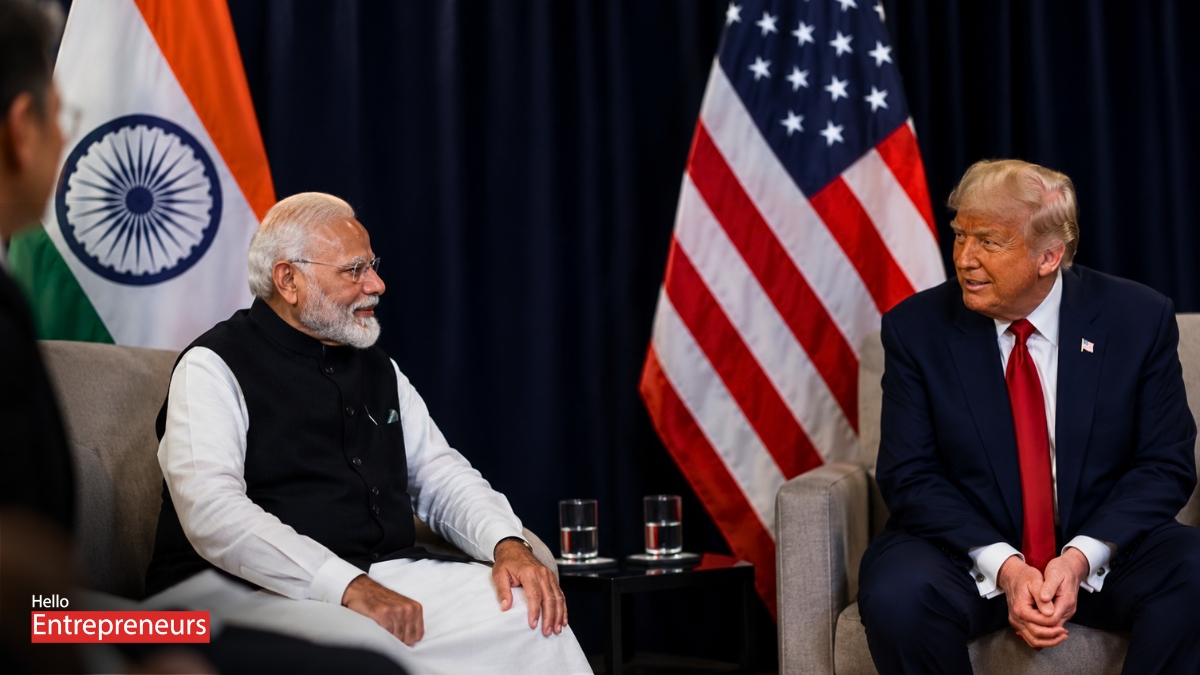
A renewed push for deeper India-US cooperation across artificial intelligence, quantum technology and semiconductors signals a broader ambition: building the infrastructure, scientific capabilities and supply chains that sit underneath the AI economy. The idea is no longer simply to consume advanced technology, but to participate in the systems that create and power it.
And, naturally, that is where things become interesting.
From AI Ambition To Technology Infrastructure
The India-US technology relationship has already moved beyond diplomatic handshakes. The two countries launched the TRUST initiative in 2025 to encourage cooperation between governments, academia and private companies across AI, semiconductors, quantum technology, biotechnology, energy and space. The initiative also called for greater collaboration on AI infrastructure, computing capacity and processors.
More recently, Indian and US officials have stressed that the private sector will be crucial in turning these frameworks into actual projects. India’s strengths in talent, digital infrastructure and mission-driven technology programmes could complement American research, capital and industrial capabilities.
That distinction matters. A memorandum can create optimism; factories, research laboratories and commercial products create economic value.
India is already putting serious money behind the semiconductor side of the equation. As of June 2026, 12 semiconductor projects had been approved with an investment pipeline of around ₹1.64 lakh crore, while three facilities had entered commercial production.
Then came Semicon 2.0, approved in July with a budget outlay of ₹1,27,500 crore, aimed at expanding India’s semiconductor design and manufacturing ecosystem.
The Numbers Are Encouraging, The Execution Is The Test
India’s AI ambitions are equally substantial. The IndiaAI Mission carries an outlay of ₹10,372 crore, while more than 38,000 GPUs have been onboarded for common compute facilities aimed at startups and academia.
These figures provide a useful reality check. India is not starting from an empty room.
But there is an uncomfortable footnote.
A parliamentary committee has previously flagged funding constraints, under-utilisation of allocations and execution gaps in India’s AI and semiconductor push. The FY2026-27 allocation for MeitY was reported at ₹21,632.96 crore, down from ₹26,026.25 crore the previous year, while the IndiaAI Mission faced a significant reduction in allocation.
In other words, ambition is not the scarce commodity. Turning ambition into infrastructure at speed is.
Quantum Adds A Longer Game
Quantum technology makes the partnership even more intriguing because it operates on a different clock.
Unlike AI, where products reach consumers almost immediately, quantum computing remains largely a research and development contest. Yet its potential implications for cryptography, materials science, drug discovery, optimisation and national security make it strategically important.
The US has intensified its own quantum programme this year, including a June executive order aimed at accelerating quantum innovation, developing quantum-enabled applications and strengthening the workforce and supply chain.
India therefore has an opportunity to enter a field where the final hierarchy has not yet been completely written.
That does not mean the country can simply leapfrog decades of research overnight. Quantum hardware remains technically difficult, capital-intensive and talent-hungry. The same applies to advanced semiconductor manufacturing, where India is still building foundational capacity.
The Opportunity Comes With A Price
The advantages are considerable:
- More resilient technology supply chains for India and the US.
- Greater access to research, capital, expertise and advanced computing.
- Potential growth in high-value manufacturing and specialised employment.
- Stronger domestic capabilities in chips, AI infrastructure and quantum research.
- Opportunities for Indian startups to participate in global technology markets.
The risks are equally real. Strategic technology partnerships can create dependencies of their own, particularly when critical hardware, intellectual property or advanced manufacturing equipment remains concentrated in a handful of countries.
There is also the perennial problem of execution. A semiconductor plant cannot be built with a press release, and a quantum ecosystem cannot be summoned by changing the font on a policy document. Apparently, physics remains stubbornly unimpressed by government timelines.
India’s Bigger Technology Bet
The real significance of deeper India-US cooperation is that AI is increasingly becoming only one part of a much larger technology stack.
Semiconductors provide the hardware. AI provides computational intelligence. Quantum could eventually open an entirely different class of computing possibilities. Together, they form a strategic technology ecosystem rather than three isolated sectors.
India already has a substantial semiconductor investment pipeline, a growing AI compute base and an expanding research ecosystem. The next challenge is to convert those assets into commercially viable companies, globally competitive intellectual property, reliable manufacturing and sustained research.
That is where the partnership will ultimately be judged.
Not by how impressive the announcement sounds, but by what gets built after everyone leaves the conference room.
Read More: Nvidia’s $3 Billion Bet

