



New Delhi: AI-generated video has revolutionized content creation. Marketing teams can now produce videos in weeks instead of months. Teachers can create tailored learning experiences without a huge production budget. Entertainment companies can test ideas more quickly and see how they can iterate on the storytelling in ways that were previously not possible. Despite all these advances, however, there has always been a disconnect between the visuals AI could produce and the authenticity it could provide. The technology has become surprisingly capable of generating scenes, moving characters, and even complex stories. What it struggled with was something deceptively simple: making a digital character’s mouth actually match what it was saying.
That’s where ai lip sync video generator comes in. The progress is more than just another step in the AI video toolkit. It symbolizes a basic paradigm change in the experience of real, credible, and even meaningful digital communication.
Understanding Lip Sync Technology in AI Videos
Essentially, the lip sync technology of AI videos synchronizes the audio with the facial expressions and mouth movements of computer-generated characters. It seems fairly simple, but the engineering involved is quite complicated.
In traditional animation, the parts of the mouth had to be adjusted by hand for every frame, which was very time-consuming and labor-intensive. Today’s lip sync solutions are powered by artificial intelligence and automate the tedious, manual tasks. These systems are analyzing sound patterns and segmenting the speech into phonemes, the smallest sound units in language. The technology correlates each phoneme with the mouth position and the facial landmarks that would occur naturally if a human made that sound.
The systems will now be broader than just “matching lips to words” because of the context that is being taken into account. Advanced lip-sync technology analyzes not only the pattern and phonetic content of speech but also the emotional tone in speech, timing and pacing of words, and the expressions that would naturally be expected on certain words. The objective is not only to synchronize the technical aspects. The objective is to generate communication that seems authentic to humans.
The Evolution of AI Video: From Visual Generation to Human-Like Communication
Initial AI video creation primarily centered on visual attributes. Are there images that we can make that look realistic? Is it possible to move an object with animation? Are we able to link scenes together logically? These were the issues that developers and researchers were focused on. The outcome was visually striking, but something was always amiss with the characters’ speech.
It would provide lines with mouths that moved in weirdly plausible but ultimately creepy fashion. If the character were still talking, lips would close. There would be mismatches between the mouth openings and the sounds that are made. These misalignments were readily apparent to viewers at first glance and were often not their choice but were rather a result of their own subconscious. This led to a steady loss of viewership, trust, and interaction.
The disparity of visual sophistication and communicative realism became a blocker for adoption. Brands were reluctant to leverage AI avatars for customer-facing applications. Educators worried that students would disengage from AI-powered lessons. Entertainment creators felt that the AI characters seemed to be functioning correctly when in abstract or stylized scenarios but were struggling to become meaningful in situations where they were meant to be close to being human.
This communication challenge had to be overcome in order to move from AI-generated visuals to AI-generated experiences. As long as lip sync became more than just predictable and not a distraction, everything changed with AI video. At once, digital characters could make sales pitches, instruct lessons, and narrate stories in a more seemingly interactive manner.
How Lip Sync Technology Creates More Realistic AI Avatars
The difference between an AI avatar that feels like a gimmick and one that feels like a legitimate communication partner comes down to several interconnected improvements that advanced lip sync capabilities enable.
Accurate mouth movement forms the foundation. When AI models correctly map sounds to specific mouth positions, the result is speech animation that stops looking robotic and starts looking like actual talking. This alone would be valuable, but it’s only one piece of a larger puzzle.
The real impact emerges when lip sync integrates with the broader expressiveness of AI avatars. Modern systems combine accurate lip movement with eye movement that tracks where the avatar is looking, facial expressions that shift to convey emotional tone, and head gestures that mirror natural human communication patterns. An avatar delivering exciting news will have a different facial expression and body energy than one delivering bad news, and those emotional markers will align with how a real person would communicate the same message.
This capability to adjust expressions based on the emotional content of speech represents something genuinely important. An excited tone produces different facial muscles in actual humans than a serious one. A curious question produces different eyebrow positioning than a statement delivered with certainty. When AI systems capture these correlations, digital characters transition from feeling like performers reading lines to feeling like actual communicators expressing genuine content.
The impact on how viewers respond to these avatars is measurable. They maintain attention longer. They report higher levels of trust. They’re more likely to believe the information being delivered and act on it.
Role of Lip Sync Technology in Different Industries
Better lip sync technology has opened up a multitude of new possibilities in a wide range of industries that rely on video communications.
In marketing and advertising, AI avatars can now help brands craft personalized video campaigns that convey a message with a believable presence. A financial services company can create various versions of a customer testimonial video without having to shoot anything again. A retail brand can now make marketing videos in multiple languages and ensure they sound and feel the same in every region without having an obvious dubbed difference, as was common with video localization for many years.
Another field of significant transformation is education and online learning. Students are more likely to absorb concepts presented by AI instructors when the AI’s face, mouth, and voice movements are synchronized, and the face conveys realistic expressions. When the audio and visual content don’t match, there is a reduction of cognitive friction, leading to improved learning. Content can be localized at school or online without losing the presence and credibility of the instructor.
AI characters are now available for entertainment and media production for creating interactive characters for games, animated stories, and virtual influencer content. The characters are more responsive and less artificial, and it alters the sorts of stories that creators can tell, as well as the audiences that can be reached.
AI-powered video assistants are now assisting businesses in customer support and business communication, handling routine interactions with a human-like quality that makes customers less frustrated. New applications are springing up, such as AI sign-language interpreters and communication assistants that cater to the needs of individuals with disabilities.
The Importance of Multilingual Lip Sync in AI Video Creation
Global content distribution has always faced a fundamental problem with video. When you dub content into different languages, the audio changes but the actor’s mouth doesn’t. Viewers in non-native languages see an obvious disconnect between lips and sound that creates cognitive strain and breaks immersion.
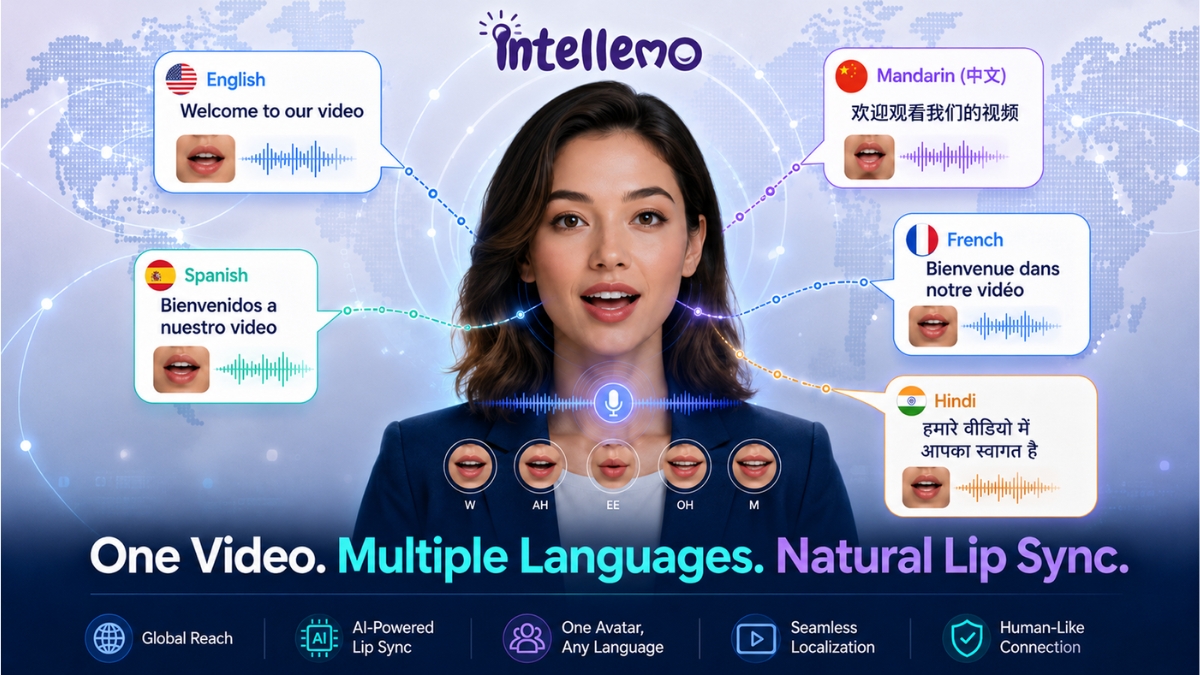
AI lip sync technology solves this problem by allowing mouth movements to adapt to translated speech. A marketing video originally produced in English can have its audio translated to Mandarin, Spanish, or French, and the avatar’s mouth movements will adjust to match the phonetic patterns of the translated speech. The result is content that actually looks dubbed properly rather than visibly mismatched.
This capability changes the economics of global content distribution. Brands can produce content once and scale it across language markets without the production overhead that used to be required for proper dubbing. Educational content becomes more accessible across language barriers. Entertainment products can reach global audiences without the production complexity that previously limited this expansion to major studios with massive budgets.
Improving Viewer Engagement and Trust Through Realistic AI Videos
Humans have finely tuned sensitivity to facial and speech inconsistencies. We evolved to read faces and voices as sources of truthfulness and emotional state. When those signals conflict, we automatically register distrust, even if we can’t articulate what feels wrong.
Poor lip sync triggers this automatic distrust response. Accurate synchronization does the opposite. When mouth movements align perfectly with speech, when facial expressions match emotional tone, when the overall communication feels coherent, viewers relax their guard and engage more genuinely with the content.
The improvement in engagement metrics is consistent across applications. Watch time increases. Information retention improves. Users report higher satisfaction with interactions. Most importantly, the credibility of the message strengthens when it’s delivered through communication that looks and feels authentically human.
This shift moves AI video beyond novelty into genuine utility. Businesses can use AI video for communication that actually matters. Creators can build audiences around AI characters because those characters feel like legitimate personalities rather than technological experiments.
Challenges and Future of AI Lip Sync Technology
It is important to recognize that there are still some restrictions that exist today. There is still a lot of work to be done in getting it right with the emotions and all the possible muscles of the face. Even some of the videos produced are still slightly weird-looking due to some facial minutiae. It’s still a technical challenge to maintain absolute consistency over long videos.
The direction is evident, though. The next generation of improvements will likely be more sophisticated, with emotion detection that will allow it to detect more complex emotions. Real-time lip sync generation will make it possible to create more interactive applications, where digital faces respond dynamically to the user’s actions. The more sophisticated the underlying models, the more expressive AI characters will be. Seamless integration with AI video creation platforms will be possible, so as to enable advanced lip sync for creators with a lack of technical know-how.
The line between AI-generated and human-generated communication will remain increasingly indistinct as these enhancements keep rolling out. The question will not be “is the content AI-generated?” but “is the content effective for its intended use, and is it human?”
Frequently Asked Questions
How does AI lip sync differ from traditional dubbing?
Traditional dubbing records an actor speaking a new language while the original video plays unchanged. Viewers see the obvious disconnect between lips and sound. AI lip sync technology actually generates new mouth movements that match translated or re-recorded audio, creating the illusion that the original character is speaking the new language. The result looks far more natural than conventional dubbing.
Can AI lip-sync handle different languages and accents accurately?
Yes. The technology analyzes the phonetic patterns specific to each language and generates mouth movements accordingly. Different languages have different speech sounds that require different mouth positions. Advanced platforms like Intellemo AI can now handle accent variations within languages as well, though some uncommon languages or very specific regional accents remain challenging. The technology continues improving as more training data becomes available.
How does AI lip sync compare to human-performed video?
High-quality AI lip sync is now difficult to distinguish from human performance in most contexts. For formal presentation content, customer communication, and educational material, the differences are minimal to viewers. In scenarios requiring subtle emotional nuance or extreme close-ups where every facial detail matters, trained eyes can sometimes detect differences. But for the majority of practical applications, the viewer experience has reached parity with human-performed content.
Which content types benefit most from accurate lip sync?
Educational content, customer-facing communication, marketing presentations, and any scenario where credibility and viewer engagement matter most see the biggest benefits. Entertainment and games with avatar characters also benefit substantially. Content that’s highly stylized or abstract benefits less because viewers have different expectations for what looks “natural.” Customer support, sales, and training applications see the most dramatic improvements in effectiveness.
Conclusion
Lip sync technology represents more than an incremental technical improvement in AI video capabilities. It addresses a fundamental gap between what AI could create visually and what it could deliver in authentic communication. By ensuring that digital characters speak with mouths that move naturally, with facial expressions that match emotional content, and with the coherence of genuine human interaction, this technology opens up entirely new categories of application for AI video.
The impact will continue expanding across industries. As lip sync technology becomes more sophisticated, as integration with creation platforms becomes more accessible, and as viewers increasingly see AI avatars delivering genuine value in their lives, the adoption curve will steepen substantially. What matters now isn’t whether AI video will be used for serious communication purposes. What matters is how quickly creators and businesses adapt to this new reality and how they use these capabilities responsibly.

