



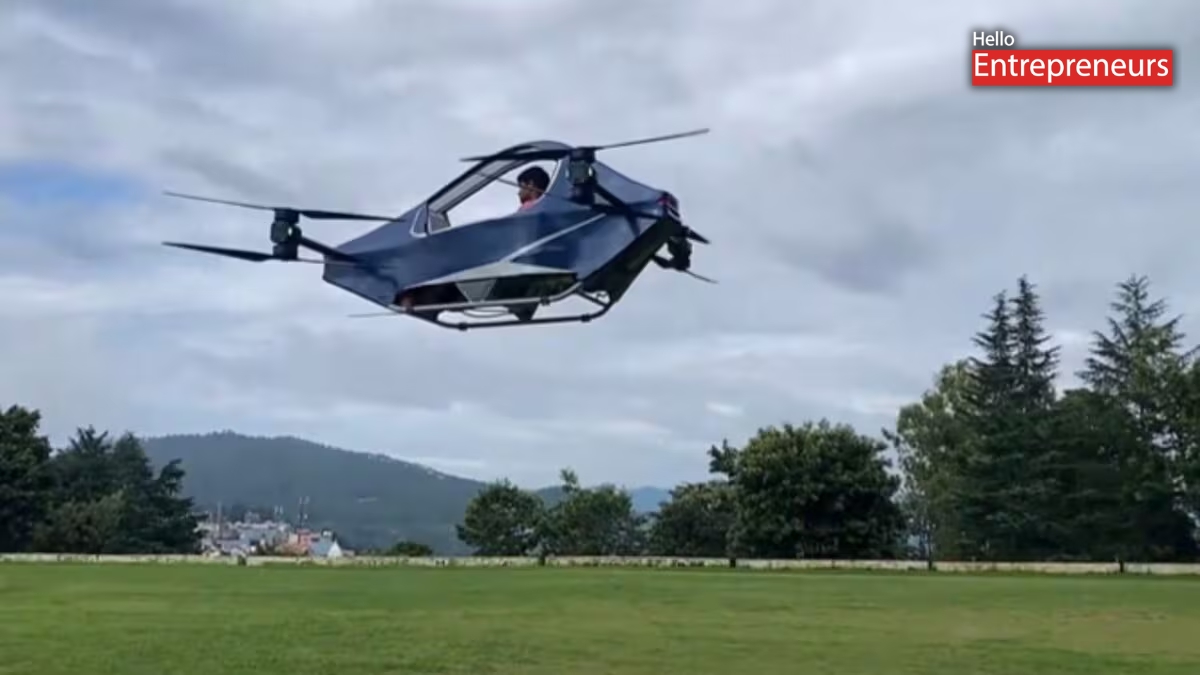
New Delhi: Technology isn’t always created in a large company, with millions of dollars in funding or big laboratory. For some occasion, it can begin with an idea and the will to make it happen happen work. At times, it’s an easy thought and the will to get it to serve happen work. The inspiring journey of a small innovation, by a man called Ravi Tamta from Almora, Uttarakhand has caught the eye and paved way for greater opportunities.
To achieve the feat of creating a one-seater flying vehicle prototype, called HAPIDA SKYNeX, Ravi Tamta the innovator from Kaflikhan village in Almora has high-tech founded his own start-up ‘Hapida Sky’. Its prototype is adopted from the drone technology and recently test flown in Almora.
On the surface a flying vehicle sounds like something out of a science fiction film. The larger story is one that transcends a flying car, however. It’s the idea of using a current piece of tech in a new way to address a true need.
Turning a Simple Idea Into Technology
According to reports, Ravi took almost one year to develop the prototype before he flew the test. The project is not based on new technology, but on existing technology that has been applied to a new task either from drone devices or a new type of drone.
This is one thing for consideration when developing technologies. A leap of imagination that leads to a new and innovative product doesn’t always require the creation of an entirely new product. Sometimes, it means taking an existing technology, improving it and finding a new use for it.
Initially, Drones were linked primarily with photographic and surveillance purposes, industrial applications. Similar technologies of flight are looked into today with respect to transporting, delivering and emergency service.
Why It Could Matter for Uttarakhand
The project is of special interest in the Indian Geography of Uttarakhand. Long roads and rough tracks on the mountain; steep terrain and crooked roads may slow down travel time. Safely flying a vehicle over such obstacles may be another way to link up tricky places someday.
It is said that a trip of approximately 40km on foot may take approximately 90 minutes to complete, but could be completed in about 10 minutes in the air. But HAPIDA SKYNeX is still in the prototype stage, and extensive testing and development is required before they can be used as a feasible transport system.
Small Innovations Can Lead to Bigger Changes
Perhaps the most significant thing about Ravi Tamta’s work, is the concept behind it. An outsider has demonstrated that valuable innovations can emerge from anywhere except the tech center. Sometimes, a technological improvement of an existing technology will result in an entirely new type of product. That’s how many techs develop it’s a small experiment that expands and grew and then boom, it can be a bigger solution.
It’s a grassroots innovation that is significant for India. It can inspire younger, more vibrant populations in places lacking in cosmopolitan art of experimentation; places that, for better or worse, have fewer large companies to brainstorm solutions for.
The Road Ahead
HAPIDA SKYNeX is still in its infancy and difficult to say finally that it’s the future of transportation. Safety, battery performance, reliability, regulation and cost are key challenges for flying vehicles.
Nonetheless, Ravi Tamta’s experiment makes a point that’s clearly worth keeping in mind: huge technological changes can begin with small ideas. Sometimes the best measure of the promise of innovation is not the best first prototype. This can be determined by if the concept can tackle a genuine issue and encourage others to enhance it.
In the hills of Almora, an experiment has begun, a conversation that is a much larger one about the future of mobility. But that could be the biggest one yet.

