



Mumbai: There was a time when a semiconductor chip had one job—compute quietly and efficiently, preferably without attracting attention. It didn’t need a history, a location, or a moral compass. It simply worked.
That time, it seems, has expired.
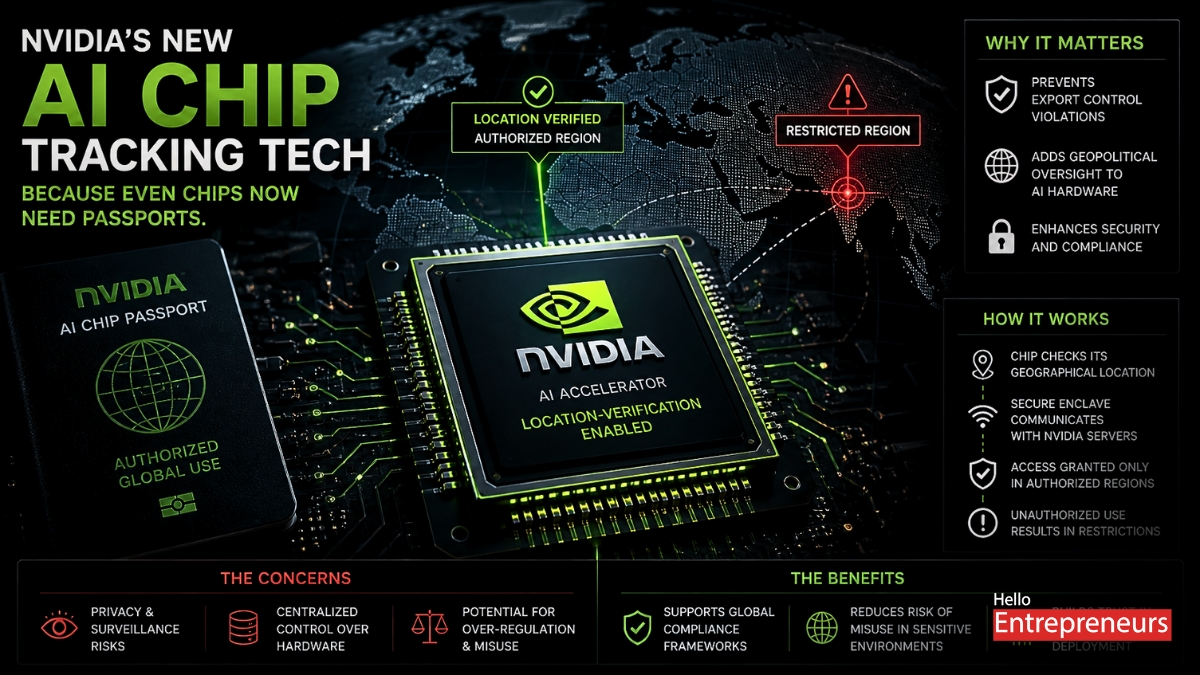
With Nvidia introducing location-verification technology into its AI chips, hardware is stepping into a new role, one that involves awareness, accountability, and, rather intriguingly, traceability.
In simpler terms: your processor might soon know where it’s allowed to be.
And if that doesn’t sound like a subtle shift in how technology behaves, it probably should.
The Moment Hardware Became Self-Aware (Geographically, At Least)
The idea behind this development is straightforward, at least on paper.
- AI chips can verify their geographical usage
- Systems can detect if hardware is operating in restricted regions
- Export control compliance becomes enforceable at the chip level
This isn’t just software regulation anymore.
It’s embedded oversight.
Which means enforcement is no longer external, it’s built into the product itself.
The Backstory Nobody Mentions First
To understand why this exists, you have to look at the broader context.
- Governments have tightened export controls on advanced AI hardware
- High-performance chips are considered strategic assets
- Concerns around misuse and geopolitical leverage have intensified
Companies like Nvidia find themselves in a delicate position:
- Innovate aggressively
- Comply rigorously
- Navigate international regulations without losing market presence
The result?
Technology that doesn’t just perform, but verifies.
The Economics Of Compliance
This isn’t just about regulation. It’s also about scale.
- AI chips can cost $10,000 to $40,000 per unit
- Data center deployments involve thousands of these units
- Global AI infrastructure investments are in the hundreds of billions
At this level, misuse isn’t a minor concern, it’s a strategic risk.
So companies are responding with mechanisms that ensure:
- Controlled distribution
- Verified deployment
- Reduced liability
In other words, compliance is becoming part of the product’s value proposition.
The Positive Case: Security With Structure
Let’s be fair, there are tangible benefits.
- Prevents unauthorized use of advanced hardware
- Supports global regulatory frameworks
- Enhances accountability in AI deployment
For governments and enterprises, this creates:
- Greater control over sensitive technologies
- Reduced risk of misuse in restricted environments
- A more transparent hardware ecosystem
From a PR perspective, it’s almost elegant.
Technology that enforces responsibility… automatically.
The Slightly Unsettling Implication
Of course, every elegant solution comes with… questions.
Privacy Concerns
- If chips can verify location, what data do they access?
- How is that data stored and protected?
Surveillance Potential
- Could tracking capabilities extend beyond compliance?
- Who controls the oversight mechanisms?
Autonomy Of Hardware
- At what point does a tool become a monitored entity?
None of these questions has a simple answer.
But they are increasingly relevant.
The Subtle Shift: From Product To Policy Instrument
What’s particularly interesting is how this changes the role of hardware.
AI chips are no longer just components.
They are:
- Compliance tools
- Policy enforcers
- Strategic assets
This blurs the line between technology and governance.
Because when regulation is embedded into hardware, enforcement becomes… automatic.
And automation, as we’ve learned, rarely stops at its initial purpose.
The Industry Perspective: Necessary Evolution
From an industry standpoint, this move is less controversial than it appears.
- Regulatory pressure is increasing
- Global markets require compliance flexibility
- Reputation management matters
For companies like Nvidia, the choice isn’t between innovation and regulation.
It’s about integrating both.
Because in a highly scrutinized environment, adaptability is survival.
The Sarcasm (Because It Practically Writes Itself)
There’s something undeniably fascinating about the situation.
We’ve spent decades making technology smarter.
Now we’re making it… more accountable.
Because apparently, even silicon needs to explain where it’s been.
One can only assume passports are next.
The Global Angle: Technology As Territory
This development also reflects a larger trend.
Technology is no longer neutral.
- It’s tied to national interests
- It’s influenced by geopolitical strategies
- It’s regulated as a critical resource
AI chips, in particular, have become central to this dynamic.
Which means their movement, usage, and ownership are all… monitored.
Not casually. Systematically.
The Consumer Perspective: Distant, But Relevant
For everyday users, this might feel abstract.
After all:
- Most consumers don’t interact directly with AI chips
- Location verification operates behind the scenes
But the implications are broader.
- Device costs could be affected by compliance measures
- Availability of advanced technology may vary by region
- Innovation cycles could be influenced by regulatory frameworks
In other words, even indirect changes have downstream effects.
The Innovation Trade-Off
As with most technological shifts, there’s a balance to consider.
Pros:
- Increased security and accountability
- Stronger regulatory alignment
- Reduced risk of misuse
Cons:
- Potential privacy concerns
- Increased complexity in hardware design
- Risk of over-regulation impacting innovation
It’s not a simple equation.
It rarely is.
The Bigger Pattern: Intelligence Meets Oversight
What we’re seeing here isn’t an isolated feature.
It’s part of a broader transformation:
- Technology becoming more intelligent
- Systems becoming more integrated
- Oversight becoming more embedded
The goal isn’t just performance.
It’s control.
And control, when automated, becomes… consistent.
So, Where Does This Lead?
Short answer: deeper integration.
Long answer: a more structured technological ecosystem.
- Hardware will increasingly include compliance features
- Software will adapt to regulatory requirements
- Global tech strategies will become more coordinated
This isn’t the end of innovation.
It’s a redefinition of it.
The Final Thought: When Tools Start Keeping Records
The introduction of location-verification technology in AI chips marks a subtle but significant shift.
From passive tools to active participants in compliance.
From silent components to accountable systems.
It’s not dramatic. It’s not disruptive.
It’s… deliberate.
And perhaps that’s what makes it more impactful.
Because when technology begins to track itself, the question isn’t just what it can do.
It’s what it chooses—or is designed—to report.
And in that quiet layer of accountability lies the next phase of the AI era.
Read More: The Return Of The Chip Crisis

