



Mumbai: There was a time when innovation was romanticised—garage startups, late-night breakthroughs, ideas powerful enough to disrupt entire industries.
That version still exists. It’s just… no longer in charge.
Today, the Artificial Intelligence race looks less like a sprint of ideas and more like a marathon funded by balance sheets that refuse to blink. The latest spending wave from giants like Microsoft, Amazon, and Google makes one thing abundantly clear:
This isn’t just about building smarter systems anymore.
It’s about proving you can afford to keep building them.
Because in this version of progress, capital isn’t support, it’s the strategy.
The Scale Of Spending (Subtlety Not Included)
Let’s address the numbers first, because they’re difficult to ignore.
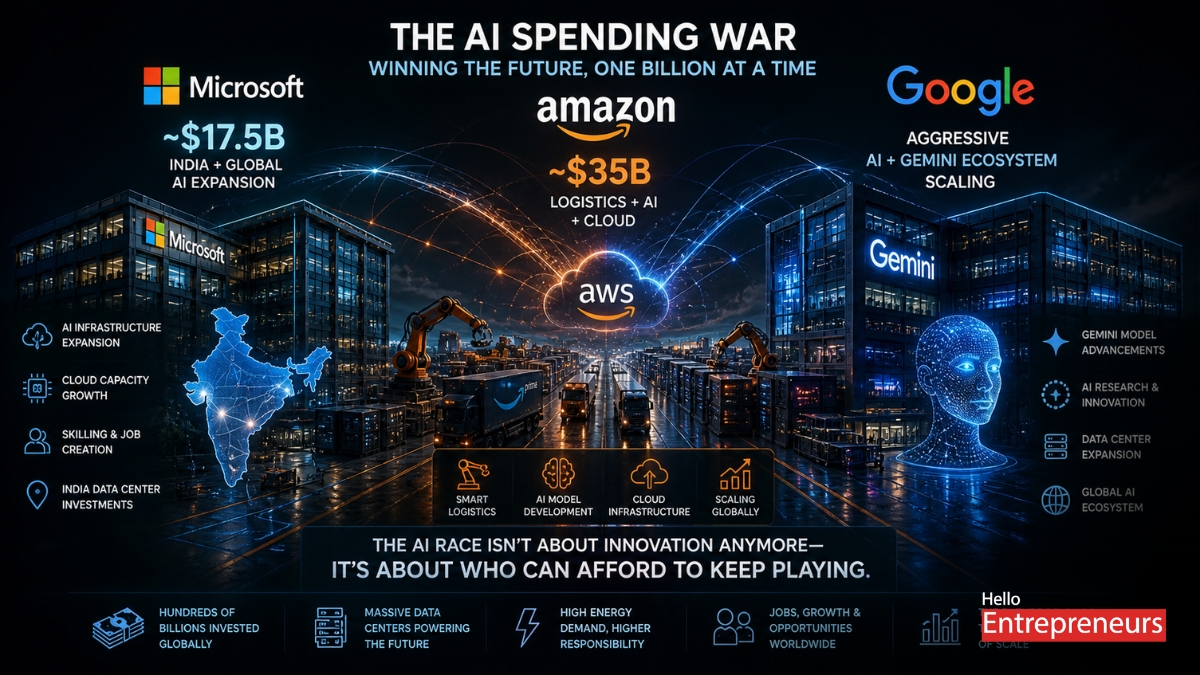
- Microsoft is committing roughly $17.5 billion toward AI infrastructure, including expansion in India and global cloud capacity
- Amazon is pushing close to $35 billion across logistics, AI, and cloud ecosystems
- Google continues aggressive investment into Artificial Intelligence models and its Gemini ecosystem, alongside expanding data centers worldwide
Collectively, these numbers move comfortably into the hundreds of billions globally when you factor in ongoing commitments.
This isn’t experimentation.
It’s an industrial-scale transformation.
The Real Battlefield: Infrastructure, Not Interfaces
For a while, the conversation around Artificial Intelligence focused on what users could see:
- Chatbots
- Image generators
- Smart assistants
But the real competition isn’t happening on screens.
It’s happening in data centers.
- Massive GPU clusters
- Energy-intensive server farms
- Global cloud networks
These are not optional upgrades. They are prerequisites.
Because AI at scale requires:
- Processing power
- Storage capacity
- Continuous optimization
In simpler terms, the most advanced model is only as strong as the infrastructure supporting it.
And infrastructure… is expensive.
The Positive Case: Building The Future (At Full Volume)
Let’s give credit where it’s due.
This level of investment is accelerating progress at a pace that would have been unimaginable a decade ago.
- Faster AI model development
- Improved accessibility for businesses and consumers
- Expansion of cloud services enabling global innovation
For countries like India, investments from Microsoft and others also mean:
- Job creation in tech infrastructure
- Strengthening of digital ecosystems
- Increased global relevance in Artificial Intelligence development
From a macro perspective, this is growth—visible, measurable, and undeniably impactful.
The Slightly Less Celebrated Reality
Of course, every arms race comes with its own set of complications.
Barrier To Entry Is Rising
- Smaller companies struggle to compete
- Innovation risks becoming concentrated among a few players
Operational Costs Are Immense
- Data centers consume enormous amounts of energy
- Maintenance and scaling require continuous investment
Dependency Is Increasing
- Businesses rely heavily on cloud providers
- Ecosystems become more centralized
In essence, the same infrastructure that enables progress also narrows the field.
Because not everyone can afford to play at this level.
The Backstory: From Innovation To Domination
The shift didn’t happen overnight.
- Early Artificial Intelligence development focused on algorithms and research
- Cloud computing expanded access to computational resources
- Data availability improved model training
Then came the realization:
Whoever controls the infrastructure controls the ecosystem.
And once that realization set in, spending followed.
Aggressively.
The Strategic Shift: Endurance Over Breakthroughs
What’s interesting about the current phase is the change in priorities.
Earlier:
- Breakthroughs defined leadership
Now:
- Sustained investment defines leadership
Because Artificial Intelligence isn’t a one-time achievement.
It’s an ongoing process that requires:
- Continuous updates
- Constant scaling
- Persistent funding
Which means the real question isn’t “Who builds the best model?”
It’s “Who can keep building without slowing down?”
The Sarcasm Writes Itself (Again, Unfortunately)
There’s something almost poetic about calling this an innovation race.
Because nothing says “creative disruption” quite like multi-billion-dollar infrastructure budgets.
It’s not that innovation has disappeared.
It’s just… been accompanied by a very expensive support system.
The Environmental Question (Quiet, But Important)
Large-scale Artificial Intelligence infrastructure isn’t just costly, it’s resource-intensive.
- Data centers require significant electricity
- Cooling systems add to energy consumption
- Sustainability becomes a growing concern
Companies are investing in renewable energy initiatives, which is commendable.
But the scale of demand continues to rise.
Efficiency improves. Consumption follows.
It’s a balance that hasn’t quite stabilized yet.
The Workforce Angle: Growth With Complexity
Investment at this scale does create opportunities.
- Infrastructure development jobs
- AI research and engineering roles
- Cloud management and operations
But it also shifts the nature of work:
- Higher specialization requirements
- Greater emphasis on technical expertise
- Increased competition for top talent
The industry isn’t shrinking—it’s evolving.
Just not evenly.
The Global Impact: Power Dynamics Redefined
Artificial Intelligence infrastructure isn’t just a business asset. It’s a strategic one.
- Countries hosting data centers gain a technological advantage
- Companies controlling cloud ecosystems influence global markets
- Access to AI capabilities becomes a competitive differentiator
This turns the AI race into something larger than technology.
It becomes a question of influence.
And influence, historically, tends to concentrate.
So, Is This Sustainable?
Short answer: cautiously.
Long answer: It depends on outcomes.
If investments lead to:
- Scalable, profitable AI solutions
- Broader accessibility
- Sustainable infrastructure
Then yes, the model holds.
If not, adjustments will follow.
Because even the largest companies eventually notice when costs outweigh returns.
The Final Thought: When Progress Becomes A Financial Endurance Test
The current phase of Artificial Intelligence development isn’t subtle.
It’s not experimental. It’s not cautious.
It’s decisive.
Companies like Microsoft, Amazon, and Google aren’t just building technology.
They’re building capacity at a scale that defines the future of the industry.
And in doing so, they’ve changed the nature of competition.
It’s no longer just about who innovates.
It’s about who endures.
Because in a race this expensive, the finish line isn’t defined by speed.
It’s defined by who can afford to keep running.
Read More: AI Stopped Knocking

