




Mumbai: There was a time when technology companies operated like explorers—moving fast, breaking things, and occasionally apologising later. Regulation was something that arrived eventually, usually a few steps behind innovation, slightly out of breath.
That era, it seems, has been politely escorted out.
Now, the relationship between governments and technology is no longer reactive. It’s… conversational. Persistent. Occasionally tense. And, depending on who you ask, long overdue.
Across Europe and beyond, regulators are no longer observing from a distance. They’re intervening—with intent, with structure, and with a growing sense of authority.
Because when platforms start behaving like infrastructure, oversight becomes less optional.
The Shift From Observation To Intervention
For years, regulation followed innovation.
Now, it’s trying to keep pace with it.
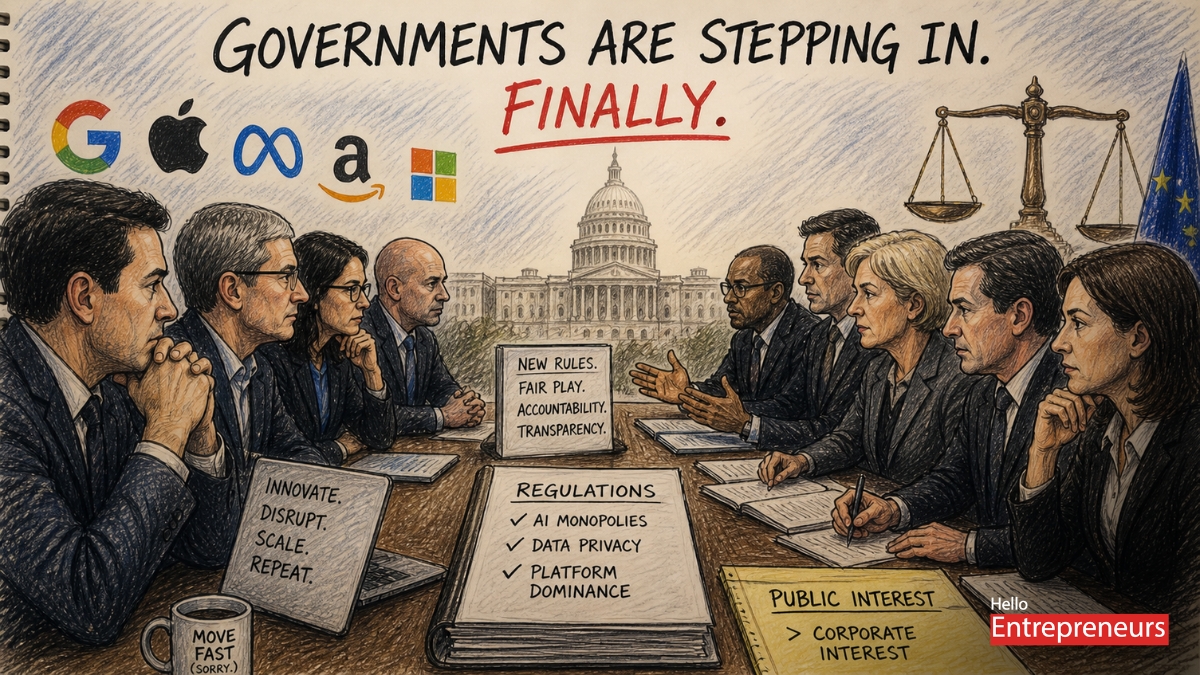
Policies across the European Union are increasingly focused on:
- AI monopolies and competitive fairness
- Data privacy and user rights
- Platform dominance and market control
Frameworks like the Digital Services Act and Digital Markets Act aren’t symbolic—they’re operational.
They introduce:
- Strict compliance requirements
- Transparency obligations
- Financial penalties for violations
In other words, regulation has moved from suggestion to enforcement.
The Backstory: Why Now?
This didn’t happen overnight.
- Tech platforms scaled rapidly over the past decade
- Data became one of the most valuable resources globally
- Market power is concentrated among a handful of companies
At some point, the balance shifted.
Technology wasn’t just influencing economies—it was shaping them.
And when influence reaches that level, governance tends to follow.
The Economics Of Regulation
Let’s talk scale, because it matters.
Companies like Google, Apple, Microsoft, and Amazon operate with:
- Market capitalisations in the trillions
- Annual revenues exceeding hundreds of billions of dollars
- Global user bases in the billions
Regulation at this level isn’t just about compliance.
It’s about influence, accountability, and control.
And, inevitably, negotiation.
The Positive Case: Structure In A Rapidly Expanding Industry
Let’s acknowledge the benefits—because they’re not insignificant.
- Stronger data protection for users
- Increased transparency in platform operations
- Greater accountability for AI systems
For consumers, this translates to:
- More control over personal information
- A clearer understanding of how platforms operate
- Reduced risk of unchecked dominance
From a PR perspective, regulation provides reassurance.
A sense that someone, somewhere, is paying attention.
The Slightly Less Celebrated Reality
Of course, regulation isn’t universally convenient.
Innovation May Slow
- Compliance processes can delay product launches
- Smaller companies may struggle with regulatory complexity
Operational Costs Increase
- Legal and compliance teams expand
- Systems must adapt to meet requirements
Global Fragmentation
- Different regions implement different rules
- Companies must navigate multiple regulatory environments
In short, structure introduces friction.
And friction, while necessary, isn’t always efficient.
The New Role Of Big Tech: Builder, Operator… Negotiator
Perhaps the most interesting shift is in how technology companies operate.
They’re no longer just building products.
They’re:
- Engaging with policymakers
- Adapting to evolving regulations
- Anticipating legal frameworks
This creates a dynamic where innovation and regulation are… intertwined.
Not oppositional, but interdependent.
The Sarcasm (Because It’s Earned)
There’s something almost poetic about the transformation.
Companies that once prided themselves on disruption are now attending regulatory briefings.
Because nothing says “cutting-edge innovation” quite like compliance documentation.
Progress, it seems, comes with paperwork.
The AI Factor: Why It’s Different This Time
Artificial intelligence has accelerated regulatory attention.
- AI systems influence decision-making at scale
- Bias, accountability, and transparency become critical
- The potential for misuse increases with capability
Governments aren’t just regulating technology.
They’re attempting to shape its trajectory.
Which is… ambitious.
And necessary.
The Global Perspective: A Coordinated Effort (Sort Of)
While Europe has taken a leading role, other regions are following.
- The United States is increasing scrutiny on AI and platform practices
- Asian markets are developing their own regulatory frameworks
- International discussions around AI governance are intensifying
It’s not perfectly aligned.
But it’s moving in a similar direction.
Toward oversight that matches the scale of influence.
The Consumer Angle: Invisible Protection
For most users, regulation operates in the background.
- Privacy settings become clearer
- Platform behavior becomes more transparent
- Data usage becomes more controlled
It’s not dramatic.
But it’s meaningful.
Because the best safeguards are often the ones you don’t notice.
The Innovation Trade-Off
As always, there’s a balance.
Pros:
- Increased accountability
- Stronger user protections
- More equitable competition
Cons:
- Slower innovation cycles
- Higher operational costs
- Potential barriers for smaller players
It’s not a perfect system.
But it’s an evolving one.
The Bigger Pattern: Technology Meets Governance
What we’re witnessing isn’t just regulation.
It’s integration.
Technology and governance are becoming:
- More connected
- More collaborative
- More complex
The goal isn’t to control innovation.
It’s to guide it.
Which, historically, is easier said than done.
So, What Happens Next?
Regulation isn’t going away.
If anything, it’s expanding.
- AI-specific laws will continue to develop
- Data privacy frameworks will evolve
- Platform accountability will increase
For companies, this means:
- Continuous adaptation
- Strategic compliance
- Ongoing negotiation
Because in this environment, success isn’t just about building better products.
It’s about navigating the systems that govern them.
The Final Thought: When Innovation Learns To Ask
The relationship between Big Tech and governments has entered a new phase.
Less confrontation. More coordination.
Less independence. More interdependence.
It’s not the end of innovation.
It’s the beginning of a different kind of progress.
One that doesn’t just move fast—but moves… carefully.
Because in a world where technology shapes society, oversight isn’t a limitation.
It’s a necessity.
Even if it occasionally feels like innovation has to knock before entering.
Read More: When Smartphones Stopped Evolving