



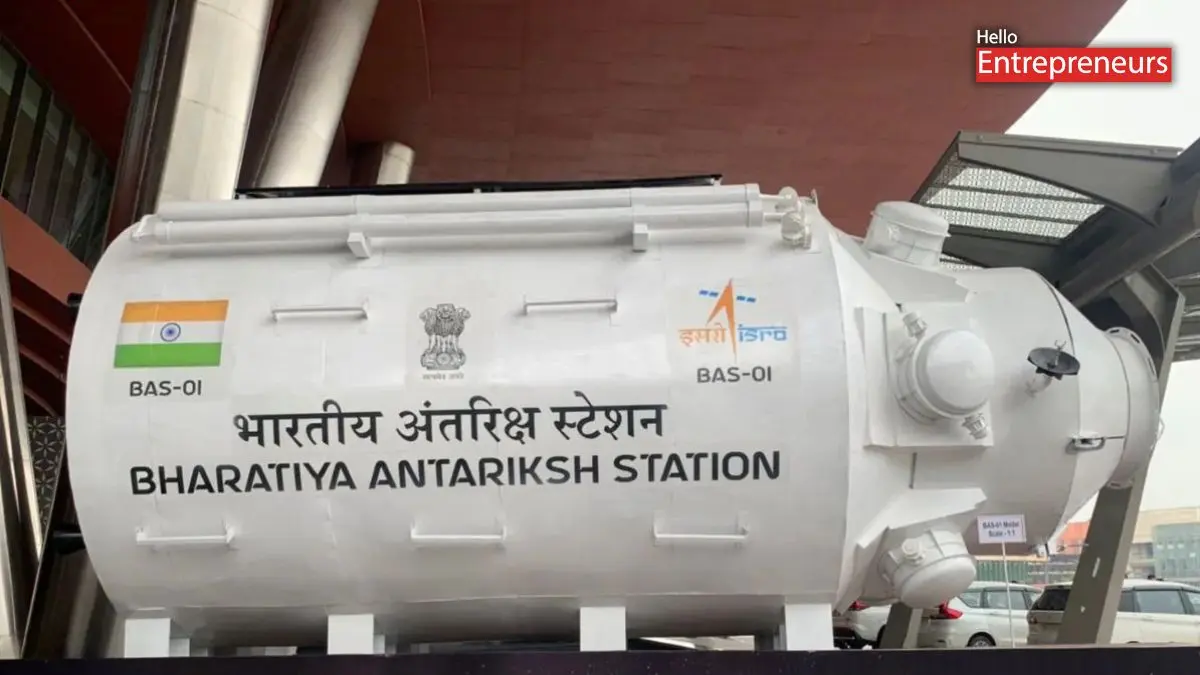
New Delhi: ISRO has officially introduced their first-ever Orbital Lab model, which is the Bharatiya Antariksh Station module, during their two-day National Space Day celebrations, which began with the unveiling, and this is a proud moment for those engineers who built this masterpiece for the country. Indian has planned to launch the first module of the BAS, its own home-built space station, by the end of 2028, marking its entry into the group of the handful of nations that will operate orbital laboratories. Currently, there are two orbital laboratories, the International Space Station operated by the five space agencies, and the Tiangong space station of China.
India also plans to have five modules of the Bharatiya Antariksh Station in place by 2035 as part of its ambitious plans for the space sector. This BAS-01 module might weigh 10 tonnes and will be placed in a low Earth orbit at 450 km above the Earth’s surface. Salient features of the BAS include, indigenously developed for the Environmental Control and Life Support System, Bharat Docking System, Bharat Berthing Mechanism, automated hatch system, the platform for the microgravity research and the tech demonstration, viewports for the scientific imaging and crew recreation.
This BAS will also have provision for the refilling of the propulsion and the ECLSS fluids, radiation, thermal and Micro Meteriod Orbital Debris protection, space suits, airlocks, to support extra vehicular activity, and to plug and play integrated avionics. This BAS is expected to serve as a research platform for studying various aspects of space, life sciences, medicine, and interplanetary exploration.
It will also provide an opportunity to study the effects of microgravity on human health and test essential technologies needed for the long-term human presence in space. The space station will also support space tourism, with India entering the commercial space sector by leveraging the orbital lab’s resources. It will also get the ongoing international collaborations, which serve as a hub for scientific research, and it will also inspire the younger generations to consider careers in space science and technology. There will be a massive 3.8 meter x 8 meter BAS-01 model, which was the centre of the attraction among those attending the National Space Day celebrations at the Bharat mandapam.

