



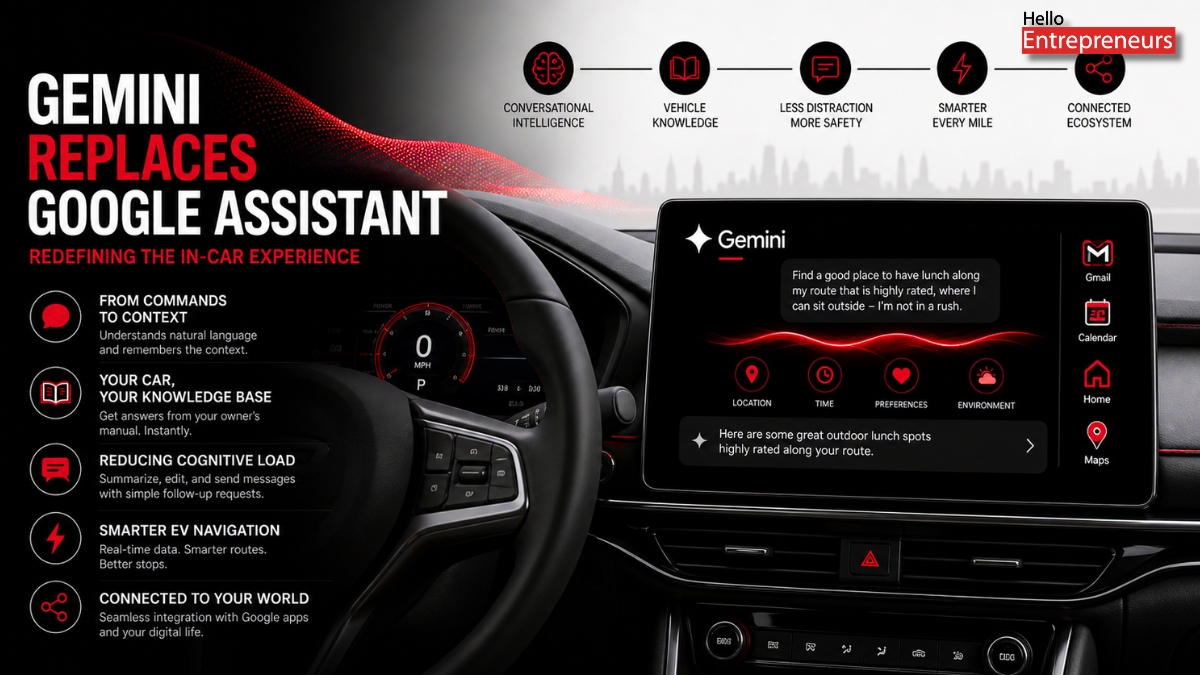
Google has started to integrate its next-generation artificial intelligence system, Gemini, into cars with Google built-in – signaling a fundamental change in driver-vehicle interaction. This shift means the old Google Assistant is out and a conversational AI system is in.
The shift represents more than a simple software update. It signals a shift in how we might think of the in-car user interface, from structured, command-based voice commands to natural conversation.
From Commands to Context
Existing in-car voice assistants have a problem with variability. Users had to give specific, often awkward orders – “Find restaurants” rather than “Look for restaurants”. Gemini turns the tables by understanding nuanced queries.
A driver could request, “Find a good place to have lunch along my route that is highly rated, where I can sit outside – I am not in a rush,” and the system will process several factors: location, time, preference, and environment. Subsequent questions like “Is there parking?” no longer erase the original question; they supplement it.
This is the point where the system becomes more of a co-pilot.
The Car as a Knowledge Base
A more significant improvement is Gemini’s connection with car data. By integrating owner’s manuals into the AI system, vehicles can provide technical advice on themselves.
Rather than seeking answers elsewhere or delving into complicated manuals, drivers can pose questions based on their current driving situation (such as the meaning of dashboard warnings, the operation of features, or maintenance procedures) and receive answers that are specific to the vehicle’s make and model.
This eliminates the knowledge gap between driver and vehicle, making the car its own manual.
Reducing Cognitive Load While Driving
The change also solves an age-old safety problem: communication while driving. Google Assistant could read and dictate messages, but was one-dimensional.
With Gemini, there is summarisation and dynamic editing. Threads can be summarised and a response can be edited on-the-fly – “Add that I will be 10 minutes late and ask if I need to bring anything to the dinner” – without starting over.
The end result is less cognitive load. The driver’s attention is freed up from managing the command structure.
A New Layer for Electric Vehicles
The benefits for electric cars are more practical. By linking vehicle telemetry in real-time with other data ecosystems such as Google Maps, Gemini supports smarter navigation.
A search like “Where can I charge my vehicle near my destination, preferably with a café” would combine vehicle telemetry data with route planning and consumer preferences. Charging stations become planned pit-stops.
The Start of a Mobility Ecosystem
While the initial roll-out will be small (English only, launching in the US), the possibilities are big. The links to Google products like Gmail, Google Calendar, and Google Home indicate the vehicle will become an extension of the user’s digital life.
This could translate into changing home settings on the way, checking schedules for conflicts before adjusting routes, or turning the commute into a productive or a learning experience through conversational AI.
The Strategic Shift
In switching out Google Assistant for Gemini, Google is not just making a better product, but is reimagining the function of software in the car.
The vehicle is now not only reactive but also intelligent. It knows what you mean, what you want and what you need.
In the process, the industry takes another step toward a long-anticipated vision: driving in which technology becomes invisible – not through absence but through recognition of the driver.

