


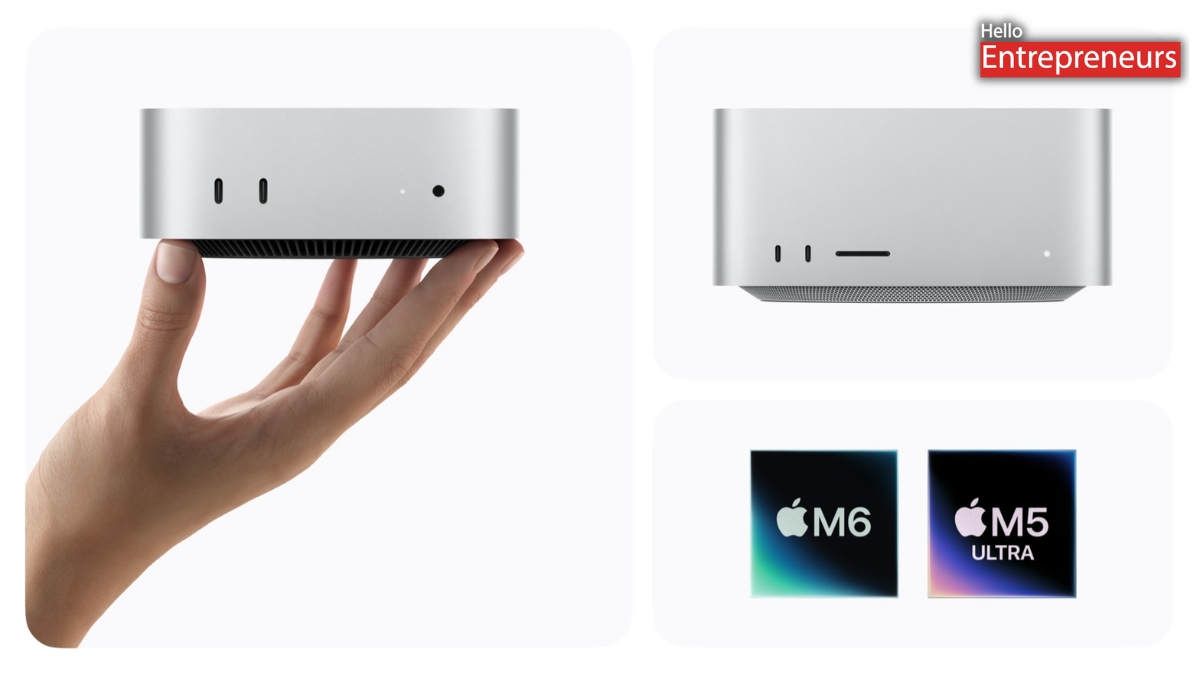
New Delhi: Apple rolled out the redesigned Mac mini and the updated Mac Studio today, about a month after it first showed them off. Both machines lean hard into the same story Apple’s been telling all year: more compute packed into less space, faster local AI, and unified memory that just keeps getting fatter. They’re running macOS 27, and this is the part that’ll matter most to anyone doing on-device ML work the GPUs now carry Neural Accelerators baked into every core, on top of the usual Neural Engine upgrade.
Let’s start with the Mac mini, since that’s the one most people will actually buy.
It comes in two flavors: M6 and M5 Pro. The base M6 model gets you a 12-core CPU and a 12-core GPU (each core with its own Neural Accelerator, which is honestly becoming Apple’s whole pitch these days), a dual 16-core Neural Engine, and Apple’s claiming up to 4x faster AI performance over the previous generation. CPU throughput is up 40%, and graphics plus storage are both roughly 2x quicker. Memory starts at 16GB and tops out at 32GB, with bandwidth up to 170GB/s fine for most people, a little tight if you’re doing anything memory-hungry.
Step up to the M5 Pro and you’re looking at up to an 18-core CPU, a 20-core GPU, 64GB of unified memory, and 307GB/s of bandwidth. That’s a real jump, not a token one.
Connectivity-wise, both mini tiers get Wi-Fi 7 and Bluetooth 6, plus 2.5Gb Ethernet standard you can pay extra to bump that to 10Gb if you need it.
Now the Mac Studio, which is really where this launch gets interesting (and expensive). It’s still Apple’s workstation box, aimed at people doing 3D rendering, 8K video work, or running LLMs locally and it comes in M5 Max or M5 Ultra flavors.
The M5 Max gets an 18-core CPU, up to a 40-core GPU, and up to 128GB of memory. Solid, but the Ultra is where things get a little absurd: up to 36 cores on the CPU, up to 80 on the GPU, and I had to double check this up to 512GB of unified memory, with bandwidth hitting 1.2TB/s. Apple says that’s good for 4.3x faster AI compute and 1.8x better graphics than the previous gen. Whether real-world workloads actually hit those multipliers is a different question, but on paper it’s a serious machine.
There’s also Thunderbolt 5 across the board, hitting 120Gb/s, which opens the door to external PCIe expansion and beefy storage arrays. And if one Mac Studio isn’t enough sure, why not Apple’s letting you cluster multiple units together over Thunderbolt 5 with RDMA, which apparently gets you up to 3x faster performance for distributed AI inference. That’s a pretty niche feature, but for studios running local models across multiple machines, it’s a big deal. Display support tops out at eight independent monitors, or four Studio Display XDRs running native 5K at 120Hz.
As for pricing in India because that’s where this rollout is happening here’s how it breaks down:
Mac mini with M6 chip starts at the pricing of ₹99,900 (₹88,900 for education pricing). Go for the M5 Pro and you’re at ₹2,09,900, or ₹1,97,900 for students and educators. Whereas, the Mac Studio jumps considerably: M5 Max starts at ₹2,79,900, and the M5 Ultra will run you ₹6,29,900 a little less, ₹5,84,900, with education pricing.
Everything’s available now through Apple Store locations, Apple’s authorized resellers, and the Apple India online store except the fully loaded 512GB M5 Ultra config, which won’t ship until late October. If you want the absolute maximum, you’ll be waiting a few extra weeks.

