



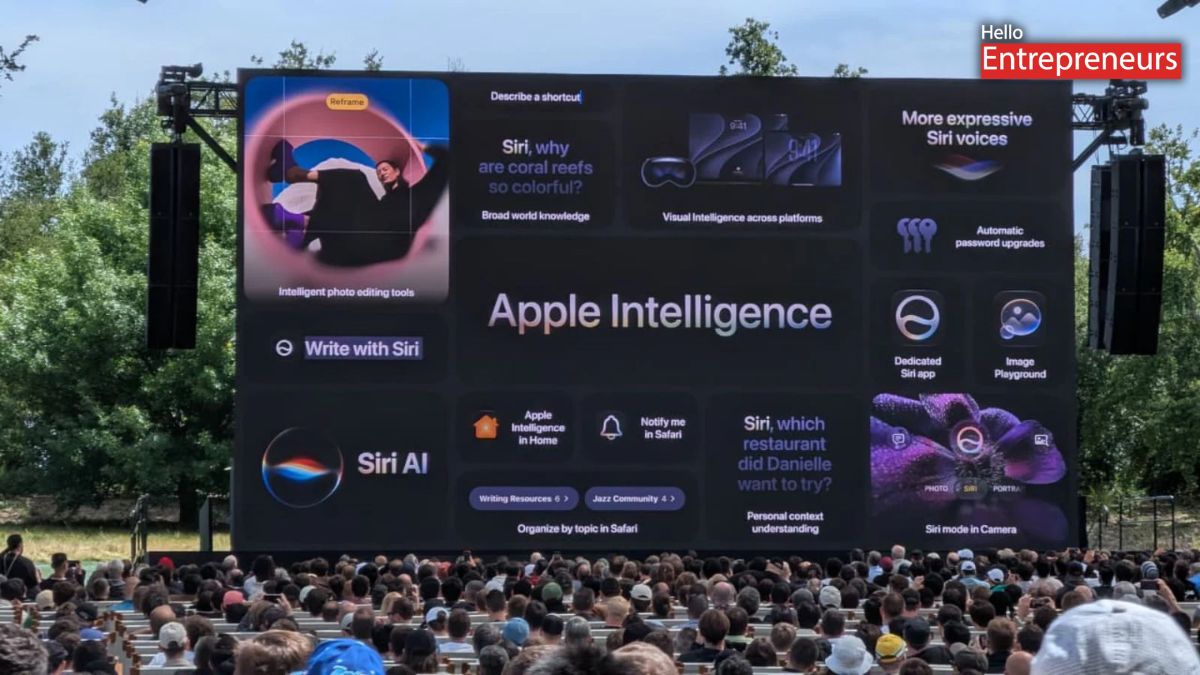
New Delhi: Apple has officially kicked off its Worldwide Developers Conference (WWDC) 2026 on June 8 with a broad set of announcements spanning AI, platform upgrades, and system-level improvements. Apple has unveiled the latest version of Siri, powered by an upgraded Apple Intelligence architecture developed in collaboration with Google’s Gemini models. Apple also announced upgrades across iOS 27, macOS 27, iPadOS 27, watchOS 27, tvOS 27, and visionOS 27, with the aim of performance, reliability, and deeper AI integration.
Apple has officially released its Siri AI, the latest version of its digital assistant that integrates deeply with its latest Apple Intelligence system. The assistant is now specially designed to be more conversational, context-aware, and capable of executing tasks across applications and devices. Siri can now draw on personal context, understand what is on the screen, access broader web-based knowledge, and take actions across applications. It also maintains context across multiple prompts by allowing for more complex, multi-step interactions.
Apple demonstrated use cases such as drafting emails, planning events, retrieving information from messages and photos, and executing app-based tasks without requiring users to switch between applications manually. Siri also unveils the latest Ask Siri interface, enabling users to interact through both voice and text, with a more detailed, full-screen conversational experience. They have also introduced a dedicated Siri application, which enables users to revisit past conversations and continue ongoing interactions across devices.
At the core, they have made changes to the redesigned Apple Intelligence architecture. Apple has officially confirmed that it has partnered with Google to integrate Gemini-based models into its foundation layer, combining on-device processing with server-side computation via Private Cloud Compute. This architecture enables the AI approach to remain privacy-focused, with on-device processing and cloud interactions designed so that the user’s data is not stored or accessed externally. Apple is also extending AI capabilities beyond Siri via the features integrated across its ecosystem.
Visual Intelligence, which enables Siri to understand and act on visual input. On iPhone, this is embedded directly into the Camera application, by allowing users to point their device at objects, text, or scenes and receive contextual responses or actions. The upgraded Passwords application can now automatically navigate websites, sign users in, and upgrade credentials when changing passwords. Rather than manually visiting each site, the system handles the process in the background, effectively turning password upgrades into an automated workflow.
Apple has also improved its underlying models to support more photorealistic image generation by using natural language prompts. Users can now generate images with greater detail and consistency by including the ability to use photos from their library as reference inputs and maintain subject consistency across multiple generated images. Apple is also bringing similar AI capabilities to editing tools. A latest Extend feature enables users to expand images beyond their original frame by using generative AI, while an upgraded Clean Up tool improves object removal accuracy.
Apple has also announced the latest versions of its operating systems, including iOS 27 and macOS Golden Gate. The aim this time is optimization and usability instead of major design overhauls. iPhone and iPad applications will load up to 30% faster, while photo previews in the Photos application load up to 70% faster. File transfers on iPadOS are up to five times quicker, and AirDrop speeds have been improved. It also optimized its CPU scheduler, expanding performance improvements to older devices, with iOS 27 supporting models as far back as the iPhone 11. Apple is refining its Liquid Glass interface with the latest customization options, improved readability, and greater consistency across applications.

