



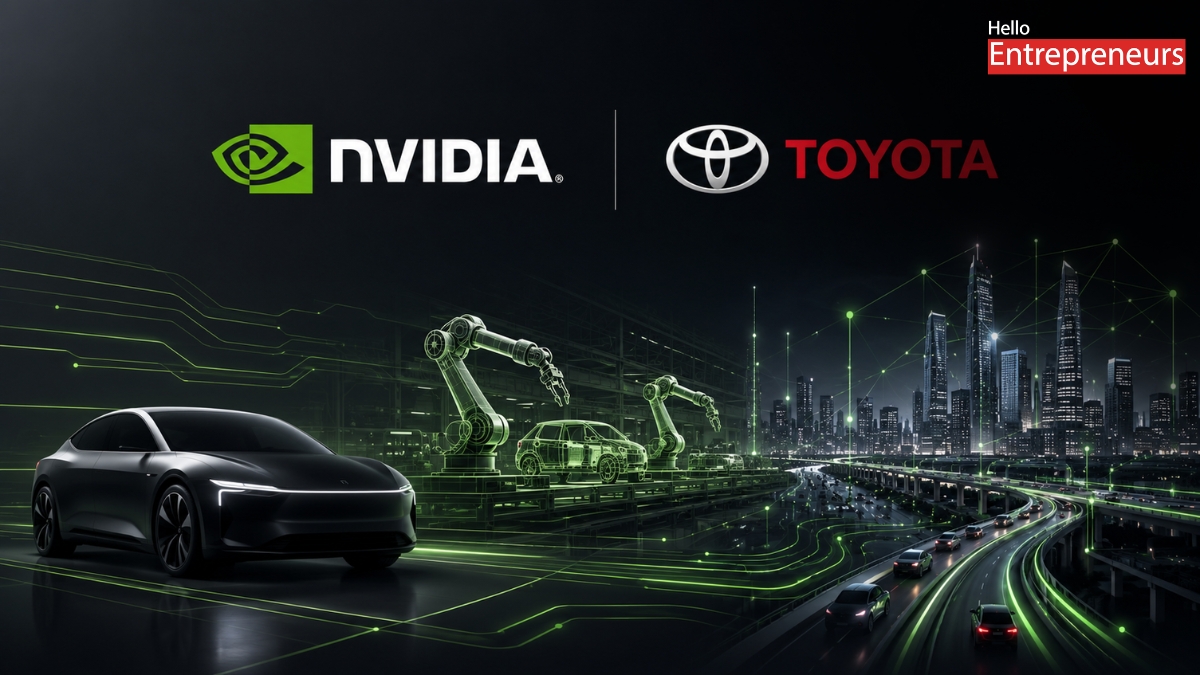
Nvidia and Toyota just announced a big upgrade to their partnership, which goes way beyond their original focus on self-driving cars. Now, they’re teaming up to bring AI into factory automation, smarter traffic systems, and even Toyota’s experimental smart city.
The news dropped during Nvidia CEO Jensen Huang’s visit to Japan. Toyota’s now using several Nvidia platforms, not just in their cars, but also in their manufacturing plants and Woven City — that futuristic place where Toyota tries out new ideas for mobility and urban living. The main goal? Get “physical AI” — the kind of AI that actually controls machines and city infrastructure — out of the data center and into real-world spaces, like streets and factories.
Here’s what’s changing:
Smarter Cars, Faster Development
Toyota’s next wave of vehicles will run more advanced driver-assistance features on Nvidia’s Drive AGX platform, powered by DriveOS. This setup juggles perception and decision-making so well that Toyota plans to scale it up for both regular passengers and commercial fleets.
But it’s not just about the hardware. Toyota engineers get access to AI tools from Nvidia for developing and validating automotive software. That means faster progress (and less waiting) without sacrificing safety, thanks to models trained with Nvidia’s Megatron-LM and Nemotron datasets.
Digital Factories
On the factory end, Toyota’s diving into digital twins using Nvidia’s Omniverse and Isaac Sim. Imagine running full simulations of assembly lines before actually touching anything physical — engineers can optimize how robots move, tweak layouts, and streamline processes without shutting down production. Nvidia’s robotics team will also help merge robotic systems and AI, making factory automation more coordinated and responsive.
Smart Cities and Urban AI
Woven City — Toyota’s bold smart-city project in Shizuoka — will use Nvidia GPUs and advanced multimodal AI to power their vision-language engine. This system interprets what’s happening around the city, predicts traffic events, and helps manage everything from traffic flow to safety monitoring. So they’ll test AI-powered traffic management and urban mobility in real time, but within a controlled space.
Japan’s Broader AI Push
During Huang’s visit, Nvidia also kicked off a new collaboration with Mitsubishi Heavy Industries to help build out Japan’s AI data-center infrastructure. Nvidia’s betting big on Japan because of its industrial strength and tech talent, which are key for rolling out physical AI systems on a large scale.
A Decade-Long Story
Toyota started working with Nvidia in 2017, using Drive PX for their early self-driving experiments. In 2023, they switched to Drive AGX Orin for commercial fleets. Now, their partnership covers vehicles, factories, and cities — the most ambitious chapter yet.
Looking Ahead
This move ramps up the shift in auto and industrial tech, where carmakers turn into software-first companies, depending on AI models and simulations for designing everything from cars to factories. Toyota expects the new tools to help them innovate faster and cut costs.
Still, there are hurdles. Deploying AI in real public spaces isn’t easy — safety, privacy, and tough regulations all factor in. Bringing third-party AI into safety-critical systems means Toyota needs intense validation, constant oversight, and strict compliance with safety standards. Plus, scaling up AI will strain local infrastructure and budgets.
What’s next? Toyota and Nvidia are rolling out these features gradually, starting with some vehicles and pilot programs in Woven City and select plants. They’ll keep regulators and partners in the loop as things progress.
As the race heats up between chipmakers and automotive software firms, this partnership positions Nvidia and Toyota to lead the way, moving AI out of the server room and right into the everyday spaces where it can really make a difference.

