



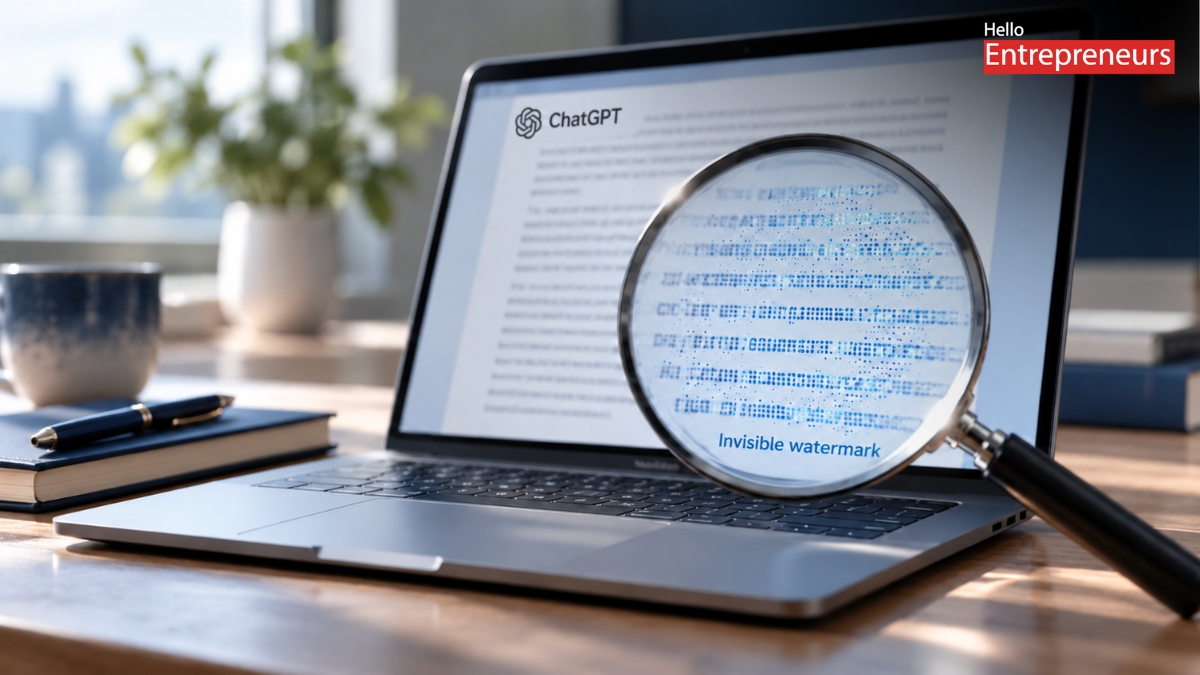
When people think of watermarks, they picture faint text on a photo or a logo over a video, just an obvious sign of where something came from. In the world of AI writing, watermarks are trickier: they’re not visible at all. Instead, they’re buried as subtle statistical patterns in the text, only detectable with special software.
That’s important now, since smooth writing no longer tells anyone who actually created a piece. A news story, a product review, or a viral post could come from a human, an AI, or a messy mix of both. Watermarks offer publishers another tool for figuring out what’s actually in front of them when the origins are murky.
OpenAI is pushing this idea forward. On October 5, 2026, they announced invisible watermarks will roll out for eligible ChatGPT and Codex outputs in the European Union. Developers around the world can enable watermarking for specific API models, but it’s off by default for now.
Their system, called textGrain, works by guiding the model’s word choices to create a fingerprint in the writing. To the human eye, everything reads as usual. But if you run the text through a detector, it’ll flag the watermark if it’s there. For now, only approved researchers and specialized groups can use OpenAI’s detector.
For editors and publishers, this could become another way to check where work came from. Picture an editor handed a draft by a freelancer — watermark detection could reveal if AI helped, and point to what else needs reviewing.
But watermarking isn’t magic. It can’t pinpoint who used the tool, doesn’t declare true ownership, can’t fact-check claims, and doesn’t show how much humans tweaked the text. Sometimes, the detector gets it wrong. And if there’s no watermark, you still can’t be certain a human wrote the piece — the tool just didn’t leave a mark.
Editing complicates things further. Google DeepMind’s SynthID, released in 2024, works better on long, varied pieces. Heavy editing or translation can strip away the watermark, and short snippets don’t offer enough space to hide one.
Think about a newsroom workflow: a writer hands in a draft, an editor rewrites the opener, a copy editor polishes the language, and another person does the translation. That chain of hands makes watermark detection pretty unreliable. Editors and publishers need to know these quirks before making decisions based on the results. Reacting too fast could mean questioning a writer’s honesty unfairly, or rejecting work over a false alarm.
Writers might find that keeping thorough records becomes more important — interview notes, links, and early drafts help prove how a piece took shape. Ground rules about where AI can help are key, too. If editors are fine with machines proofreading or translating, but want all the ideas and research to come from humans, both sides need to agree upfront to avoid confusion later.
European law already covers some of this. Article 50 of the EU AI Act says you must disclose when AI writes something meant to inform the public — unless there’s genuine editorial review and someone takes responsibility. Quick fixes like spell-checking don’t count as real supervision, the Commission says.
OpenAI’s changes don’t mean everyone, everywhere, gets watermarks out of the box. Early rollout’s limited to the EU, and outside that, developers have to turn it on for their apps.
Looking ahead, watermarking will probably live alongside other tools for tracing content’s history. C2PA’s Content Credentials, for example, can log the origin and edits of images or writing. Used together, these methods could give publishers a better map of how each piece arrives on their desk.
All these tools come with new headaches. Smaller publishing houses might need to buy new systems, run staff trainings, and develop ways to deal with false positives. Writers also deserve a way to challenge a detection result before their work or reputation takes a hit.
As tech keeps evolving, the pressure to show where stories come from, who double-checked the facts, and who gave final sign-off will only grow. Watermarking can help build those records, but ultimately, the people making choices about what to publish still carry that responsibility.

