



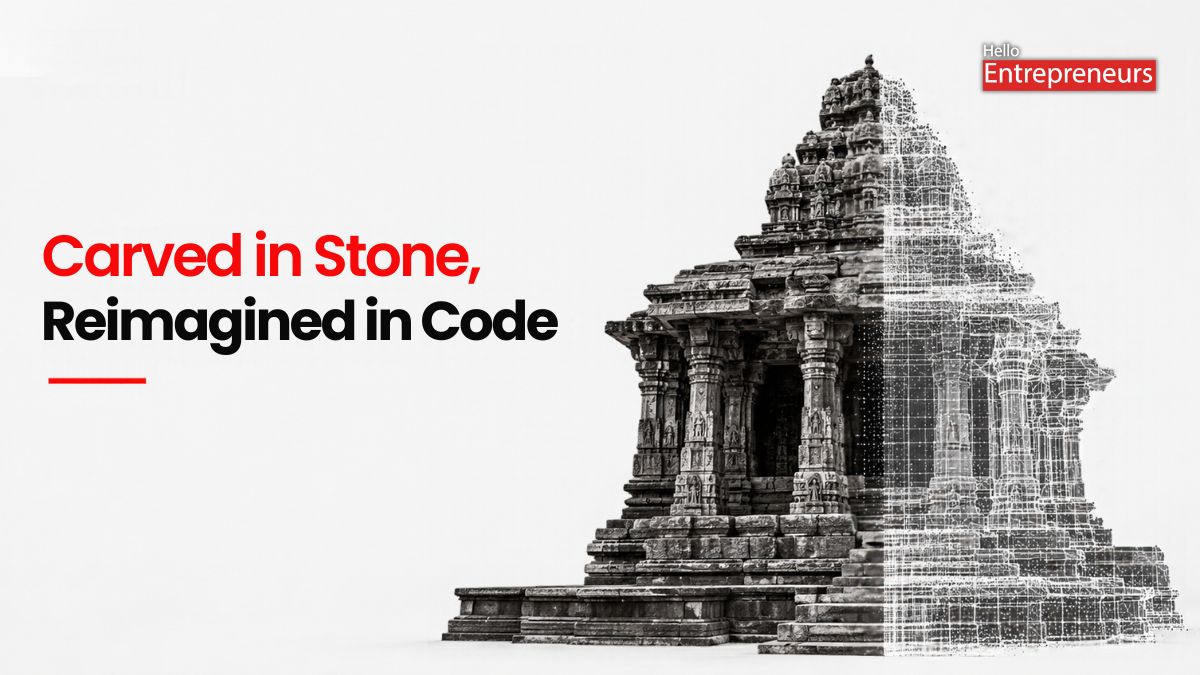
Go to almost any old temple and look closely at the carvings. Sooner or later you will find one with a piece missing. A hand, say, or a flower. Rain took it, or time did, and the sculptor never left a drawing to tell us what it was. These days software can offer a replacement in seconds, and it will look convincing. Should we believe it?
That small question sits underneath most of what India is doing with digital heritage. Temples, mosques, forts and stepwells can now be recorded in ways nobody could have managed a generation ago. Yet the tools bring awkward questions with them. What does preservation actually mean? Who decides? And how much of the past do we really know?
Start with the engineering, which is genuinely good. A laser scanner measures a surface as millions of points. Photogrammetry takes overlapping photographs and builds a 3D shape out of them. Put the two together and you can capture an entire building, right down to the ornament on a pillar. Scan the same wall again a few years later, carefully, and conservators can see what the monsoon has been doing to it and mend it before the damage spreads. That is what makes a model worth having. It is evidence, not a toy to rotate on a phone.
We have done some of this already. The Department of Science and Technology supported the Indian Digital Heritage project, which centred on Hampi. In 2020, the National Museum held an exhibition where visitors could walk through virtual monuments and explore 3D models of places like Konark’s Sun Temple and Gujarat’s Rani-ki-Vav. For a schoolchild in a small town, or anyone who cannot manage the journey or the ticket, that matters.
Access isn’t the whole point, though. Buildings carry know-how. UNESCO describes Rani-ki-Vav as a water-management system and also an inverted temple that honours water as sacred. Its builders saw no gap between the useful and the beautiful. So an engineering student shouldn’t stop at asking how to copy it. Ask how they managed it, how a practical need and a public meaning ended up in one structure. A scan can get you started. But if you want to borrow an old idea, test it against the conditions of today.
The trickier part is honesty. An AI reconstruction can look perfectly finished and still rest on guesswork. History seldom comes that neat. Every reconstruction should carry labels: this part survives, this part is backed by records, this part is a guess. Without them, a good-looking picture slides into being accepted as fact, and nobody can say when it happened.
Some things a scanner will never catch. It can map a carved doorway to the millimetre without learning how the craftsperson chose the stone, or changed the angle of a chisel halfway through. Only that person can tell us. Projects should pay artisans and local historians to share what they know, ask for their consent, and credit them by name. Money should also go to explanations in regional languages and formats that everyone can use, not just to equipment. And then there are the small neighbourhood shrines and wells that will never get a museum exhibition. They count too.
The archive itself needs looking after. Files need backups, and formats that can still be opened in twenty years. Somebody has to keep paying for that once the launch event is over and the cameras have gone home. Meanwhile the real building still needs its drains cleared, its repairs done properly, and someone to inspect it regularly. A flawless model is cold comfort when the monument beside it is falling apart.
So the aim should be a habit of care, with technology as one part of it. That takes engineers who listen, historians who keep asking questions, and communities who get a say in what is recorded. We may never learn what the missing flower looked like. Keeping the evidence safe, and saying openly where it runs out, is still worth doing.

