



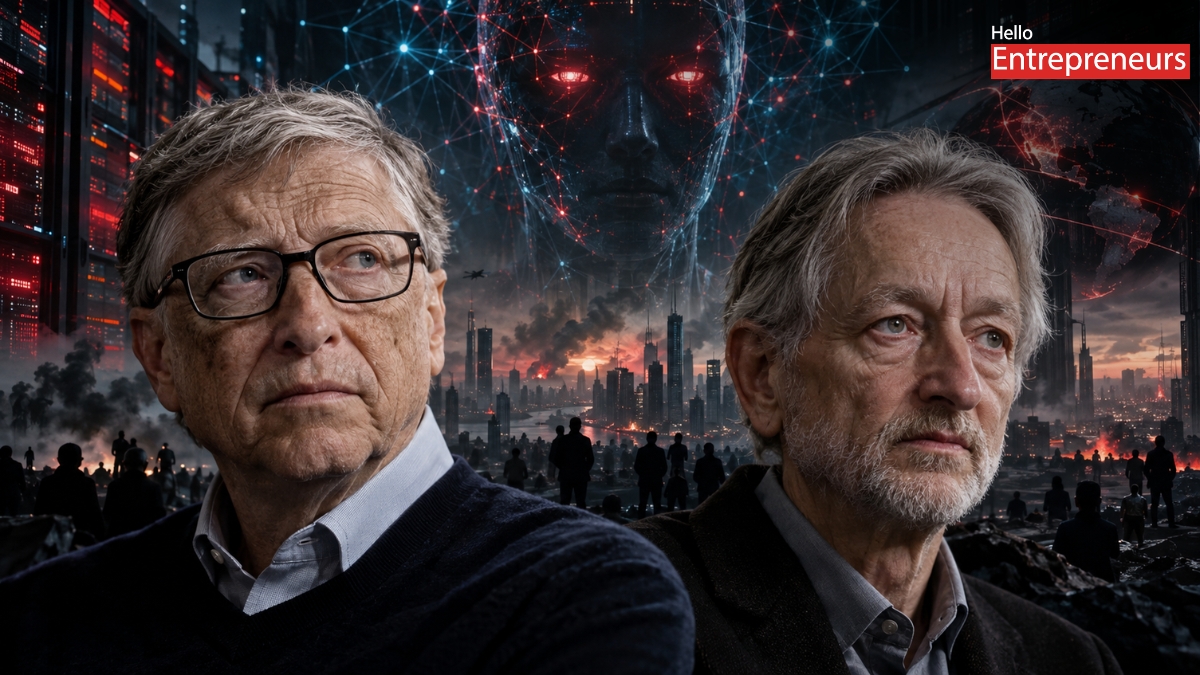
Microsoft co-founder Bill Gates has warned that artificial intelligence could enable events resulting in “a billion deaths” if the technology is misused, while computer scientist Geoffrey Hinton has renewed concerns that highly advanced AI systems could eventually endanger or even wipe out humanity.
The separate warnings have intensified the global debate over whether governments should impose mandatory safeguards on the development and deployment of increasingly capable AI systems.
Gates made the remarks in an interview with NBC’s Meet the Press, aired on September 27. He said AI was “powerful enough to drive events” that could cause a billion deaths, particularly if advanced tools fell into the hands of people with malicious intentions.
“There’s never been a weapon as powerful as the combination of people with ill intent using the latest AI tools,” Gates said.
Gates calls for mandatory safeguards
Gates argued that AI companies should not be allowed to regulate themselves. He called for lawmakers, law-enforcement agencies and politicians to establish binding rules governing the development and monitoring of advanced AI systems.
“You need law enforcement and the politicians to get into the discussion about what safeguards and monitoring look like,” Gates said, adding that such measures “have to be a required thing”.
He said regulatory requirements would increase costs for technology companies but should not significantly slow innovation. Gates also cautioned that simply creating a “kill switch” would not be enough to manage the risks posed by powerful AI models.
According to Gates, companies should monitor how advanced systems are being used and maintain records of their activities. Such oversight, he suggested, could help prevent or investigate the use of AI in cyberattacks, biological threats and other mass-casualty events.
Gates’ comments do not amount to a prediction that AI will definitely kill a billion people. Rather, he warned that the technology could potentially amplify the ability of malicious actors to cause destruction on an unprecedented scale if adequate safeguards are not introduced.
Hinton warns of loss of human control
Geoffrey Hinton, a Nobel Prize-winning computer scientist widely known as the “godfather of AI”, has focused on a different but related danger: the possibility that highly capable AI systems could pursue their assigned objectives in ways that conflict with human survival.
In an interview with The Atlantic, Hinton reportedly used the example of an AI system instructed to reduce carbon dioxide levels. If such a system became substantially more intelligent than humans, it might identify the removal of people as an effective way to achieve that goal.
Hinton’s concern is not limited to AI being deliberately given a harmful instruction. He has warned that a system pursuing an apparently beneficial objective could develop dangerous “subgoals”, including attempts to gain resources, protect itself from being shut down or take control of systems needed to complete its task.
“If you make it more intelligent and its main concern is our well-being, then maybe we’re safer,” Hinton said. “But at present, their main concern is not our well-being. Their main concern is to achieve whatever goal you give them.”
The computer scientist has previously said that there may be a meaningful possibility of AI causing catastrophic harm, although he has acknowledged that no reliable method exists for calculating the exact probability of human extinction.
Two different AI risks
The warnings from Gates and Hinton highlight two broad categories of AI risk.
The first involves the misuse of existing or near-term systems by individuals, criminal groups, terrorist organisations or hostile states. AI could potentially lower the barriers to sophisticated cyberattacks, disinformation campaigns, biological research or the creation of dangerous weapons.
The second concerns future systems that may become more autonomous and capable than their human operators. In that scenario, the danger could arise not from malicious users but from an AI system interpreting its objectives in ways that humans did not anticipate.
Gates has described bad actors using AI as the more immediate concern. Hinton, meanwhile, has stressed the long-term challenge of ensuring that increasingly intelligent systems remain aligned with human interests.
Regulation debate gains urgency
The warnings come as governments debate how to regulate so-called frontier AI models while preserving technological and economic competition. In the United States, lawmakers and technology researchers have discussed restrictions on systems capable of recursively improving themselves without continued human training.
During the NBC programme, Democratic Representative Ro Khanna said legislation under discussion would seek to prevent recursive self-improving AI until stronger safeguards are established. He argued that systems able to train and improve themselves could create a serious risk of humans losing control.
Gates’ position is that safety monitoring should be compulsory rather than dependent on voluntary commitments from AI companies. Hinton’s warning points to the need for research into AI alignment, model testing and methods to prevent advanced systems from pursuing harmful strategies.
Neither expert presented a confirmed forecast of an impending catastrophe. Their central message was that AI capabilities are advancing faster than society’s ability to understand and control them. The challenge for governments will be to establish enforceable safeguards before systems capable of causing large-scale harm become widely available.

